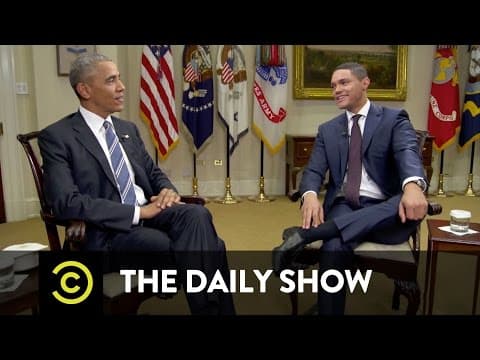
[0:01]Welcome back to our conversation with soon to be former tenant of the White House. I've got one more question for you. Um, this is a personal question, it's a little bit selfish. Um, I look up to you because we we share a lot in common. We both have parents who are black and white, uh, both half African, uh, South side of Chicago, south side of Africa. Similar. In and around race. Yeah. When you are a person who has a platform, Right. When you are in a space where you are engaging with people, it is often difficult to navigate and skirt that line between speaking your mind and sharing your true your true opinions on a race, whilst at the same time, not being seen to alienate some of the people you are talking to. Right. You know, because if you are a white person who is speaking about race, then you are just a person who's interested in race. Right. If you are a person of color who speaking about it's like, oh, the black thing started again. So the question I've always wanted to know is how did you navigate that? Because we watched you do it, but I always wanted to know how you navigated that through through your two terms. You know, my general theory is that if I was clear in my own mind about who I was, comfortable in my own skin, and had clarity about the way in which race continues to be this powerful factor in so many elements of our lives, but that it is not the only factor in so many aspects of our lives, that uh, we have by no means overcome the legacies of slavery and Jim Crow and colonialism and racism. But that the progress we've made has been real and extraordinary. Uh, if I'm communicating my genuine belief that uh, those who are not uh subject to racism, uh, can sometimes have blind spots or uh, lack appreciation of what it feels to be on the receiving end of that, but that doesn't mean that they're not open to learning. And uh, caring about equality and justice and that I can uh, win them over because there's goodness in the majority of people. If I I always felt that if I really knew that and I just communicated it as as clearly as I could, that I'd be okay. Um, another way of saying this is there's not been a time in my public life or my presidency where I feel as if I have had to bite my tongue. There have been times in my public life where I've said, how do I say this diplomatically? How do I say this as you've indicated in a way that it's received? Yes. Right. So there there have been very few instances where I've said, well, that was racist. You are racist. There've been times where I've said, You know, uh, you might not have taken into account uh, the uh, the ongoing legacy of of uh of racism. And typically has more to do with the fact that uh,
[4:59]people got other stuff they want to talk about and it's sort of uncomfortable and it's um, you know, uh, who gets the you know, TV acting job, the actress who doesn't quite look the part and what does that mean and and in in that environment where you're not talking necessarily about cut and dried uh, uh, racist behavior, but rather about the complex ways in which society is working these issues through. Uh, you know, uh trying to reach folks uh in ways that they can hear. Uh I I think is uh is important. And I would add, everybody's got a different role to play. Um, you know, if Chris Rock's doing standup, then there's a benefit to him doing something. that is different from the President of the United States doing something. Uh for one thing, you know, he doesn't have to uh, edit his language quite as carefully because I am still subject to um, You still got your last two days. on on those seven words George Carlin talked about and I I can't use those. Uh, as a general proposition. Um, because a lot of children are watching. I I try to I try to comport myself in a way that uh, my mother would approve of. Well, um, I just want to say thank you so much for being on the show. Thank you for being an inspiration and most importantly, thank you for giving me an opportunity to see what I would look like after eight years of the toughest job in the world. You know, I I will say that I uh, I resent uh, how how young and good looking you are because uh, I used to think of myself in those terms and uh, it's been downhill for uh quite some time. Thank you, sir. Thank you, man. Thank you very much. Appreciate it.
[7:13]Hey there. Thanks for watching. Uh, if you like that video, click here to subscribe. Just keep the mouse pointed away from my face, please. No, don't here, click here, to not my click here. Please. Please, that looks don't do that. That's sharp. That's sharp. Click here to subscribe.


