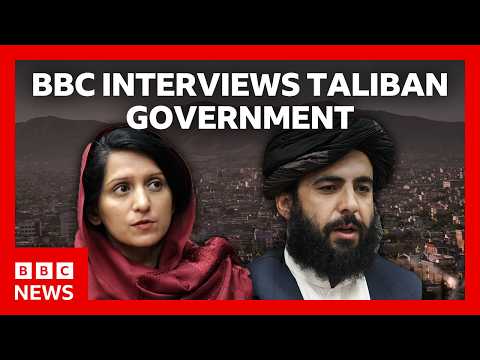
[0:00]The Taliban government seized power in Afghanistan nearly five years ago. How are its policies impacting its people? Early in May in Kabul, I interviewed Deputy spokesman Hamdullah Fitrat. He didn't want to be pictured with a woman and didn't want to sit across from me, but he answered my questions. So the conflict between Pakistan and Afghanistan is continuing. Are negotiations also continuing or are they effectively dead at this moment? The door for negotiations with Pakistan are open. Efforts are being made indirectly through different channels. There have not been any formal talks after the meeting in Urumqi in China but efforts are still being made and our doors are open. What does each side want to stop this conflict? Can you ever reach an agreement? It's definitely possible to solve the problems through dialogue. Of course, some of Pakistan's demands are unrealistic, which cannot be implemented or accepted by the Afghan side. If they withdraw such demands, make concessions and show flexibility, then it's possible that the talks could yield results. Afghanistan's demand is clear. It is to respect Afghanistan's territorial integrity and sovereignty and to stop unjust attacks on Afghan people. Afghanistan's position is that it will not be a threat to others, and we stand by our position. The claims made by them that all security threats in Pakistan originate from Afghanistan are incorrect, and we have rejected them. In its response to the BBC, the Pakistani government said they're facing the grave threat of terrorism emanating from territory under the control of the Afghan Taliban regime. We will continue to take every necessary measure to defend our citizens, degrade terrorist capability and deny safe haven to those who wage terror against Pakistan. Pakistan says it has evidence that it is your government that is supporting militants from the Tehrik-i-Taliban Pakistan or the TTP in carrying out attacks in Pakistan. How do you respond to that allegation? Pakistan's claims are only claims and they are not true. TTP is active inside Pakistan. It neither has bases in Afghanistan nor does the Islamic Emirate support or back other groups. We reject this allegation and it's untrue. Can we talk about the specific incident of an attack on a drug rehabilitation center in Kabul on the 16th of March? You call that incident a war crime. Do you want it to be investigated as a war crime? In that incident, more than 400 innocent patients and drug addicts who were undergoing treatment were killed, and more than 250 others were wounded. The reality is that targeting innocent civilians is a war crime. So international organizations should investigate the incident and prosecute those responsible accordingly. In its response to the BBC, the Pakistani government said it had not hit a hospital, drug rehabilitation center, or a civilian facility. It said military installations and terror infrastructure, including ammunition and technical equipment storage sites, had been precisely targeted. We've asked the Pakistani government for their response in this matter. They say it was not a rehabilitation center that they hit, but a terror training camp. And these were not addicts, but people who were being trained to be suicide bombers. How do you respond to that? This is a clear case of brazen denial and pulling wool over people's eyes. Realities cannot be changed by such baseless claims. A UN investigation here in Kabul also confirmed that around 300 innocent people were killed in that incident. That is a huge number. When an international body is confirming 300 dead, that is hard evidence. This is the largest civilian loss of life in a single incident in decades. As a government, what accountability can you bring for the people who have killed the brothers, fathers, sons, relatives of civilians in your country? It really was a big tragedy. The victims were innocent. They had already been suffering from addiction and isolation from the society because of the drug use. The Islamic Emirate bears the responsibility of safeguarding the lives and property of its people. Accountability for such crimes will be ensured and justice will be served. Efforts to support the victims' families and provide them with various forms of assistance are continuing. Just recently, our supreme leader issued a decree to allocate land and build houses for all the victims' families. This is a huge attack right in the heart of Kabul. One of the big claims of your government since you seized power has been that you brought safety and security to the people of Afghanistan. Is Kabul safe now? Kabul is definitely safe. The Islamic Emirate is trying to control and eliminate threats against the people, whether internal or external. Even the capitals of some of the safest countries in the region have become insecure recently because of war. Our policy is to prevent attacks and war through dialogue. You said that during the negotiations, Pakistan has made what you called impractical demands. What were those demands? One of their demands is that whenever there is a security incident in Pakistan, Afghanistan should accept responsibility.
[5:53]This is an unreasonable demand. Another demand is to transfer members of the TTP to Afghanistan and keep them here. These demands cannot be implemented. They are asking us to control their people. Those people, TTP are active inside their territory and maintain their own camps there. I saw an interview with your defense minister to Tolo News where he was asked a question about whether he believes the US is involved in any way on Pakistan's attacks. Do you believe that? Do you believe that the US has a role in the conflict between you and Pakistan? Definitely, the Minister of Defense has said this. It is a fact that the instability and war that Pakistan has started in the region are being dictated by bigger powers, and Pakistan is doing it to satisfy them. And you believe the bigger power is the US? Definitely, yes. The US State Department did not respond to this specific allegation, but in a statement to the BBC, it said that it does not condone military targeting of civilians and supports Pakistan's right to defend itself from the Taliban, which it designates as a global terrorist group. Al-Qaeda put out a statement supporting and praising your government and calling for Pakistanis to topple their government and their military leadership. Why is Al-Qaeda coming out in your support if, as you claim, you have severed all ties to it? We cannot confirm whether Al-Qaeda has said this, and even if they have, it's their opinion. Anyone can make claims for their own advantage and interests. And you still maintain that you have no ties with Al-Qaeda? Yes, the position of Islamic Emirate is clear that Afghan soil will not be used to threaten other countries. There have been multiple comments from the US President Donald Trump that he would like a base in Bagram. Have they been speaking to you about that? Because we know that American diplomats have been coming here regularly. Is that a possibility? During the Doha talks between the Islamic Emirate and the Americans, one of the important points was their desire to maintain bases here. However, our position on this matter is very clear. The people of Afghanistan cannot tolerate foreign forces in their country or accept any deal involving their land. Afghanistan has one of the worst hunger crises in the world. As a government who is now been in power for more than four and a half years, what are you doing on the ground to tackle this? Afghanistan is one of the poverty-stricken countries in the world. During the 20 years of invasion, an artificial economy was created. Due to the influx of US dollars, many people believed that Afghanistan's economy was strong. Unfortunately, after the end of the invasion, we inherited poverty, hardship, unemployment, and other problems. The Islamic Emirate has been taking significant steps to reduce poverty, create jobs, implement major economic projects, and attract investment. For example, last year, despite trade routes between Afghanistan and Pakistan remained closed for more than six months, Afghanistan's trade remained in good condition. We recorded a 1 billion dollar increase in trade compared to the previous year. According to the World Bank, Afghanistan's economy recorded around 4% growth. There are also major economic projects such as Tabi, Casa 1000, and the Trans-Afghan railway, which, once implemented, are expected to improve Afghanistan's economic situation, create job opportunities for Afghans, and boost trade. We've seen the World Bank report, but there's also fine print in that World Bank report, which says that your population is also expanding rapidly. So on a per capita or a per person basis, actually your economy shrinking. And the reality that we see on the ground therefore is there are people who go out trying to find work every day, unable to find even three or four days of work a month, unable to feed their families, saying what is my government doing for me? What would you say to those people? It is certain that the population growth in Afghanistan and the repatriation of Afghans are a challenge. In the past two and a half years, more than 4 million Afghans have been forcibly deported by countries including Iran and Pakistan. The Islamic Emirate assures the people of Afghanistan that it will provide job opportunities for them. Since the beginning of the Islamic Emirate's return, it has created jobs for 250,000 people in the mining sector. I understand your long-term plans, but the reality is that there are people right now who simply will not survive without help. You could get that help from the international community, but you're not getting international recognition. You have international sanctions against you. People who could give aid are walking away because of the policies of your government, particularly your policies on women. Is there a recognition that you, as a government, you can help your people, but you need to walk forward as well towards the international community? In my opinion, the reduction in aid has directly affected people's lives. Humanitarian assistance should not be used as a political tool. Regarding women's work, the Islamic Emirate has issued thousands of permits to women to run businesses, which is a positive step. We have been coming here for four and a half years, so this is not, this is based on what I have seen in the last four and a half years. And a lot of aid agencies are now telling us that it's becoming increasingly difficult to operate in the field here. How do you respond to that?
[12:22]Regarding the ban on education, our figures show that around 7 million boys and 5 million girls are currently studying. The restriction on education beyond grade six is a separate issue. When secondary and higher education for girls will be opened is a question for the Ministry of Education, and hopefully they will provide a satisfactory response. You are giving licenses to women businesses, but at the same time, you won't allow there to be female doctors, female nurses, female midwives. That is affecting, it's not just about the right to education there, it is about the right to health. It's about their right to a life. The issues of nursing, midwifery, and medicine are important for Afghanistan. But these are matters for the health and education ministries to answer. Regarding women's rights, the Islamic Emirate releases data every year. But unfortunately, they are not considered important enough by the media to cover. For example, last year, the Ministry for Promotion of Virtue and Prevention of Vice resolved more than 8,000 cases involving violations of women's rights. More than 2,000 women who had been denied their inheritance were given their rightful share, and more than 2,500 women who were being forced into marriage or were underage were assisted. The Islamic Emirate is committed to granting women their rights according to Islamic law. I've got to ask a few questions about India now. Do you think your growing relationship with India has been an irritant for Pakistan? India is an important country for Afghanistan because we have got trade and economic relations with them in different fields and we want our relationship to be strengthened. We have our acting ambassador in Delhi, and we have also presence in Mumbai and Hyderabad. In Kabul, the Embassy of India has upgraded its technical mission to a political mission, which is a positive development. It's natural that some people in Pakistan may be against the relationship between Afghanistan and India. However, Afghanistan's relations with the world are aimed at safeguarding the interests of our people. It's our right, and we will not allow anyone to threaten or criticize our foreign policy. So one key question that we get asked a lot and there's a lot of curiosity that since your foreign minister's visit to India, what kind of agreements or deals have been signed between the two countries? Is India investing in Afghanistan? During his visit to India, the foreign minister met with many officials as well as Afghan businessmen based in India and Indian investors. I'm sure that agreements were reached in several fields following his visit. I would recommend that you ask the Ministry of Foreign Affairs about this. How has the closure of the border with Pakistan, which as I understand it is unprecedented in history or at least unprecedented in recent decades, how is that impacted trade and your economy? In the past, Afghanistan's trade was fully reliant on Pakistan, and efforts were not made to trade with others. The Islamic Emirate has now succeeded in finding alternative routes, which helped maintain stability in the prices of food and other supplies. One of the alternative routes was through Iran. Has that been affected because of the ongoing war in the Middle East? And if so, what effect has it had? As far as I know, the supply of goods from other countries that used to come to Afghanistan via Iran were affected. However, goods coming from Iran to Afghanistan were not affected. For instance, fuel prices in Afghanistan were not significantly affected because of fuel camps from Iran. Although prices fluctuated a bit, we were able to manage the situation.


