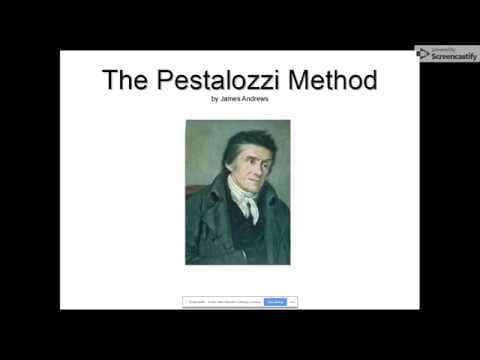
[0:01]The Pestalozzi method by James Andrews. This presentation will break down the theories of Swiss educator Johan Pestalozzi. We will establish a historical context for the development of his ideas, discuss their contributions to the evolution of the modern classroom, and finally, discuss their applications and limitations. But first, let's begin with four themes to his method. The first was a simple but revolutionary idea that education was a right to all, and not just children of the wealthy classes. He believed educating the poor was not just the right thing to do, but that it also bettered the function of society. Pestalozzi was also a proponent of active education. His approach shifted from traditional rote memorization in crowded classrooms to one that incorporated movement activities, as well as the belief that physical exercise and the exploration of nature were an essential part of effective learning. Finally, Pestalozzi's approach stressed that children had innate knowledge that should be developed, rather than being an empty vessel to be filled with knowledge. The teacher's role is to make sure their influence does not disturb what he called nature's march of development. Putting Pestalozzi's method in historical context is important because it's one of the older theories we will be studying. Pestalozzi lived from the mid-18th century into the early 19th century, and his method stressed treating students as individuals, which stood in contrast to the educational trends of his day. It's important to note his method had a greater influence beyond his lifetime and should be seen as providing a foundation for the ideas that influenced later reform movements. He was also a big influence on later constructivist theorists, such as Montessori, Piaget, and Dewey.
[1:57]Looking closer at Pestalozzi's classroom style, we see a focus on the emotional security of his students. Pestalozzi looked at other schools of his day and observed that students were being made to learn in an atmosphere of fear. He sought an alternative and offered an approach that aimed to educate the head, the hands, and the heart. The head represented the development of intellect and intelligence through critical thinking. For Pestalozzi, he believed that all knowledge had its origin in a child's own experience. In this way, all three elements had to be connected. The hand represented learning by doing. Walks in nature and playtime were highly valued in his schools, as well as frequent interaction with peers. The heart represented emotional development, moral development, and having students be motivated and invested in their own education. In terms of practical application, here's an example of Pestalozzi's model being used in a modern cooperative education approach. A project where a student designs a structure or perhaps builds a model is using the head and hands. In music class, singing engages emotional connection as well as the intellectual exercise of performing correctly. Encouraging students to create abstract art engages the heart and hands. And a class maintaining a community garden and preparing a meal together would engage all three elements. Another element of Pestalozzi's theory was his concept of Anschauung. Anschauung is a German word that translates as sense intuition. Pestalozzi defined it as having direct concrete experience with a word or concept. In his theory, it was essential that this be established first before an instructor tries to present it intellectually. He described this in phrases like from the simple to the complex, from the concrete to the abstract, and from the near to the far.
[4:03]As secondary teachers, this concept should be approached as a guiding principle rather than a hard rule, as it is probably more relevant in an early childhood or elementary context. It is logical that an elementary teacher would want a child to perhaps experience a garden rather than sit for a lecture on gardening. However, with secondary students where abstract thinking is possible, it would be impractical to require concrete experience first. For example, in a high school history class, it is not essential that a student experiences direct democracy before the concept can be introduced. However, the lesson could be reinforced with the concrete experience of taking students on a field trip to a polling station. In closing, the most practical aspect of Pestalozzi's approach and perhaps his greatest legacy was how inclusive his method was. Pestalozzi is remembered for his great empathy and tireless work with lower income children. He had an unwavering belief that all classes deserved an education. When we work in public schools and work to create lesson plans that reach all our students, we are applying the most important principle of the Pestalozzi method.


