[0:00]When it comes to the First World War, there's one thing that we all think of, trenches. Muddy, rat infested hell holes with death around every corner. Places so bad that only going over the top could actually be worse. Trenches dominate our perspective, but are our perceptions actually accurate? Well, today, we're going to answer three big questions. Why did trenches exist? What were they like? And how did the allies managed to break the trench deadlock? But before we do that, a reminder to subscribe to the Imperial War Museums YouTube channel for more videos just like this every two weeks. So, let's start simple. How prevalent were trenches during the First World War? Well, trenches were really the defining concept of the First World War. They were literally on every front. The Western Front most famously in France and Belgium. They're in Gallipoli, they're in the mountains of Northern Italy, they're in the Middle East, even in Africa. Trenches were everywhere. Which then begs the question, why? What did trenches offer to First World War armies? Well, trenches are really an antidote to modern weaponry. When the First World War comes along, everybody thinks it's going to be a war of movement, with masses of infantry and cavalry moving forward, classical old style battle. The reality though, was very different. Attacking armies were confronted with previously unimaginable amounts of firepower thanks to new war fighting technologies. The machine guns are firing hundreds of bullets a minute. A modern magazine rifle that can fire 20 to 30 rounds a minute. And then you have artillery firing shrapnel, these are shells explode in the air and fire lead bullets towards the enemy. An absolute killing zone could be created and really puts the emphasis on the advantage of the defender. So they begin to dig in in 1914 and they never stop until the end of the war. Initially, trenches were seen as a temporary measure, one which armies would move on from soon enough. These early trenches were more like ditches, the kind you'd see at the side of a road today. But over the course of the war, they developed into more complex systems. And you end up with a fire trench, which is your front line trench, and there is a support trench, and then behind that a reserve trench. You've got three lines. Connected by what's called communication trenches, so that men and material and supplies can move up and down between the trench lines without having to go over open ground. As trench systems developed, sometimes particular trenches were given names to help identify them. As you can see in this picture, sometimes those names related to familiar places from home. If you look at the battlements of a castle and you lay them down on the ground, that's the pattern you get on a frontline trench. The idea is that if a shell lands in one of these bays, it's contained, the explosion is contained, so you cut down the casualties. Though trench systems developed, life inside one was far more rudimentary. When able to rest, soldiers in frontline trenches would try and shelter from the elements in dugouts. These varied from deep underground shelters to small hollows in the side of the trench, as shown here. Most activity in frontline trenches took place at night under the cover of darkness. While during daytime hours, soldiers would try to get some rest but were usually only able to sleep for a few hours at a time. And of course, rats proliferate around the trenches, they they they feed on the dead bodies. Men would wake up with, you know, face to face with a rat sitting on their chest. You always get problems in the summer or in in hotter climates from from masses of flies. And of course, flies move from corpses, to toilets, to food, and that way spreading disease such things as dysentery, etcetera. So just your basic daily life, is is pretty monotonous. And if you think trench life is boring, the food was worse. According to Harold Mayo of the Durham Light Infantry, rations were very poor. You'd try to brew tea and you couldn't, it was always cold and probably the water was all tasted of petrol because it came up in petrol tins, which were never cleaned out properly, and the tea was half petrol and cold. The food, they were supposed to give you some bacon, well you were lucky if you got a piece of bacon, it was all cold and greasy. I mean you couldn't get any. And the cooks, probably if a man was a chartered accountant, they'd make him a cook or something like that because it was always square pegs in round holes, you know. They couldn't cook. We used to say they couldn't boil water without spoiling it or something. The food was terrible. Though the food was nothing compared to the ever present danger. An artillery shell, a sniper's bullet, those are two of the most almost random ways you can die. The shells are supposedly aren't aimed, they're just aimed at a particular area of trench. And if you happen to be there at the wrong time, then you're going to get killed. One minute you were talking to your best mate, and the next minute, he could be gone. And that almost random death took a real psychological toll on the soldiers. For that reason, the armies tried to rotate people through the line. So the idea you'd stay in the front line for say, four to six days. And then if possible, you'd move back to the support line for a similar period of time, then the reserve line, and then you get a period of time actually behind the line. Naturally, being behind the line was a favorite time for many soldiers. You could get a hot bath, a good night's sleep and a clean pair of clothes. Many played sports, took part in amateur dramatics or even got to head back to Britain for home leave. During all this time, there were many attempts to break the deadlock. Large and small, new ideas were being continuously experimented with. The First World War is almost like an arms race between the defense and the offense. So the defense develop a new way of holding ground, then the attacking side has to find a way of overcoming that. If they achieve that, then again, the defense needs to come up with a new tactic. Despite the many well documented disasters from the Somme to Passiondale, all the time armies were learning. Officers who'd been trained on classical battle techniques were beginning to learn how trench warfare worked, while generals were beginning to master the management of giant armies. And they try a number of things. They use mass artillery fire. So they have these what are called barrages lifts, but they fire on set lines for a certain period of time. They lift forward and fire again, they lift forward and fire again, and the infantry follow up. They use poison gas as well. The idea of poison gas floating in and then later shelled into the lines. The idea is it makes you put on a gas mask. Once you put a gas mask on, it's very hard to see or hear anything, it's hard to breathe, and it just debilitates your ability to actually fight. 1916, the British bring the tank onto the battlefield. Initially it's not very successful. Later in the war, they redefine the tactics and the way it's used and the numbers of tanks used. They have new infantry tactics. You now have light machine guns, rifle grenades, trench mortars. The light machine guns, mortars, etcetera, lay down fire and then you can move forward and occupy positions. It's all of these weapons were invented at different times. And in 1918, the allies, they all come together. At the Battle of Amiens in August 1918, the largest combined arms offensive of the war, the Allies were finally able to break the trench deadlock. Those four years of turget learning finally brought about the resumption of open warfare. In just one day, the Allies had made almost unheard of advances, pushing into the German line 11 kilometers deep on a 24 km wide front. It was so successful that General Ludendorf called it The Black Day of the German Army. I think the trench culture as probably imagination, probably goes down as the defining feature of the First World War. The common view is that every day was like the first day of the Somme, which it plainly wasn't. Casualties were terrible and a terrible scale, but we were fighting a total war at that time. The whole trench experience was was a terrible experience, but but the men fought through it. And they never lost sort of their faith in the fact that they had to fight that war to a successful conclusion. I think that that's a really important part to draw out.
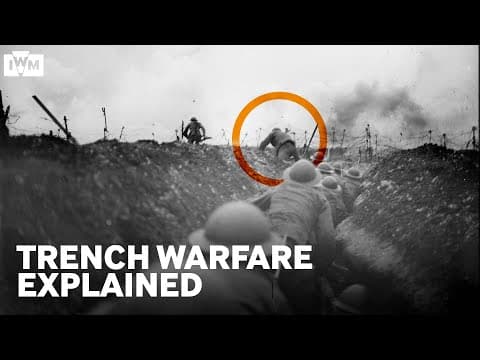
Life in the Trenches WW1 | Trench Warfare Explained
Imperial War Museums
8m 47s1,524 words~8 min read
YouTube auto captions
Transcript source
YouTube auto captions
This transcript was extracted from YouTube's auto-generated caption track. The transcript below is server-rendered so it can be read, searched, cited, and shared without opening the original YouTube player.
Pull quotes
[0:00]When it comes to the First World War, there's one thing that we all think of, trenches.
[0:00]But before we do that, a reminder to subscribe to the Imperial War Museums YouTube channel for more videos just like this every two weeks.
[0:00]They're in Gallipoli, they're in the mountains of Northern Italy, they're in the Middle East, even in Africa.
[0:00]When the First World War comes along, everybody thinks it's going to be a war of movement, with masses of infantry and cavalry moving forward, classical old style battle.
Use this transcript
Related transcript hubs
Watch on YouTube
Share
MORE TRANSCRIPTS


