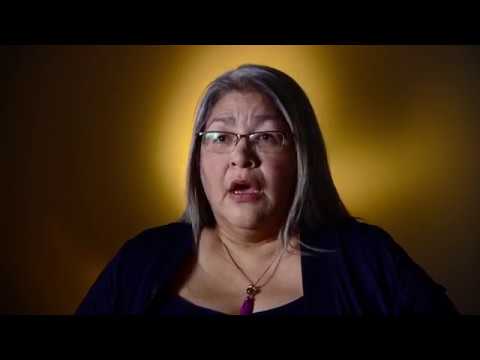
[0:09]We weren't allowed to leave the residential schools, and from where, from where I was, I'd go up to the second level, and I could look out the window and and see my house across the road. And I wasn't allowed to step out to go over there. I went over one time and they sent me back out of fear.
[0:34]My name is Debbie and I'm a residential school survivor. When my sister came, when she first came the first year, they made an example of her because there was her and a couple of kids had gotten into something and they were just little small little children, and we were all in a dorm, all little girls' dorm. Sister Rose came and then she said she's going to make an example out of out of what they had done and that we weren't allowed to be able to do those things so what they did was they took the the three of them and they pulled their pants down and started whipping them, and I had to watch my little sister get whipped. Sorry.
[1:16]And I couldn't do anything to help her, and that's that was one of my responsibilities because it was just her and I all the time, right? When I was in the residential schools, my my very first experience of somebody coming of age, um, was a very violent one. The uh uh, there was a young woman that uh that that was buding way before the rest of us, we were just we were just younger, and uh and she was, she was around the same age as we were, um, and then she was sitting on her on her bed and uh one of the nuns came and and I said, oh, what's what what is that? because she had something on her on her nightgown. And uh and then she started to cry, and she thought she was dying. And uh and then the the nun went in and and started yelling at her and started hitting her. Called her a dirty little sauvage. Told the rest of us that we had to come and watch her. She dragged her out of the room by the hair. She was holding on to her sheets, and she dragged her into the into the uh the shower, and then she she told her to strip in the shower and she got the rest of us to come and watch while she while she told her, you're just a dirty little sauvage and then she said some other words that were. But that for me was the most negative thing in learning to that the beauty of being able to to bring life forth. When you're talking about that that kind of abuse and that kind of trauma that's been then replayed, replayed, replayed over and over again throughout the generations, you don't just get over those things. And it takes a great deal of time to be able to do that. So I think that for sure, like those stories need to be told. You know, they they need to be recognized for for the effects that they have on our people. A lot of times that it the the the recognition that the that the residential schools made that much of an impact on our people was is not really recognized out there. And a lot of times what I do is I I try to um educate people. The thing about trauma is that it's not it's not something that we're just going to be able to get over like that. You know, when you I hear this being said time and time again where where we're told that, uh, you know, pull up your boot pull yourself up by the bootstraps and and and just just get over it, right? You really can't just get over something that's been ingrained in for like 147 years, right? It took a long time to be able to work through the the pain that it caused, right? I'm still not quite through all of it. Um, I've I've been walking this way, uh really implementing it when my daughter was about four years old and it and so and I'm and I'm 55 now, right? Um, it's taken that long to to be able to get to a place where I feel good again, like where I feel uh that that uh that I'm blessed that uh that my life is in a good place, that uh that I'm able to let go of that of that ugliness that that's that came through the residential schools and and my experiences there. I definitely think it's important for Canadians to know about residential schools, like I without a doubt 100%. It should be it should be in the schools, it should be the education should be should be there for all Canadians to know about. When you when you look out in the street and you look out on on some of our people and some of the issues that they have to carry, and and where does that trauma come from, right? It comes from the place of of being in the residential schools. It comes from from that history, it comes from that pain that's that's been passed down through the generations.


