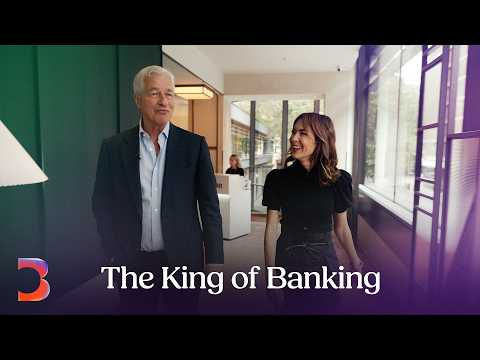
[0:04]I'm here in London. It is a bustling Monday morning, and I'm about to go meet one of the Titans of banking.
[0:16]Hello! You guys love these meeting things. Yes, we do. It's good to have a good handshake. Have we ever met like I feel like I know you because I've seen you so many times. I've only just met you. Jamie Diamond is an institution. Since 2005, he's been the head of the world's biggest bank, J.P. Morgan Chase. He's widely seen as a rock in the storms of 21st-century finance, and even at times, a kind of guardian of the U.S. and global economy. He's a leader and he understands the importance of stepping up at a time where there's great uncertainty. This country is a lot better off because Jamie Dimon has been running J.P. Morgan. He's also a highly visible figurehead in the banking world, always in demand for media appearances where he reliably delivers hot takes on the current thing. I care less with Bitcoin trades for, how it trades, why it trades, who trades it, if you're stupid enough to buy, you'll pay the price for it one day. Dimon always seems to be ready with blunt insight into the events of the moment, but I wanted to zoom out and talk about his broader philosophy. To learn about the principles that guide the decision-making of this incredibly influential person. A family man from Queens, who's at least as invested in being a dad and a grandpa as he is in shaping the global economy. So you're on the road, how how often? I actually, we checked last year, it was like 120 nights or something like that. But some of us, COVID catchup. Right. And all these conferences are on again, and uh, of course, I'm here, I do more than just this conference, so. Do you have any travel hacks? What does that mean? You know, ways to make your life easier. Yes. Well, I try, when I land, when I exercise, when I eat, when I don't get tortured by people. You have a lot of folks from Bloomberg here. Uh-huh. This is the Jamie Dimon treatment. Exactly. So how long have you been at Bloomberg? I have been at Bloomberg 13 years. Where are you from? I'm from Hawaii originally. Hawaii? Yeah. And married? Married. Children? Four kids. Holy moly. Yeah. How do you do it? What do you mean? How did you juggle it all? I pretty much had a binary life. I worked and family. So you didn't see me in black ties and red carpets and very rarely stuff like that. So a big family life. I know. I've heard you're a family man. Yeah. How old are your daughters now? 38, 36, 34. And seven grandkids, six girls and finally a boy. Do you baby sit? Yeah. My wife does more than I do, but I do. We do it together. They come over sleepovers and all that kind of stuff. Any any parenting advice? Just love them. Yeah? Yeah. So what do you like to do with your daughters now? Everything. We barbecue, we eat, we go to restaurants, we travel, we listen to music, we do wine. I love my son-in-laws. It's quite the test, going to meet Jamie Dimon as your future father-in-law. They they have no problem. I'd be shaking in my boots. God knows if I ever say something where I wrong, they correct me. They like finding me wrong about something. If that sounds modest, well, there's nothing modest about Dimon's professional life. J.P. Morgan Chase is the world's biggest bank by market cap and one of the biggest companies of any kind. In 2023, they set a record for the most profits of any U.S. bank ever. $49.6 Billion. It's no exaggeration to say that entire economies depend on this bank. J.P. Morgan played a crucial role in stopping the bleeding during the 2008 financial crisis. The better we do here, the better for the United States economy. And more recently stepped in to mitigate the damage from the collapse of Silicon Valley Bank and First Republic. Dimon regularly speaks with prime ministers and presidents around the world, and there's been plenty of speculation he might run for office someday. All this translates into a great deal of power and influence. You've built a bank that's $4 trillion in assets and counting. How big is too big? I think the question is what works for consumers and industries and stuff like that. So, you know, if you want to build a Boeing aircraft, you have to be big. You can pretend that you don't. If you want to do what J.P. Morgan does, we move $10 trillion of money around the world every day. We bank some of these companies in 30 countries. We bank countries. We bank the World Bank, the IMF. We bank the United States government. You have to be big. You can't do those things and be small. I applaud the small banks. We we're the biggest bank community banks and and regional banks and stuff like that. And I understand, you know, some of the stress that they're under, and we're trying to help. So it's not either or. So, going a little bigger picture now, you run the biggest bank in the world. You have our money. You've got world leaders on speed dial. That's a lot of power. How do you decide when and how to wield that power? Yeah, I'm not sure I have a lot of people on speed dial. So you say all that, sometimes I think I'm just riding the Bronco and hanging on for dear life. I, you know, I love what I do. I try to talk to everyone. I try to keep my mind open. I one of the benefits from traveling the world. You know, I was just in Mumbai and and Switzerland and seeing clients. You learn a lot, and you try to make sure you're that you're doing a proper assessment of the world. You're that you're looking at the options. You're not like just saying we're going to do this. I've looked at as part of our job to try to have countries, to help countries do the best they can for their citizens. So we bank countries. We also advise them on skills and trade and economics. You look at our research. It's a lot around, how does an economy run? So when you go to like, when I got back from Mumbai, we research 150 companies now or something like that. So we're educating the world about those companies. We're educating the world about the Indian economy. As we do that, we also educate the Indians about what works in their economy and what doesn't work. And those are important things to lift up society. You've got this reputation as a sort of white knight for the economy. Do you ever feel pressure to come in with the save? I feel a tremendous amount of pressure to do obviously my family comes first, okay? But to do a great job for my company and our clients, but I also feel a huge burden to do a good job for my country. So, you know, when my country wants me to do something, and we talk all the time to, you know, the senators and regulators, what can we do to make the system better, to lift up the country, to lift up inner cities? We're trying to figure out how to make society better. And I do consider that part of our job. You grew up talking finance at the kitchen table as a kid. What was it like growing up, Jamie Dimon? Like, what do you think prepared you for all this? Well, I grew up in Jackson Heights Queens and my grandparents, three of whom were Greek immigrants, one was born here. I don't think any of the four finished high school. There was a loud table. People arguing and stuff like that. But my parents were, well, my dad was a stock broker. You know, I was the only one that took interest in that, reading the paper, understanding, I bought a stock when I 12, 13 or 14. You know, they didn't ask us to go into finance. So my older brother's a physicist. My other brother's a teacher. And so it was basically do the best you can, make the world a better place, treat everyone with respect. Have a purpose in life. It was more around that. But a lot of intellectual debate at the table. Dimon quickly rose through the ranks of finance. Right out of Harvard Business School, he became the protege of his dad's boss, Sandy Weill, a legendary banking deal maker. Dimon and Weill oversaw a series of massive bank mergers together through the '80s and '90s. Until in 1998, Weill forced Dimon out of City Group, and Dimon struck out on his own. Dimon landed on his feet as chief executive of Chicago-based Bank One. When Bank One was acquired by J.P. Morgan Chase in 2004, Dimon quickly ascended to the top spot. Just a couple years later, in 2007, Dimon warned shareholders that the bank was seeing trouble in its subprime mortgage business. When the financial crisis hit, J.P. Morgan's relatively cautious investing approach meant that they were able to help avert catastrophe by acquiring the struggling Bear Stearns and Washington Mutual. That saved the government billions in bailouts and made Chase the biggest commercial bank in America. Though American banks came in for some well-deserved criticism during this time, Dimon emerged as a staunch defender of J.P. Morgan and the financial system as a whole, as a force for good. 224,000 employees. We give health care to 4,000 people. We pay $10 billion a year in federal taxes over the last five years. We've given $600 million to organizations. This is a terrific company. And when I hear the constant vilification of corporate America, I personally don't understand it, and I'm I would I would ask a lot of our folks in government to stop doing it because I think it's just hurting our country at this point. More crises would follow. In 2012, a rogue J.P. Morgan trader, nicknamed The London Whale, lost the company more than $6 billion, putting the harsh spotlight of scandal on Dimon and calling his leadership into question. But Dimon weathered it all, keeping the top job even as other top U.S. banks have gone through multiple CEOs. Along the way, he became a billionaire, a rarity among banking executives. Many attribute Dimon's success to what's known as the fortress balance sheet. Essentially, he takes the cautious approach, never getting so over leveraged that the bank can't withstand a major unforeseen shock. The strategy has been criticized for leaving profits on the table, but it looks pretty smart when a crisis comes along. Going way back, I used to do a presentation on financial crises, you know, going back to there was blowups in Ginnie Maes, Penn Central, commercial paper, the '87 crash, the '90 recession, the '74 recession. And if you make a list of all those things, you realize, and I'm not making fun of it, they happen all the time. And the best preparation is in our business, capital and liquidity, which Dodd Frank improved. We already had a lot. Be prepared. You know, you don't you can't be prepared after the fact. You have to be prepared before the fact. When I talk about risk management, it's always about the range of outcomes, can we handle them? And beyond that, we talk about geopolitical crises, cyber, you know, I put cyber to the heart of it. You got to be prepared for that stuff. And it does happen, and it's going to surprise you one day. Just like, you know, am I surprised if oil goes to 150? I will not. It can easily happen if a bunch of factors fall a certain way. So, so the best thing is be prepared for any business, think when you think about risk, think about things that can go terribly wrong, can you survive them? You know, it could be technology, it could be government regulations, it could be, uh, it could be literally the weather if you're a restaurant, you know, that might close you down if you have if you lose this week's business, you're out of business, you don't have enough cash. So you should think all that through. Bill Gates once said, banking is necessary, banks are not. To what extent could AI or Fintech replace traditional banks? So I think I remember him saying banks are dinosaurs. I spoke to him about it in 1997. And he obviously, he was dead wrong. He probably agreed to that. But but he's not wrong that technology changes everything. And if anyone is complacent or arrogant or think that because you have a big position today, you're going to have a big position tomorrow, that's a mistake. And but at the end of the day, what is banking? Someone's going to have to hold the money. Someone's going to have to move the money. Someone's going to have to raise the money. Someone's going to have to do research, you know, around money. Those services will still be around. And, you know, hopefully, we're doing it and using a lot of tech to do a better job at it. But I've always thought it's very possible that some tech thing, you know, disin intimates a piece of that. And I've been writing about, you know, big tech going to our business. We got Fintech, but we also have big tech. And they will embed payment systems in there, and some are going to white label banks, kind of what Apple did. Uh, you know, they have the right to do that. I'm not against that. I would be against unfair use of their position to dominate us in a business. Well, Apple is is going deeper into financial services. Do you worry about the bank of Apple?
[12:04]Well, I'm we're going to compete. So they have a they have a tough competitor, but, you know, they hold money, move money. Yeah, they're a form of competitor. You know, we also partner with them, but I'm very used to partnering and competing with lots of people. Existential threat? I don't think it's an existential threat, but I think if we were complacent about it, yes. Still, as with most industries, an AI revolution is coming for finance. The question is, how much about banking will change? Some predict AI will enable us to put our money on autopilot, telling you where to invest, planning your retirement, and even filing your taxes. I know you mentioned chat GPT in your annual letter. Have you tried it? Yeah, if I had my phone, I'd show you. What do you what do you use it for? I just ask it questions. Like what? I don't remember. What's Emily Chang going to ask me? You've got a top-notch group investigating AI. What are they up to? What's the next level of finance you think AI can unlock? Yeah. So I think the most important thing is that it's it's AI is real. We already have thousands of people doing it. Top scientists from around the world. Manuel de Velosa from who ran Carnegie Melon Machine Learning. Uh, and it's a living breathing thing. So people want to answer what's going to do? It's a living breathing thing. It's going to change. There are going to be all different types of models and different types of tools and technology. But the the way to think about for us is every single process. So errors, trading, hedging, research, every app, every database, you're going to be applying AI. So it might be as a copilot, it might be to replace humans, like, you know, AI is doing all the equity hedging for us for the most part. It's idea generation, it's large language models. It's note-taking while you're talking to someone. And while I'm taking notes, I'm actually say to you that, you know, here's the thing of interest the client might be interested in all error all customer service. It's a little bit of everything. But it is going to replace some jobs. Of course, yeah. But I I look, folks, people have to take a deep breath, okay? Technology has always replaced jobs. Your children will live to 100 and not have cancer because of technology. And literally, they'll probably be working three and a half days a week. So technology has done unbelievable things for mankind. But, you know, planes crash, pharmaceuticals get misused. There are negatives. This one, the biggest negative in my view, is AI being used by bad people to do bad things. Think of cyber. But, you know, the fact and I do think, you know, eventually, you have legal guardrails around it. It's kind of hard to do because it's new. Uh, but it will add a huge value. And, you know, for J.P. Morgan, if it replaces jobs, we hope to redeploy people. So is there going to be a point where I can turn to chat JPM and say, I have 30 years, or I want to get rich quick, what should I do with my money? Well, the rich quick, I hope it tells you that you're crazy. Uh, yeah, but we in some ways can do a little bit of that right today. And, you know, usually, if you look at like wealth plans that we have, which I think are quite good, they have a lot of AI embedded in that. You know, or analytics embedded in that. And it soon have more AI. All that AI is going to do is know more about you, learn more about you, look at patterns and, uh, you know, look at successful things in the past and, yeah. So AI will be a huge aid to things like that. Interesting. So, do you see like a finance super app in our future or Yeah, you already have that a little bit. So 10 years ago, I took the people around retail, Gordon Smith and the whole team, I said, you're getting an airplane, and you're going to China. And they said, why? We're American. I said, go to China. You know, and they went to Ping An and Tencent and WeChat and Alipay and all that. And they had all the super apps. I made them come back and do a big chart of super apps, all the service they do. What they do is a whole heck of a lot. WeChat, for example, combines text messaging, a social network, and a widely used mobile payment system and has over 1.2 billion active users. The kind of ubiquity most American companies can only dream of. So I think in America, it won't be a super app. It'll be, I'm going to call mini super apps. So you might, like, you can already do a lot of stuff with us around money, but that's why we do travel. It's an adjacency. It's not just a credit card. Now we want to offer you great travel and great hotels and great restaurants and, so there are all these adjacency on everything we do that will be our tech driven and will be increasingly AI driven. What's your biggest AI fear? Well, I think Henry Kissinger, Eric Schmidt wrote a book about, you know, if it gets used in weapons. Uh, but it, you know, and that obviously could be terrifying if it's deciding who the enemy is. Uh, and then, you know, obviously, it's going to be used in cyber. Uh, bad guys will use AI. And it well, I think we need guard rails. No one knows exactly what they should be yet. But it's not going to stop bad guys. So we got to think through the guard rails here. You want to have plenty of innovation. You need guard rails, like, you know, maybe it'll tell you at the bottom of something that is generated by AI. But the bad guys will still use it. And the question is, how we're going to I'm a little concerned about that. While AI is changing the technology of banking, geopolitics is creating a different kind of disruption. With tensions between powerful countries like the U.S., Russia and China reaching a boiling point. There are signs the economic ties that bind the world are starting to fray. Dimon, for his part, strikes a tone of cautious optimism about current events, but warns that we're living in a very dangerous time. Our conversation took place before the recent outbreak of conflict in the Middle East, which he said will create ripple effects that extend far beyond the region. Where's China on the list of risks? When I say geopolitical, that's the big one. It's the, it's the, it's the thread from Ukraine, oil and gas, food, migration, all our relationships, the most important one being China. That is the most important for the future of the world. Uh, and and obviously, Ukraine is affecting it. And in fact, it's very hard to see really positive outcomes with China until the Ukraine war is resolved, hopefully, uh, where the Ukraine can say they have a victory of some sort. You've said you're worried about another Trump presidency. How worried? I we look, we need good American leadership. And I think that we need to explain to people why they're so important for the world. You know, and so there's a little bit of this, you know, America first, and you know, no American president is going to say America second. But but we need to explain is why Ukraine is important to us and why American security relies on global security and why our allies rely on that. And if they can't rely on on America, they will have to rely on someone else. And so I just think it's very important, you know, Bob Gates writes in his book, the exercise of power about the symphony of power. And all the soft things, not the military, which we've overused, but diplomacy, development finance, education, communication. Uh all and obviously economic, trade, investment, all those things, and I think we need a better job in that. You're revered for your long-term view, so I just like to tick through a few topics quickly and get a quick sort of one-sentence long-term view. What's your long view on China? It'll be okay, but we need really good American leadership to do that. And don't worry. They're not a 10-foot giant. They have a lot of issues. America's got a lot of strengths. We should I like the fact the American government is talking to them constantly now. Crypto. If you mean crypto like Bitcoin, I've always said that's a fraud. So no hope for it. Well, if it's if they think they're a currency, there's no hope for it. It's a Ponzi scheme. It's a public decentralized Ponzi. If it's a crypto coin that can do something, like, you know, a smart contract, that has value. There will be smart contracts and blockchain works. So to the extent crypto is accessing certain blockchain things. Yeah, that might have some value. American leadership. The most important thing for the world for next 100 years. Warren Buffett would tell you one of the great things about America, it's our constant resiliency, ability to adjust, adjust. I mean, we adjusted pretty quickly to bad COVID and then getting out of COVID and and American leadership moves pretty quickly and, uh, you know, autocratic leadership gets stasis. So you got to look at, yeah, sometimes democracy's messy, but it also allows change. Dimon is 68, and the question of succession is looming. In 2021, he received a bonus to stay on for another five years, and while various J.P. Morgan executives are rumored to be in the running to replace him, nothing official has been announced. Given the success of Dimon's 18-year run, no one is particularly eager for him to move on. And for the moment, he shows no signs of slowing down. What advice would you give your 20-year-old self? You have to work hard. I mean, that doesn't but but work smart. You know, a lot of people don't. They waste so much time and they don't think carefully. And there's that great quote, I'm sorry, I wrote you such a long letter. I didn't have time to write a short one. People that's respect to people. You know, you get your thoughts together. Have a process in place for decision-making. Don't allow yourself to become weaponized, like at all, like, you know, or and don't have it to the extent you have a temper, it works against you. You always have to end up apologizing. Have a thought process around things that are complicated. And you'll get better over life. You don't have to answer everything all at once, you know, uh, I tell all the people J.P. Morgan, everyone should take care of on their own, their mind, their body, their spirit, their soul, their friends, their family, their health. They have to do that. That's part of their life. If you mess that up, you know, it makes everything else particularly hard, so uh, and I heard a great speech from a woman once who said, you can have it all, you just can have it all at the same time. I like that advice. What else do you want to accomplish in the world aside from making your bank succeed? Most important, family. And you have three wonderful kids, two wonderful son-in-laws, seven great grandkids. That that is the most important. You know, second most important is my country, the United States of America. I'm a red-blooded, full-throated, free enterprise American patriot. And and don't misunderstand that. And so therefore that is a big effort of mine personally, and my country, the company stands behind that to the extent we should. Uh, and then in the inside the company, just I just hope people say, you know, we're going to miss this son of a bitch when he's gone. And he made the world a better place and he created opportunity and uh uh uh for all of us and our clients. You sure you're not writing for office? I'm pretty sure. I have I just spoke to some friends who left the U.S. who said if you ran, they'd come back. I got four more votes.


