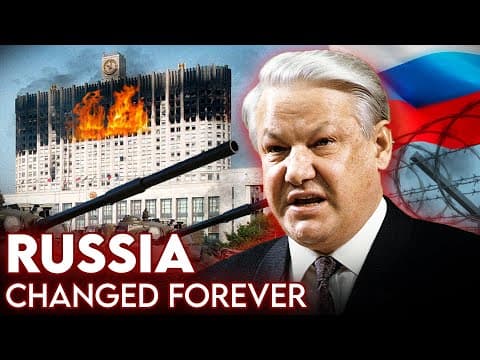
[0:00]The 4th of October 1993 is the day when Russian democracy has officially died. Yes, contrary to popular belief and what Reddit comment experts might say, Russia is not a country that never had democracy in its entire history. It did, although not for a very long time, and the effects of how this democracy was crushed can still be felt to this day. If you've ever had an interest in Russia or the history of post-Soviet countries, you might have seen this footage. Tanks in the middle of Moscow, shooting at the House of the Parliament, people running around, starting clashes, the Parliament building burning. If you're a Westerner, you'd probably say, oh yeah, this is when the USSR was falling apart, right? The August coup of 1991, when the Communist Party hardliners tried to overthrow the last Soviet leader Mikhail Gorbachev. That was when the future first president of Russia, Boris Yeltsin, climbed a tank in front of the Parliament and gave a speech. Well, you're actually wrong. You see, this was actually a completely different coup in 1993, which was perpetrated by the first Russian President, Boris Yeltsin. In 1993, Russia as a country was in a constitutional crisis. The Parliament was at war with Yeltsin, and they both tried to kick each other out. That is correct, people, in 1993, the political power in Russia was actually split between different governmental branches and did not just belong to one person. Sounds exciting and like a good basis to build a new country on. Only if Yeltsin was not so hungry for power that he didn't illegally try to fire the entirety of the Parliament, and when the Parliament members locked themselves in the governmental building, he didn't send tanks to shoot at them, essentially committing a violent coup. The events known as Black October of 1993 in Russia did not just shock the average citizen, but also led to chaos and clashes on the streets and loss of human life. But worst of all casualties, one thing that truly died on that day was Russian democracy. What is up, everybody? My name is Roman, your favorite neighborhood Russian, and in today's video, guys, we're going to be talking about the 1993 events in Moscow, the Russian constitutional crisis, and how it shaped the Russia of today. Also, a quick shout out to the Russian channel PostRussia. I took some of the footage for this video from his video on the topic. And yeah, it's a great channel if you know Russian, and I'll link it down in the description. To really get into this topic, we have to go back to the last few years of the Soviet Union and its dissolution. In a larger sense, the events that led to the constitutional crisis in Russia actually started before Russia was even a sovereign nation. In the mid-80s, the last leader of the Soviet Union, Mikhail Gorbachev, kick-started a series of societal and economic reforms in the Soviet Union known as Perestroika. The point of Perestroika was to get the USSR out of Brezhnev's stagnation era, switch to a more of a market economy, introduce free speech, and reduce censorship and political persecution. Gorbachev's reforms ended up being extremely controversial, being semi-successful as far as free speech goes, but utterly failing in regards to the economy. I have a full separate video on Gorbachev and his legacy if you want to watch it, but long story short, the USSR's economy was flushed down the toilets. In six years of the Perestroika, the Soviet ruble crashed more than 140 times in its value. Going from 0.64 rubles for a dollar to 90 rubles for a dollar. The Soviet economic growth in 1991 was at minus 11%, and the USSR's foreign debts basically quadrupled. It turns out that switching a huge country with a population in the hundreds of millions from a planned communist economy to a market capitalist economy is quite difficult. Especially when every single governmental system, be it welfare, education, medicine, food, the industrial and military sector, etcetera, is built around this planned economy. Unsurprisingly, this transition from communism to capitalism actually was far from over even after the fall of the Soviet Union. After the August coup of 1991, the signing of the Belovezh Accords, and the official dissolution of the USSR, the newly elected first president of Russia, Boris Yeltsin, and his government had an excruciating task to perform. Not only did they have to lay the groundwork for a new sovereign democratic nation, but also to finish the transition from communism to capitalism. And did they lay that groundwork?
[3:58]But before we get into the battle between President Yeltsin and the Parliament that ended up in a coup that killed democracy in Russia, I would like to try to paint a picture of what Russia was like in those first few years. To put it short, it was vastly different. Modern Russia is often described as a super-presidential republic, where all the branches of government are technically independent from each other on paper, but in reality follow the directions of the president. The president decides who gets to be in the parliament, the Constitutional Court, and so on, and all the branches of government have no real power against the president. That was not the case in 1993. The President's power was limited quite a lot by the Parliament, which at that time was called the Supreme Soviet of Russia. The Parliament itself was a bit of a reminder of the Soviet era because it was established to be similar in structure to the Supreme Soviet of the USSR. It consisted of democratically elected so-called people's deputies, and it was the highest organ of power in Russia that had the ability to veto or pass laws, fire and appoint governmental officials, and even impeach the President. So the governmental system was way more democratic than what we have today. The way the system was established is that in Russia there will never be a person who will be able to usurp all the power and basically do whatever he wants without any part of the government being able to object it. I'm sure that would never happen. Anyway, the government system was quite outdated, though, because at the time Russia did not even have its own Constitution yet, and the country technically functioned according to the Soviet Constitution of 1977, written in the times of Brezhnev. However, a new constitutional project was in the works and the government seemed to be taking decent steps towards true democracy. What a great start for a new country. I'm sure they will not screw this up. Anyway, the society itself was also obviously way more free than it is in modern Russia. The majority of the media, for example, TV channels at the time were not owned by the government, and the media could not just criticize but openly mock the presidents and the governments with no repercussions. Freedom of speech was at an all-time high and political persecution was at an all-time low. And don't get me wrong, I absolutely do not idolize the 90s in Russia. It was a time of poverty, decay, civil war, and insane gang violence. And overall, even though the government was built on democratic principles, it was still not good. However, there was a place for real debate and real discussion in the public sphere, and that is just something we could only dream of today. The economy was still awful, though, and the empty shelves in grocery stores that became a symbol of Gorbachev's later years in power were still very much a thing. The industry was in a terrible state, and there was a real lack of supply of essential goods and food products in Russia, such as bread and potatoes. The government knew that they had to enact massive economic reforms in order to fully embrace the new market economy and also get things in order. Russia decided to undertake a sort of shock therapy for the economy. This shock therapy consisted of two reforms, and the first one was the so-called liberalization of prices. In the Soviet Union and in the first years of Russia, the prices for the majority of goods and services were dictated by the government. This led to a so-called economic imbalance in 1991, when the amount of money in circulation in Russia was three times higher than the total price of all perishable goods on the markets. And people were not rich either, by the way, so essentially, people were not only quite poor, but they also could buy barely any food or necessities with the little money that they had because there was no food available. The demand was there, but the supply was not. The liberalization of prices meant that now prices for the majority of goods and services will no longer be controlled and restricted by the government. Salaries also got liberalized, and the government gave freedom to retailers. On paper, this reform was meant to kick-start the market economy in Russia and to increase the supply of goods in the market. The government was sure that the prices will not see massive inflation, and therefore Russia would reach a decent economic balance. It all went horribly wrong, though. Here's the cold hard facts. Even though the amount of goods has increased, the prices skyrocketed, making a lot of basic necessities unaffordable for the average person.
[8:12]The lack of monetary reform alongside the liberalization actually led to the majority of the companies in Russia going bankrupt. The government basically started printing money and giving out huge loans to the agricultural and the industrial sector, which led to hyperinflation of 2,600% in the year 1992. That is absolutely insane.
[8:51]People's savings and salaries turned to dust in the blink of an eye. Poverty and unemployment went through the roof, and the economy only continued to tank. There are many different opinions on why this went wrong, but most Russian people and also the Parliament blamed Yegor Gaidar. The Russian Minister of Economy at the time and one of Yeltsin's closest allies. He was the author of the price liberalization project. This unsuccessful reform was hated by the Parliament, and it's basically what started driving the wedge between Yeltsin and the Parliament, which got only worse with time. The second economic reform was the privatization of Soviet governmental property and companies, including companies controlling Russia's vast natural resources. The privatization was mainly led by Anatoly Chubais, the Minister of Russia's State Property at the time. And it was supposed to go kind of similar to the privatization that actually happened in the Czech Republic, where basically every citizen had a chance of owning shares and ex-governmental companies. Privatization in Russia is a huge and convoluted topic, but long story short, it also failed. While most Russian citizens lost their savings in only a few weeks, a few rich people with connections to the governments rapidly became billionaires by arbitraging the vast difference between the old domestic prices for Russian commodities versus the prices prevailing in the world market. Basically, the rich not just got richer, but they also acquired all of the Soviet governmental companies, and the average Russian Joe got nothing. This is pretty much where Russian oligarchy was born, by the way. Obviously, people were not happy with this, and due to Chubais being a close associate of Yeltsin as well, this only drove a wedge between the President and the Parliament even further. Yeltsin and his ministers demanded more money from the Parliament to fund these reforms, and the Supreme Soviet did not budge. In general, the Parliament was mostly composed of ex-members of the USSR Supreme Soviet, and these people were not huge fans of Yeltsin and his policies.
[11:17]So, if Yeltsin's attempts to rule over everybody and remove political power from the Parliament worked, he wouldn't have to deal with the annoying Parliament members at all. The full-on war between President Yeltsin and the Parliament started in December 1992. Yegor Gaidar, the creator of the price liberalization reform and many other economic reforms, was fired from his position of Deputy Prime Minister of Russia by the Parliament. This infuriated Yeltsin. During this month, the Parliament also decided that Russia should conduct a public referendum in April of 1993 regarding a new Constitution. Yeltsin, however, single-handedly decided that that is not going to happen. On March 20th, of 1993, the President appeared with a public address to the people in Russian TV, in which he stated that the current Constitution is no longer relevant and has no legal power, and that he is introducing a new special order of rule in the country, whatever that means. However, it turned out a few days later that Yeltsin did not actually sign any decree like that. And three days after his TV address, the Constitutional Court of Russia deemed Yeltsin's actions unconstitutional, stating that there are grounds for Yeltsin to be impeached. I know, guys, it's crazy. This was Russia in the 90s. Maybe all these Redditors are wrong and Russia is not destined to be a country ruled by Tsars. On the 28th of March 1993, the Parliament gathered to vote for Yeltsin's impeachment, but not enough votes in favor of it were cast, and Yeltsin remained president. After the impeachment failed, the head of the Parliament, Ruslan Khasbulatov, proposed that Russia should conduct a nationwide referendum in April 1993. In which the people could voice their real opinion and show who they trust and who they side with more, the President or the Parliament. The referendum was also supposed to decide whether Russia is going to conduct an early presidential election, an early parliamentary election, or nothing at all. Yeltsin and his administration agreed. The thing is, the referendum was basically useless. The citizens were asked to answer four yes or no questions. Question one: do you trust the President of the Russian Federation, B.N. Yeltsin? 58.7% voted yes. Question two: do you approve of the social and economic policies enacted by the President of Russia and the government of Russia since 1992? 53% voted yes. Question three: do you think conducting an early election of the President of the Russian Federation is necessary? 50.5% voted yes. Question four: do you think conducting an early election of the people's deputies of the Russian Federation is necessary? 67.2% voted yes. And also, at the time, every single pro-Yeltsin advertisement and motto advertised that the people should vote yes, yes, no, yes. Which became a sort of a meme.
[13:57]So, if the majority of the citizens actually did cast their votes like that, then it would be a win for Yeltsin because then there would be a new parliamentary election, and essentially the Parliament would be replaced. And technically, the majority of Russians actually did vote yes, yes, no, yes. Not only that, but elections back then in Russia were actually pretty trustworthy, and this particular referendum is considered pretty legitimate by most experts because there were no signs of voter fraud. Again, something that is very different in modern Russia. So, I guess this is it, right? The referendum fixed the constitutional crisis and the country continued on fine. Well, no. You see, according to the rules set by the Constitutional Court of Russia, for the results and for the answers to any of the questions to be considered and to be constitutionally significant, they had to be voted for by the majority of the electorate, so basically, the majority of all the citizens that can vote in Russia, not just the majority of the voters. And neither of the questions basically ended up being voted for by the majority of the electorate, only by the majority of the people who actually showed up to vote. So to put it short, it was not decided whether there'll be a parliamentary or a presidential election. The referendum basically did nothing, and the heated conflict inside the Russian government continued. So yeah, not only is this video a story of how the Russian democracy died, but I guess it's also a story of how the ordinary Russian citizens have pretty much never had a say in what is going on in the country. Even if the voting process itself was honest and transparent. So yes, please, tell me once again that every single Russian citizen, including me, is responsible for what is going on in Ukraine because we all voted for Putin. Yeah, sure we did. One thing that the referendum did, though, is point out the genuine feelings of the Russian people at the time. The country seemed to be basically split in half, with half of Russia backing the Parliament, and another backing Yeltsin. Even after all the unsuccessful economic reforms of the time, Boris Yeltsin truly was a very popular politician in his first years of presidency, who actually had a lot of support from the Russian people. A lot of whom were genuinely excited to answer a new era of democracy, freedom, and openness. The only problem is that Yeltsin betrayed everybody's hopes. A lot of people in Russia describe the events that followed as a mini-civil war, and in a lot of ways, it was one. On May the 1st, 1993, a Soviet Workers' Day holiday, a huge crowd of anti-Yeltsin people, largely composed of Communist parties and their members, took to the streets with a protest. The crowd wanted to march to the Kremlin and demanded for Yeltsin to be removed from power. The police blocked off the roads, and when the crowd arrived at the barricades, massive clashes started, with the police using fire trucks and sending in riot police with shields and batons to disperse the crowd. The protesters also turned to violence, throwing rocks, using flagpoles as weapons, and even hijacking trucks, one of which ran over a policeman, killing him. This protest is remembered as one of the most violent ever in Russia's history. And even though the revolt was crushed, the stakes and the intensity of the crisis were only going up. The last attempt of Yeltsin and the Supreme Soviet to reconcile happened in June 1993, when both sides agreed to join each other for a constitutional hearing, in which they would discuss the future Constitution and what it should be. Yeltsin proposed an entirely new project of a Russian Constitution, while the Parliament's leader, Khasbulatov, proposed a Constitution mostly based on the Soviet one. Unfortunately, the hearing was a complete failure, and the sides did not come to any sort of agreement. This was the final straw. Yeltsin finally decided to strike at the Parliament on September 1st, 1993, when he announced that he's firing the Vice President of Russia, Alexander Rutskoy, who was a prominent ex-member of the Supreme Soviet, accusing him of corruption and starting a criminal case against him. There were multiple problems with this. First of all, not only did it turn out later that the corruption accusations against Rutskoy were completely false and fabricated, but also, according to the active Constitution and the law, the President of Russia had no right to fire the Vice President. Only the Parliament had the right to do so. The Parliament filed to the Constitutional Court of Russia, basically to try to get Yeltsin impeached once again for breaking the law and breaking the Constitution rules, again. However, before Yeltsin got to be impeached, on the 21st of September, he went on live TV with an address to the nation, yet again. This time telling the people that he just signed a presidential decree, according to which he's not only firing the entirety of the Supreme Soviet of Russia and all the Parliament members, but also stating that such a governmental organ as the Supreme Soviet of Russia now ceases to exist.
[18:15]Of course, according to the law, Yeltsin had no right to do this. So not only did he basically break the rules of the Constitution, but he also literally did a coup. You guys know how during the Trump presidency in America a lot of people were saying that Trump is going to try to do a coup and basically is going to turn America into a dictatorship. And Trump was impeached as well, although he did finish his term. I mean, come on, a lot of people already compare Trump and Yeltsin because of their like wacky personality and antics, but this is a bit too much. Also, just how insane is this? Just imagine if Trump came out with a speech on TV while in office, in which he said that he just signed an executive order to fire the entirety of the US Congress and the US Supreme Court, and also these are organs are now they now cease to exist, by the way. It's absolutely unimaginable, but that is literally what Yeltsin did in Russia. Immediately after Yeltsin's address, the Supreme Soviet also came out with their own statement, saying that Yeltsin's actions are unconstitutional and that he's no longer serving as the President of Russia. And they announced that the Vice President Rutskoy, the guy that Yeltsin tried to fire, is now acting as President. The Supreme Soviet gathered inside the House of the Parliament. Citizens that supported the Parliament started gathering near the building, protesting against Yeltsin and building barricades, while the military encircled the building. The events basically turned into a siege of sorts when the pro-parliamentary citizens were guarding the Parliament building and having fights with the military and other citizens. It was complete chaos for two weeks straight, and during those two weeks, Russia technically had two governments, with both of the governments claiming that the other is fraudulent. They both held their meetings, signed decrees and statements, while the people in the streets were brawling with the police, organizing militias, and camping outside of the Parliament building. Yeltsin also turned off electricity and water in the Parliament building, just to drive the Supreme Soviet members out. The last two days of this constitutional crisis were the most memorable, though. On the 3rd of October, the pro-Parliament protesters broke through the police cordon around the Parliament building, as well as driving the police out of the nearby Moscow City Council building. By the way, according to Rutskoy and other present pro-Parliament protesters, they were being shot at by snipers from the City Council building. Funnily enough, Bodie Bankruptcy told me about this as well. He actually was in Moscow in October 1993, and he went to the Parliament building to see what's up when his hotel staff explicitly asked him not to go there. Sounds like a Bodie Bankruptcy thing to do, you know? Anyway, me and him were discussing this a while ago, and he also told me that down there in the crowd next to the Parliament building you could hear like sniper shots in the air and stuff. So yeah, the environment was obviously quite heated. The protesters that broke through the police cordon were given instructions by Rutskoy, telling them that it would be a good idea to also break into the Ostankino TV Center, which is where Russia's main TV channels are based. The idea was to take control of the censor, go live on several TV channels, and spread the Parliament's message.
[21:19]The clashes near the Ostankino Center continued for the better part of the day, with multiple casualties. The protesters rammed a truck inside the TV Center and tried to enter it, but they did not manage to take control of any TV channel signal. The police actually opened fire on the protesters, which also led to multiple casualties. Meanwhile, pro-Yeltsin protesters were also gathering near different governmental buildings in Moscow, set to defend the buildings from the pro-Parliament protesters, if needed.
[21:57]And again, this is quite ironic, a tale as old as time, once again, politicians are just using regular normal people in their own interests, promising them a future of freedom and democracy, when in fact, those same politicians were actually about to take those freedoms and democracies away. And this footage is yet again proof that Yeltsin was a very popular politician, and a lot of people actually did support him, and a lot of people did want to strive for freedom and democracy. And the fact that this was actually a real movement makes what happened next even more ironic and tragic. In the meantime, Yeltsin still had his power, and as you might be able to tell, he had the police and the military on his side throughout this entire thing, which is basically what solidified his victory. The attempt to storm the TV Center was the last straw, and Yeltsin declared a state of emergency in Russia. In the morning of October 4th, 1993, Boris Yeltsin sent tanks into the city center of Moscow and commanded the tanks to shoot at the Parliament building, which not only still had the Supreme Soviet members inside, but also had a ton of citizens and police hanging around, putting them in potential danger, too. Yeltsin didn't seem to care, however. Some people claim that the rounds fired by the tanks were blank, but nevertheless, this was a wild image. Nobody could even imagine that the entire crisis could lead up to this point. The shots of the Parliament building in Moscow burning after being shot at by tanks have become deeply ingrained in the collective memory of every Russian. The soldiers then stormed the building, arresting every single Parliament member inside. The entire storm was just as chaotic as the previous events. The military's actions were not very synchronized or well planned, with some of the military even turning on Yeltsin and joining the protesters' side, opening friendly fire. Coupled with the fact that the civilians still showed a lot of resistance, it got very messy. According to the official data, 124 people died, and 348 people were wounded or injured during the storm. Absolutely terrible, but also, among all this devastating tragedy, one thing that truly died on that day, October 4th, 1993, is Russian democracy. The mini-civil war was essentially over, and Yeltsin won. Not only did he manage to avoid being impeached for breaking the law and the rules of the Constitution twice, but he also managed to eliminate all of his naysayers and everybody who's ever dared to criticize him or the policies of his administration. The political system in Russia changed completely with the adoption of a new Constitution in December of 1993, which largely limited the power of the Parliament and increased the power of the President. The Supreme Soviet of Russia was abolished, and the Parliament was remade from the ground up, now consisting of two main organs, the Federation Council and the State Duma, which both still exist and operate today. Yeltsin made sure that the new system and the Constitution will never let something like this crisis happen again. The Parliament now could do barely anything to the President, and Yeltsin finally felt like he had a firm grip on power in Russia. This, of course, did not make Russia an authoritarian country immediately. Even though Yeltsin now had way more political power, the freedom of speech was still there, and media and TV were not repressed for criticism of the government or the President. That, of course, changed later. Some people actually argue that what Yeltsin did was quite necessary, stating that the Supreme Soviet of Russia was basically full of old communist bureaucrats that didn't want to see country reform and prosper. And if Yeltsin didn't do what he did, then Russia would immediately go back to being the Soviet Union. I personally really don't agree, and I think that Yeltsin killed Russian democracy. We had the potential to be a country in which the President would not have all the political power, in which the President could be challenged by the Parliament, and a country in which the people might have more of a say in what's going on. And yes, this system did create a conflict, but in general, the parliamentary republic is one of the most popular and well-performing political systems in a civilized world, which makes sure that the system is set up in such a way that one leader could not subvert it and turn the country into authoritarianism or dictatorship. Unfortunately, Yeltsin made a mistake because he created a system in which one person with bad intentions could basically get all the power to himself and do whatever he wants and be king. Yeltsin's hunger for power created Putin. The governmental system that we have in Russia right now started at this very moment, with tanks shooting at the Parliament building in the middle of Moscow as a result of a violent coup. I also think 1993 being the end of Russian democracy was pretty obvious even in the 90s. The 1996 Russian presidential election is actually a pretty good example. In 1996, Yeltsin was running for his second term, and he was already very unpopular in the country. First of all, because of the Chechen War, and secondly, because he turned from a charismatic leader to a drunk old sick caricature of himself. Yeltsin's main rival in the election was Gennady Zyuganov, the leader of the Russian Communist Party. This guy's still alive and kicking, by the way. In 1996, there were still millions of communist sympathizers in Russia, and those who wanted the USSR back. And the overall disdain of the people for Yeltsin made this election actually very close. The oligarchs, the media magnates, and everybody alike worked their hardest to promote Yeltsin in his election. And that effort pretty much saved Yeltsin's position in power. Check out this, what the oil tycoon Khodorkovsky, one of the most influential people in the country at that time, said in an interview.
[27:24]So yeah, and Yeltsin did end up winning the 1996 election. A lot of people were pissed, and the Communist leader Zyuganov actually had the potential and the power to actually take people into the streets to protest, but he did not do it. Crisis was averted, and essentially, Russia just stayed in a sort of status quo until Yeltsin's retirement in 1999. However, I honestly think that Yeltsin and his inner circle that were grabbing and fighting for power so hard, that if Yeltsin lost that election, we might have seen the repeat of 1993 all over again, with a state of emergency being declared and tanks on the streets of Moscow once again. The events of October 1993 show that Yeltsin would not shy away from brute force and violence just to stay in power. And I think this is the precise moment in modern Russian history when the rule of law was completely thrown out and forgotten about. I mean, look, if the president can break the law and the rules of the Constitution so openly and get away with it, what can your average policeman or a governmental clerk or a soldier get away with? Pretty much anything. Russia has never been the same ever since, and we still see the ripple effects of those Black October events till this very day. This is precisely why I think that Russian democracy died on October 4th, 1993. Thank you guys for making it all the way to the end of this video. I hope you guys did enjoy it. If you guys did, slap the like on this video as well, guys. If you want to support me additionally, go down to the link in the description, become a member of my YouTube channel. It's basically like YouTube's own Patreon, except that it's easier for me to get paid. So if you want to donate to me and support this channel, that's one way to do it. And yeah, thank you guys for watching this video. Hopefully, this is some decent food for thought, and I will see you guys in the next one.


