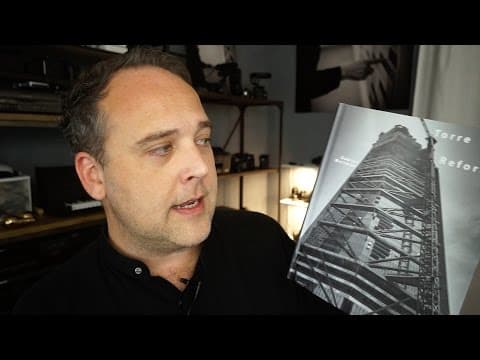
[0:00]I want to talk a little bit about project or series-based photography as opposed to single image photography. And this is an interesting conversation to open up, I think, because if you look at a lot of the points of distribution for photography now and a lot of what we have. I think this is the way a lot of especially younger photographers tend to lean towards. Um, if you consider with social media, you have Instagram and Facebook, and images don't necessarily need to relate to one another because they're really not set up to relate to one another. Um, things tend to be in the moment and they encourage likes or shares or followers or things of that nature. Even media outlets now, when they use still photography, I think tend to rely more on the single image, um, to go with a story more than multiple images or trying to tell a story through images. And a lot of that has to do with budgets that media have now for photography and the way photographers are used in that realm. And I think this is really interesting to look at. Um, there's still plenty of people who work in project-based works, particularly in the fine art world. And if you consider somebody like Michael Kenna, for instance, who is a fabulous photographer from the UK, and pretty much all of his work is series based. And he will take projects, uh, usually they're location-based, and for instance, a couple years ago, he did a major project in Japan. And it's a series of beautiful images of very high contrast landscapes that embrace this wonderful quality of Japanese minimalism and rules of composition, and it's really a wonderful set of work. And his projects tend to culminate in a series of exhibitions and or books, and the Japan project is very different than the projects he's done in France more recently. And I I think that's a really interesting way to, um, look at your own work, or in his case, look at his work and to see it work in larger format series like that. Another photographer who's modern who is very project-based is Keith Carter. Um, he does projects that tend to be series in nature, and they culminate in exhibitions and books. And even I think if you take photographers from the 1950s and 1960s, somebody like W. Eugene Smith, who was a media photographer, and he worked everything from complex projects, like the Pittsburgh project. It was literally thousands of images and took several years to do. Um, down to smaller based works that he did with the photo essay for Life Magazine, where it was a series of images that were put together to tell some kind of story. And I think this is where it gets interesting is when you look certainly all those single images in all the photographers I've mentioned, stand alone just fine. But when you put them together in that larger context, they take on a different personality, and they work in a very different way. And I think this is a great way, uh, for younger photographers to learn and for anyone to get better with their work is to consider working in a series. Now, this is not to say that this is better than the single image approach, both are perfectly valid, but I just think it's an interesting conversation to have. And I have a project that I want to share with you today, and this is a book that was given to me by Gabriel Wartman, who, uh, came to the meetup that I did in Mexico City. And I do want to say something about that meetup. Um, it was very different. I've done a lot of meetups over the years, and they're very special to me because I enjoy meeting people who watch the show. And typically, it's people bring their cameras and we hang out and talk or, you know, and possibly shoot. The Mexico meetup was very different in that most of the people that came brought work for me to look at that they'd done, and there were a lot of very talented photographers that came. A lot of people doing experimentation with dark room techniques, uh, composition techniques, and I was really impressed with that. And Gabriel, um, he is in the vlog video that I did on Mexico, you've seen towards the end. But by the time I got to looking at his work, we had moved locations and it was pretty dark, so I wasn't filming. Uh, but he did give me a copy of this book, and I asked him if I could share it on the show, and I will put a link up to his website and go check him out. I think he is a very talented, uh, young photographer, and this book is exceptional. And this is a personal project that he's doing called Torah Reforma, and it the project is based around a skyscraper that's going up in Mexico City. And basically, he just called them up and said, do you mind if I come shoot photos and document this? And so, I think what's interesting about this is not only is this a vehicle for him to experiment with his own composition, and I really like the fact that a lot of works in this book are not so much. The skyscraper itself that's being built, but using the the steel form to frame up landscapes for the city around it. And I think he's got a very mature eye for composition, and I think there's some really interesting images in here. And like I said, I will link up to his website because I strongly recommend you go check that out. Um, this is a really nice book. He just printed it on Blurb and gave me a copy, and it's really well done. And I think this is important because for a number of reasons, and I told Gabriel, one, you have a collection of work that was kind of focused. And those pictures, they work together as single images, but when they come together, they tell a larger story. I think the other interesting thing about this is something that's going to be a landmark. Uh, these images will be really special in 10, 20 years when the thing's been around, been built, and these were taken at a time when it was coming together. And so, I think that's really important and really interesting, and I will link him up in the show description. So, I'm curious to know what you guys think, um, and if any of you work on projects of your own. And I think this is just a very overlooked way of working sometimes, I think particularly with younger younger photographers and younger artists. Anyway, just some thoughts on that, that's all I got for today. Until the next video or if you enjoyed this one, please remember to like it, share it with your friends, and subscribe. I'll see you guys in the next video. Later.
SERIES BASED PHOTOGRAPHY
The Art of Photography
6m 59s1,197 words~6 min read
YouTube auto captions
Transcript source
YouTube auto captions
This transcript was extracted from YouTube's auto-generated caption track. The transcript below is server-rendered so it can be read, searched, cited, and shared without opening the original YouTube player.
Pull quotes
[0:00]I want to talk a little bit about project or series-based photography as opposed to single image photography.
[0:00]And this is an interesting conversation to open up, I think, because if you look at a lot of the points of distribution for photography now and a lot of what we have.
[0:00]I think this is the way a lot of especially younger photographers tend to lean towards.
[0:00]Um, if you consider with social media, you have Instagram and Facebook, and images don't necessarily need to relate to one another because they're really not set up to relate to one another.
Use this transcript
Related transcript hubs
Watch on YouTube
Share
MORE TRANSCRIPTS


