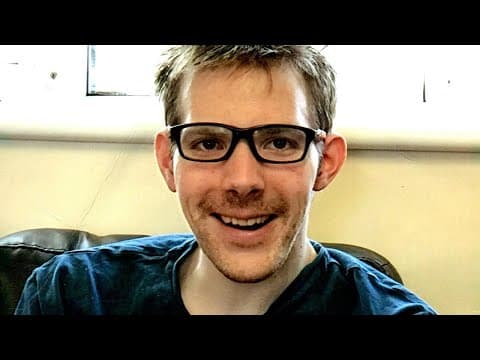
[0:04]Well, Luke's now 33 years old, and he's our second son. Luke was, um, he was born healthy, he was a good weight and born full term. Luke was a very easy, very placid baby and his milestones were early, uh both um physical, um his social, emotional um and in terms of um his his cognitive, um were all um, you know, above above average at that stage. Um, Luke started having seizures when he was two and a half. And he had up to 40 a day, and despite numerous hospital visits to some specialist hospitals in the country, some wonderful neurologists, and a huge number of investigations, Luke has never had control of his his seizures. Um, he does suffer from uh behavior changes before a seizure, what's known as pre-ictal um behavior, and he also has behavior changes when there's intense um electrical activity in the brain. Um, the age of six, seven, Luke was very ill with status seizures, um we very nearly lost him, and his behavior and his his his learning regressed from that stage. Luke has an extensive number of physical um health issues. He had uh a twisted bowel, a leaking bowel which resulted in a colostomy now reversed. He has a huge number of abdominal um issues. He also suffers from hemochromatosis, which is a build up of iron in the body. He um has a Vegas nerve stimulator in his chest implanted in his chest, and that was when he was about 13 to help him reduce um the seizures, and there has been, there has been some some impact of that. Luke has had invasive brain surgery, um to see whether surgery was an option, but um it was an investigation, unfortunately, um there was nothing that could be done um around that. Luke has been in induced coma seven times, due to seizures and mainly due to seizures but also other physical issues, um, and and three of the times, you know, we thought we were going to lose him. Luke entered the care system as an adult, and unfortunately his care has been complex and challenging. He's been exposed to a number of failed um placements, and three of them were inadequate, one of them being Winterborne View, and which was a highly um publicized scandal at the time. And he suffered a huge amount of trauma from those three inadequate placements that he he's been in, and I think there's been 17 placements in 13 years, I think it is. And this has obviously impacted on Luke's ability to build relationships and to trust people. Um, so it's been, it's been a difficult time. Luke tried to express his concerns in his placements, but unfortunately he wasn't listened to. Luke moved into the community in 2019. Um, he has 24-hour care support, and in 2022 the local authority did commission an independent review because of the recognized failings um that Luke had experienced over a huge, huge period of time. Luke, despite all that he's been through, is an intelligent, friendly, brave, the bravest person I know, incredibly resilient, and he's very thoughtful, he's very kind, he has a great sense of humor, and people who meet Luke say what a wonderful smile um he has. He loves drawing and he makes books for a local school and they write to each other, which is wonderful. Luke has a great love of wildlife and very knowledgeable about wildlife and nature and he really enjoys gardening as well. We're very proud to call him our son, and throughout, you know, all the difficulties, we've never given up hope that things would improve for Luke. Well, Luke was, he was out of county at the time. He his placements have always been out of county, and he was referred to Shropshire IST in September 22, and the aim of that was to give support um to the provider, to the carers, to the ICB, to Luke, um to prevent an admission into um a low secure hospital setting and to ensure that the um the placement didn't break down. Um, there were also a number of safeguarding concerns that Luke had had over a number of years um around the way the package was currently being delivered in particular. Luke was living in temporary accommodation. Uh, he was in the community, and there was restricted access at that time to staff, and he was being supported three to one in the community. There were some excellent staff, but there were also some very inconsistent staff. There'd be different people um coming to the house, and you know, bearing in mind that Luke had suffered huge trauma from staff that had worked with him over a number of years, to suddenly have a stranger come to his house at night and to be sitting in his house caused a huge amount of um anxiety um and stress to him. The um support plans were not being read at the time, so the intensive support team, they worked with Luke, the providers, the ICB, with us, and their work was preventative to reduce um a risk of crisis. And they've totally transformed Luke's life and indeed ours.
[6:33]As I said earlier, Luke's journey has been very challenging because he's had a number of inadequate or requiring improvement providers who were slow to improve. However, throughout, we have come across some excellent staff, and both staff that were working with Luke, um staff um through the multi-agency approach, but in a way they were powerless to change anything because they're either in a a role that they couldn't change it or there wasn't enough joined up thinking and not enough working together to enable that to happen. We came across some wonderful doctors and nurses in hospitals, um talking around general hospitals where Luke um had been for physical health needs and you know, their expertise, their experience um maintained Luke's life on a number of occasions. And for the last 18 months, Luke has had a wonderful nurse in his care package and you know, that's really given Luke a reassurance to him around his his physical health needs. It's been um a real consistency for Luke as well, um and and that has been um a huge help um to to the package. We were involved in the transitions. Several transitions were made swiftly because of the inadequate and poor care that was being provided and it was recognized by multi-agencies that this this you know, care was causing a grave a grave concern to everybody. So, we were involved, but there were often swift. We were told that in terms of the transition, we were told that the providers were strong providers, we were told that they had the skills, that they had the expertise to be able to work with Luke. Um, there were very over-promised and under-delivered, I think it's fair to say. And because a number of the moves were emergency moves, because of the concerns around what was being provided, there was little time for any transition in a number of cases. So they weren't successful, um Luke again was moved to to a provider where he didn't know the staff. They didn't hadn't had an opportunity to get to know Luke.
[9:05]Um, again, there were inconsistencies of of staff, and you know, due to those quick, quick movements really and transitions, there wasn't the planning in place. So we were involved in the transitions, but um sometimes there was an adequate planning, I suppose. Luke's most recent transition back into his home um area, his home county, so far has been really successful because of the wonderful work of Shropshire Intensive Support Team who have worked with Luke and and indeed ourselves. They their absolutely have been a lifesaver to us. There was a lot of um onsite training at the new um placement, there was a lot of training for staff, there was a lot of work um with the multi-agencies, and this really ensured that Luke's needs um were understood. People were well trained, they checked the environment to ensure it was suitable, and so that transition home to the home authority has been hugely successful and everyone now is really working together um to support Luke.
[10:16]Well, when Luke first moved to a house in the community in um 2019. There was little onsite support at all really because the care providers' management was based in Liverpool and the designated clinical lead was in Glasgow, and Luke lived in the West Midlands. Um, so there were so few visits from from management, both before Covid, because he moved into community in 2019, during Covid, and after Covid, because of the distance, there were very few um management um visits. And you know, support staff were left on their own, and there were different staff each week. Some of them were um lovely young people, but they were young support staff who had had very little training. And the support workers found us most days because they couldn't get the heating to work, they couldn't get the plumbing to work, and there was no team leader in place for many, many months, and the locality manager was based in in the South of England, and Luke, as I said, was in the West Midlands. And she worked with Luke for two years, but she'd never met Luke or ourselves, so it was all very much um long distance. And it's in my opinion really um difficult to have an effective care package when the management are so far away, you know, can't be trained, etcetera.
[12:01]Staff had no transport, so I can remember numerous occasions when we were phoned, my husband and I, we were at work, and on one occasion, Luke needed some emergency medication. We had to leave work, we had to travel the hour to get the emergency medication for his seizures. I can remember um on another occasion, there was no milk in the house, and there was no food in the house and they had no transport, so again we had to leave work and we had to go and get it. There was also at the time, with the commissioners at the time, there was a lack of oversight and monitoring of the package, and this was recognized in the independent review of 2022.
[12:47]Well, I've mentioned um a number including the inadequate um placements that Luke had. Something that was, and for years frustrated us really, was the inaccuracy of report writing, and it was agreed at times that there was inaccuracy of report writing, but then they didn't get changed. And reports were carried forward from unit to unit, and these reports followed Luke around for 10 years, and there were inaccuracies in them, and he was given a label which was impossible to change. Many meetings were poorly run. We traveled long distances to attend as Luke had placements out of county, and the meetings were often ineffective. I can remember several where there were no introductions at that meeting. We didn't know who the professionals were, and we felt quite outnumbered, I think it's fair to say, really. Often there was no clear agenda at the meetings and the CPA reviews, so it was difficult for us to know, you know, when when we we could speak, when we could actually give our viewpoint. Another point that was hugely frustrating with meetings was where documents, assessments, reports were not sent out beforehand, you know, a week beforehand would be good practice. And so many times they were issued on the day, so a meeting would start at 10 o'clock and we'd be given them. Well, some of those reports would be 10 pages long, so there was no way we could read them, and you know, it was very difficult then to challenge because we hadn't read them, but the professionals had read them. So that made it very difficult, we would then get home and think, oh, if we'd known that we would have challenged, but of course we hadn't had the reports beforehand. And whilst there were regular meetings, and sometimes there were appropriate action points from those meetings, there were so many times where the action points were not monitored, they were not reviewed, the dates, the specific time scale just just went by and nobody monitored them. And again, there was at the time, the commissioners at the time, a lack of oversight in terms of ensuring the action plans were monitored, that they reviewed, they were followed up and they were time specific. One time that we'll never forget was when Luke was making, it was the last meeting before Luke made a transition into the community, and we were sitting around a transition meeting, and I suddenly looked around and I said to the professionals who were there, how many of you have worked with Luke? And there were none of the professionals who had worked with Luke, but they were talking about him. And the staff had worked with Luke were either absent, um on holiday, wasn't their rote today. So people were talking about Luke and they they'd never worked with him. Another part really was the recording of incidents. Incidents would be recorded, this happened, but there was no no investigation really of what was the trigger to that in terms of did Luke have a seizure after, and he quite often did, what was the trigger to it, and any learning from it about what could be done differently. It was just this happened, so there was no no sort of looking into how things could have been done differently or what the trigger was. Um, little awareness I suppose of Luke's pre-ictal seizure activity. I've talked about, you know, the lack of oversight in terms of monitoring of them. Because Luke had his placements some distance from home and we were often doing a five-hour um you know, round journey. There were few assurance visits to see that the provider um was providing a safe care package, a good care package that met Luke's needs, that welfare um was in place. Um, and I've lost count of the number of safeguarding referrals that Luke had through his time, made by ambulance people, made by outside people because they were concerned um about Luke. I've talked around much being promised and under-delivered.
[17:14]And a number of placements said, you know, we have psychiatric, we have psychological input, we have speech and language, we have occupational, we have sensory needs, but actually when it came down to it, um, they did not deliver on those. And a number of places he was at, there was no speech and language, and I've already said that Luke has Dysarthria, um Luke has sensory issues, there was no occupational therapy. He didn't have an annual health check for 11 years. He didn't go to the dentist for 11 years, there was no podiatry. Luke has glasses, uh there were no um opticians visited apart from from when we took him. Luke is supposed to have checks on his hemochromatosis, it's very dangerous if he has too much iron in his body. He didn't have a check for 10 years in any of the placements. And obviously one of our concerns was that Luke was in so many placements that were poorly run, and despite our concerns, despite Luke very clearly expressing his concerns, we weren't listened to. And I know and I'm sure that we did get perceived as difficult parents, nuisance parents. Accommodation wasn't always fit for purpose. Um Luke had dirty cold rooms, showers that didn't work. And I can always remember when Luke had been in induced coma and been desperately ill, and he'd been in hospital for three weeks, been in intensive care unit, and we took him back to his placement, we we picked him up and took him back, and the bed linen hadn't been changed. There was no fresh bed linen after three weeks, we the bulbs in the bathroom had gone and we said could there be new bulbs, and we were told no, um, you know, that uh the maintenance men would come later in the week. And that was just so incredibly distressing, um, you know, most of us, if we were been in intensive care and induced coma, we'd go home to loved ones, we'd go into a warm bed, we'd be given nice food, we'd have TLC. Luke went back to a room with dirty bed linen, into a dark room where he has epilepsy so he could have, you know, um a seizure in the dark. Safeguarding concern in terms of health and safety, and also remembering that Luke has had abuse from some settings and many of those happened in a bathroom, and he was expected for days to go into a darkened bathroom. There were little activities to keep Luke and the other service users occupied. Very few trips out, we have always taken Luke out in the community, can I say that whenever we've visited, um we've taken Luke out, that's never been an issue. There were very few trips due to lack of staffing, um lack of vehicles. Trips would be canceled within 10 minutes notice, which is always disappointing for Luke, um because there was no staff, staff shortage, no transport. So there was very little in the way of activities um given to to keep to keep Luke stimulated, to keep him interested. I think one of the most frustrating things has been through the last, I think it's 12 years actually, is that the inconsistency of staffing. Every report that has been written about Luke has stressed the importance of consistency of staffing, and that's for many reasons. One, because of his past history of trauma and abuse, but also because of his needs, his autistic traits, he needs the absolute consistent approach to to working with him. And the inconsistencies of staffing um have just been huge, really. Different people on different days, different people who um had not read um the care, the support plan. They didn't had time for any training around Luke's needs, including um emergency medication if he has um, you know, a number of seizures. Um, little training of autism or no training or of trauma-informed um training. Luke experienced staff who were bullying um and aggressive in their approach to him. And I can always remember, you know, inconsistency of staffing when his first um placement in the community, there was a support worker coming at night, never met Luke. And Luke was in a residential street, and he knocked on the doors all the way down the residential street. He didn't know Luke's name, he was saying, do you know where somebody lives with epilepsy? um, do you um, he needs a support worker at night and wants a male support worker. So that's absolutely shocking, one, confidentiality, but two, they clearly'd been no training because he he didn't he had no idea of even Luke's name. Um, so I've talked around the lack of oversight um by the management and the commissioners. And his second home, there were no checks, there was no risk assessment, there was no visit for over a year into that home. And no health and safety checks, no environment checks, was the environment right for Luke and it probably wasn't, it was an emergency placement. So, yeah, there's been there's been a lot.
[23:03]Luke's care has been it's been very distressing for us. We've always had hope, hope that things would improve um for him, and I think if we hadn't had hope, we may not have got through it. Um there's been huge sadness. Luke's had a different journey to the journey that we'd hoped, um it's been awful to see him suffer both from his physical health and from placements he's had. You know, our smiley, vibrant, happy, cheeky son um was reduced to a shadow of himself. And, you know, to see him and to leave him, you know, in units, we'd take him out for the day and we've never had an issue with taking him out for the day, and then to leave him and trust him with the experience he's he's had in some of the placements. I think there's probably regret, uh regret, my husband and I, you know, have devoted hours and hours to Luke, but regret that perhaps we didn't, we weren't even more forceful when we knew things were not wrong. And then, you know, when it came to light actually that he was in shocking placements that we hadn't pushed that bit further. And, you know, that regret that Luke was trapped in a system for 10 years, and and we couldn't get him out, and that was, you know, 10 years of his early adult life. There's obviously the the sadness of family occasions. We're a close family, and then, you know, the sort of wider family, um that Luke isn't there at family occasions, and, you know, that included his brother's wedding, who he's very close to. There's been intense frustration that we haven't been listened to, and, you know, all the time we've been sending emails, etcetera. Um, and you know, you don't you don't get a response, or there's no action from it, that's been very frustrating and, you know, it's been frustrating that packages have not provided what what they promised, they haven't delivered. Luke had his placements away from home. We live in a very rural area in a very rural county, so his placements um had to be um away from home. So we've done a huge amount of traveling. We've always visited Luke at least once um a week, usually at weekends, sometimes more when needed.
[25:46]And, you know, we're fortunate that both my husband and I um work, but we worked out that there's been um a huge financial cost in terms of travel. We worked out that it's 110,000 miles that we traveled to visit Luke over 10 years. And as Luke was a distance from home, when he's been in intensive care units because of his um, you know, induced comas and when he's been very unwell in hospital, and he's had a huge number of hospitalizations into general hospitals, we haven't had the confidence that there was the staff consistency from the care provider to be with him.
[27:50]So, we've rarely been on holiday. Another impact I suppose has been the lack of time for ourselves.
[28:02]We've had to take a huge amount of time from work for meetings, for emergencies, when Luke's in hospital, when he's very ill. So many visits, meetings, hospital trips, and we've often worked at two o'clock in the morning to get our work done. Um, that's the only way we can do it to finish our work. And, you know, there's been lack of time for for ourselves, we never have a weekend, as I said. However, um things have improved recently, and over the last few months, and we're hoping, you know, we might find a weekend when we can do something, just normal things, really. And we have booked a holiday abroad to go to um a family wedding um in late Spring, so that's a real positive that we we feel confident that we can, we can do that. Another impact is the loss of family life. Uh Luke's brother is, who's two years older, is a remarkable person and we're hugely proud of what he's achieved in his career, but more importantly the person he's become. And he's absolutely devoted to Luke, and but, you know, it's been a different relationship because Luke has been so far from home. I mean, there is a positive impact in that Luke has taught us so much. I think we've learned to have a strength from Luke, really. We've learned to be incredibly resilient, and we no longer worry about small things because we found out what what really matters. And I think um Bill, my husband and I, we've sort of very much worked as a tag team, um, you know, that's a positive impact. We've worked as a tag team really to get everything done for Luke, for home, for work, um, but Luke's, I think taught us to have great strength and and resilience.
[30:02]This was absolutely the turning point for Luke and ourselves. Without the input from the Shropshire Intensive Support Team, Luke would be living a very different life in a unit. The IST, intensive support team, have been an absolute lifesaver, um, and they they became involved when we were in a very desperate situation. We came across the most dedicated, caring, professional, experienced, knowledgeable, um team of people, and they were absolutely highly specialized and skilled, and we're we'll forever be grateful to them. I mean, initially when they met Luke, the IST thought, you know, they read the reports, hadn't met him at this stage, and they thought perhaps the reports might be correct. They interviewed a number of people, they interviewed the integrated care board, the care provider, the staff, Luke, ourselves, and they got a balanced viewpoint. So they were getting everybody's viewpoint. However, they dug deeper and they absolutely challenged what was happening and very swiftly realized that things were seriously wrong. And there were things that absolutely were not right in the package, and they left no stone unturned. And I think, you know, I'd call it professional curiosity. They were really forensic, really, in Luke's case, is what I think in terms of um, they they looked at everything in detail. They didn't just take something on its surface value, they asked those questions and they were really challenging in the questions um throughout meetings, through discussions. The whole team was absolutely fantastic, and the lead practitioner has been the most amazing person that we've met who's dealt with Luke, and, you know, she absolutely knew that things were wrong, and she continually as lead practitioner asked those questions, and she challenged perceptions of Luke, that label of Luke, reports around Luke, and we actually called her a little rottweiler because she was always um asking those questions, always challenging. And, you know, the intensive support team were and are so person-centered. They made numerous visits to see Luke, and you remember that I said that people in the past hadn't got to know Luke. Turn up at a meeting, this is about Luke, they didn't actually know him, and in a in a short period of time really, they made um a number of visits with Luke. They very quickly engaged with him, and he got on really well with them, and, you know, for them then to um communicate with us, that they'd found the wonderful young man that we knew Luke is. And they they stripped away those labels, and they put Luke at the center of of all the work. And they they realized his strengths, and Luke has many strengths, but they'd never been noticed before. We we felt for the first time that we were listened to, and they included us in as much communication as they could and meetings that they could. Uh, they're so much listened to, uh, there's such a marked improvement, and only yesterday um there was a meeting and uh the I think it's called the complex needs team uh commented, everything was positive in that meeting. So there's been a marked improvement, and you know, although Luke has considerable um physical health needs, he's so happy, he's really enjoying himself. He feels safe, and, you know, after all that he suffered, he really does feel safe. He's benefited hugely from a consistent staff team, and just to see that smiling, happy face in an environment that he loves is just a joy to see. And you know, Luke is a total inspiration, and we're so proud of him, and we're glad we never gave up that hope.