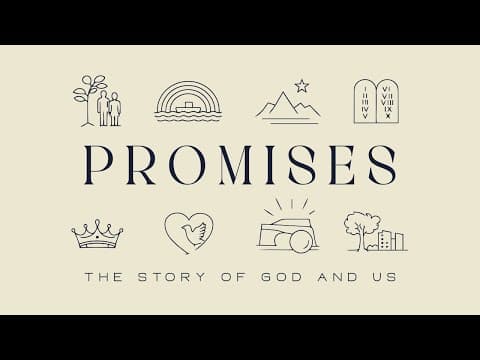
[0:03]IN THE BEGINNING GOD MADE A PROMISE TO BE OUR GOD AND TO BE WITH US HE HAS NOT AND WILL NOT CHANGE HIS MIND
[0:32]PROMISES
[0:52]So I have an important question to ask you this morning, and this might be a question that maybe you've never thought of. And maybe when you read it on the screen, you'll be like, that's a weird way to ask that question, Rob. And that's okay, too. You can have that response. Uh, but the question is this, what is God? What is God? Now, there might be a few different ideas floating in your mind. The first idea is that, just get them out of the way. You might be asking yourself, why is he asking us that? Isn't that what he's paid to tell us? Yes, I guess so. And the other of us might be saying, well, why what? Why not who is God? And that's a valid question. But what is God? What is God? Is the terminology that gets used in what's called the catechisms of the church. And for some of us who've come from different traditions, we might be familiar with catechisms. Some of us who have not been in other church traditions, maybe that's a word that we're like, that's a weird word. Why are you saying that weird word, Rob? And that's understandable, but a catechism is a teaching. And so, if you're from a church that's more liturgical, there's another weird word for you. Liturgical, like a Catholic church, or even a Presbyterian church, or an Anglican church, or a Lutheran church, you probably, if you went through as a child, went through catechism classes. And catechism was a teaching of the church about foundational things people were to know. And so you would go through this training and this teaching, and it's an ancient way of teaching people. But one of the more famous catechisms, and probably the most used one, and most of the catechism's worded similarly, they'll ask the question, what is God, as opposed to who is God? And the question as it's answered in the Westminster catechism, it's answered like this. God is a spirit, infinite, eternal, and unchangeable.
[2:54]In his being, wisdom, power, holiness, justice, goodness and truth. What is God? God is spirit, infinite, eternal and unchangeable in his being. Wisdom, power, holiness, justice, goodness and truth. Wonderful definition. Wonderful definition. It's a good one to to know. But does that get you to know God anymore? If you were to ask me, who, well, what is Rob? I could give you a definition of I'm a human being. I am a husband. I am a Montreal Canadian fan. I am and I can list off all kinds of things. And eventually I should answer some things like I am I'm trying to say, like kind. Hopefully that's something I could say about myself. You know, I can say some character stuff.
[3:47]But does that mean you know me? If you can define something, does that necessarily mean you know them? If we know that definition of what is God, doesn't necessarily mean that we fully know who God is, at least in our relationship with him. Because to know someone isn't just to define them. It's to relate to them. And if you really know someone, like maybe for some of us, we know a spouse or a family member, or even a really good friend, there's something about who they are that you can talk about that's not so much a definition or attributes about that person, but something deeply relational that you can speak to. Something that's different than what you could just write on a piece of paper. And when we talk about God, we need to talk about God like that, too. While yes, we should be asking the question, what is God? Because we need to know of what substance is God, and that's one of the big theological questions that needs to be asked. But we also need to be asked, well, who is God? So, who is the God that fits that definition? And the way we find out who that God is, is through covenants.
[5:04]There's another word for us to learn this morning, if we're not familiar with it. The word covenant, it's probably not one we usually use in our everyday language. Some of us will use it in some cases, we talk about sometimes marriage as a covenant. And so, covenants may be are not language that we are using all the time in our lives, but they are pivotally important for our understanding of who God is. In fact, scripture is all about covenants. So, what's a covenant? Here's a simple definition for us. A covenant is a binding relationship initiated by God, where he makes promises and defines what life with him looks like. God makes covenants with people. Throughout scripture, it is a series of covenants, where God is interacting with people, and he makes promises to them, but those promises have purposes, and their purposes have provisions. And if I had another P word, I'd throw it in here too, but I don't. And there's also expectations from both sides.
[6:16]God interacts with humanity through covenants. Covenants are a way that people understand their relationship and their space with God. And God is the one who initiates them. There are a series of covenants that come up through scripture, and over the next few weeks, we're going to be exploring what they are as we lead into Easter, because all of them help us understand more and more, not just what is God, but who is God, and how do we relate to him? And why do we relate to him this way? And we have to start really with the first covenant. The first covenant that God initiates with humanity is one that kind of encompasses everything that comes after. Because everything that comes after is trying to come back to that first covenant. Because covenants are interactions that God has with humanity, and with humanity, he says, that I will be your God, and you will be my people, and this is what it looks like. And the goal of these covenants is to have a relationship with God. The first one that we encounter, the word covenant doesn't get used, but it follows a pattern that the rest of scripture shows us and uses the word covenant for. And that comes in the Garden of Eden. If you have a Bible, you're more than welcome to jump into Genesis chapter two, because we're gonna be spending some time in there. But Genesis one, for those of us who are familiar, starts off with this wonderfully beautiful poem. This poem is a creation account where God takes all of the chaos and all of the formlessness and creates order and form and incent and gives us instructions of what it's all about. John Walton in his book, Lost World of Genesis One, talks about how this design of Genesis one is about understanding the function of creation, not so much how creation came about, but that there's function and purpose and order to it. Because the world in which Genesis was written in the Ancient Near East world was a world where everything came from chaos. Everything was an accident. Humanity existed just to pleasure the gods. But the God of Genesis one says, no, actually everything has purpose and intention, and everything comes together, that all those things that might have been chaotic, God brings together and brings order to them, and he calls it good. Creation is good. And then we get into Genesis two. And for some of us, when we read Genesis one, and we read Genesis two, that we have this idea of going, oh, there's two creation accounts. What do we do with that? And while there are two distinctions there, they're actually connected and interconnected more than sometimes we realize. Genesis one is this poem that demonstrates and discusses the function of creation and how God brings everything into order. And Genesis two and three is this narrative, it's a story of some of that creation and what happens in that interaction with God. Genesis one is like the 50,000 foot level explanation of what God does, and how what he does is good. And Genesis two and three are ground level of God interacting with humanity in the midst of all that. And really, what kind of brings those two sections together is this verse in Genesis 2:4. It says, this is the account of the heavens and the earth, when they were created, when the Lord God made, the earth and the heavens. And now, in our, in our Bibles, if you're looking in your Bible, like, hey, this comes just after that whole poem thing, and it comes into the narrative, but actually, if you put it together in the way, because our Bibles are different than what they had initially, it's all connected. And it's kind of like the linchpin that holds these two accounts together, saying, hey, the first part and the second part, they're connected. They're not to be disconnected. But they start off in this way. And as we come into this account, what I'm going to ask us is to try and think through what we've presuppose about this text, what we've maybe been exposed to before. If we've gone to church before, even if we haven't gone to church before, we've been exposed to the story of Adam and Eve. But my prayer is that our hearts and our minds are open to what God has to reveal through this text, that maybe, maybe it's going to reinforce what we come to the text with, or maybe it'll illuminate something that God wants us to see in this text that maybe we've missed before. We're not going to read through all of the text. You can do that definitely on your own time. It's well worth it. But we're going to jump in in chapter two, verse seven, where it says this. It says, then the Lord God made a man from the dust of the ground and breathed into his nostrils the breath of life, and the man became a living being. Now, the Lord God had planted a garden in the east, in Eden, and there he put the man he had formed. There's something we can easily miss right here. For those of us who are familiar with the story, maybe you've gone to Sunday school, you've seen the pictures, there's beautiful trees, there's animals, there's that crafty snake that we don't like, and we'll talk about that later. And then there's like these people in this garden. But the people didn't start in the garden. God put them in the garden. They were created outside of the garden. And we can easily miss this, but it's important for the story. Adam was not created in the perfect garden. He was invited into it by God.
[12:09]That may be different than what we were familiar with, and maybe different than what we've been told before, but if you look at the text, he says, and there he put the man in English. It's after the fact of creation that God puts man in. In fact, he's going to repeat it twice and we're going to get to that. But the text continues, the Lord made all kinds of trees grow out of the ground. Trees that were pleasing to the eyes to the eye and good for food. In the middle of the garden were the Tree of Life and the Tree of the Knowledge of Good and Evil. In the middle of this garden, this beautiful garden, God puts two specific trees, the tree of life and the tree of the knowledge of good and evil. Those of us who are familiar with the story, we know some of how that goes. We're going to explore that as well. But God creates this space within creation. And he says, this is his dwelling place. This is the place where God is connected with people consistently. And he invites humanity into that place, and as we end up reading the text, we'll see how God walks around with people in the cool of the day. This is like the place for God and people. They're connected. They're in relationship. They belong together. And in this perfect place, there are two trees. One's the tree of life, one's the knowledge of good and evil. One is exceptionally good for them, one, not so much. We're going to jump in in verse 15, he says, the Lord God took the man and put him in the Garden of Eden to work it and take care of it. So, in the midst of the God who creates this place, he says, human, I'm going to put you in this great place and you have a purpose. Your purpose is to take care of it. Your purpose is to steward it. Your purpose is to see that you have a role to play in this existence. God's role was he was the creator, he provided the space, he defines what is good, he defines what's life giving, and he's present with him. And Adam, the human's part is to care for this creation. He put him there for a purpose, to care, to steward, to love what God created. And the Lord God commanded the man, you are free to eat from any tree in the garden. But you must not eat from the tree of the knowledge of good and evil. For when you eat from it, you will certainly die. Two trees in the garden that got talked about.
[15:05]Tree of Life, tree of the knowledge of good and evil. God says, do not eat from that one tree, that knowledge of good and evil, for you will certainly die. Now this is where it gets really exciting. Now, I know you're excited about this, because I am. That language, certainly die. In Hebrew, wait for it. This is big. It is the infinite, absolute, imperfect tense. I know, wasn't that exciting? So exciting. It was the infinite, absolute, and imperfect tense. It's actually two words. One word is infinite, absolute, one is an imperfect tense. Why does that matter? Because the way we translate it doesn't actually pick up everything that's going on in this text. In Hebrew, it's mot-tamut. Mot being infinite, absolute, tamut being imperfect. And in Hebrew, and it's the language of its time, it could be translated a little more literally as dying, you will die. And you think, okay, that means nothing to me. No, but it should. Dying, you will die. And in English, we say, you will certainly die or you will die. And so sometimes we have this idea that's going to come up later in this text as well about how, oh, it just means death enters the picture. But that's not actually how the language works. The language works that death is already there, but it's not absolute. But if you eat from this tree, it will be. Because the tree of life gives eternity to people. But the tree of the knowledge of good and evil disconnects you from that eternity. And so when God speaks to Adam, he says, if you eat this fruit, if you eat from this tree, when you die, that's it. We're disconnected. Don't eat from that tree. It breaks the relationship forever, for eternity. So when God speaks to Adam, he says, hey, I bring you into this place, and you have a purpose. Your purpose is to care, is to tend for it, is to steward it, is to love the creation to be honoring it because God has created it. And in that, I am going to provide for you all that you need. Everything is there, but there's one prohibition. Don't eat from this tree, because it breaks our relationship forever.
[24:48]Adam's job, tell your partner. What did he do? Sort of told her. What did he also do? Nothing, when she went to listen to a serpent. He didn't hold up his end of the bargain. God had created them for something, and they just missed it completely.
[25:14]God had invited them into this, invited them into this covenant, into this deep relationship, this promise that he offers to them and says, if you keep your end of the bargain, it will be good, it will be life. What Jesus will call life in all of its fullness. But if you don't, there are consequences. And what do they do? The opportunity comes, someone comes along and says, hey, does God really care about you? That's really what's being asked. Does God really have your best in mind? Is God really concerned about, or does God even really know what is best for you? This is the same thing we deal with every day. Most of us are faced with the same question. God has given us a relationship with him. He's invited us into it, and it's relationship is two-sided. His side is he brings his goodness, his life, his forgiveness of sins through Jesus Christ. And he invites us into this relationship, and we have this relationship, but then there's our side of the relationship where we have to what? We have to follow him. We have to do what he says. We have to be conformed more and more like the image of Christ. And then every now and then we have something that comes in our mind, and we think, does God really have my best intentions in mind? Is God's way really the best way? And we break that relationship over and over and over again. The good news for us is that through Christ, we have opportunities over and over and over again. But we're meant to be more and more like him. The text will continue and this is what God has to say, in verse 17. He said to Adam, because you listened to your wife and ate fruit from the tree about which I commanded you, you must not eat from it. Cursed is the ground because of you. Through painful toil you will eat food from it all the days of your life. It will produce thorns and thistles for you, and you will eat the plants of the field. By the sweat of your brow, you will eat your food until you return to the ground, since from it you were taken, for dust you are, and to dust you will return. But God, who took dust, who took dirt, he breathes life into it and then invites it into this relationship, this covenant, this space, this garden, this perfection. Says, hey, I am providing for you everything. I have made this promise. You have one prohibition. Don't eat that fruit from that one tree. The one thing he can't do. Everything else was good. What's the one thing he does? Well, he doesn't steward the creation he's invited to do. He doesn't follow through with his purpose, and he sits by silently while his partner is led astray. Because he didn't do his job of instructing her of God's word. And everything is broken because of it. The ground is cursed. Thorns and thistles, you will work, you will toil. Everything, the joy of the stewarding the creation that God had, that is gone. Now it's just labor. It's toil.
[28:28]God's first covenant with people was that he was their God. His promise to them was he would be amongst them. He would provide for them, and they would have a purpose to care for that which he created. And the consequence of the one prohibition was they would lose that connection. God's first covenant with us was a relationship with him. And every covenant that comes after is trying to build that relationship again. But because we thought, because we still sometimes think, we know better than what God has in mind for us, that relationship gets broken over and over and over again.
[29:37]The good news for us is that through Christ, we have opportunities over and over and over again. But we're meant to be more and more like him. The truth of it is that God's faithfulness is stronger than our human failure. The God who brought Adam from the dust, put him in this place of beauty, provided purpose, provisions, with one prohibition, is the same God who says, there will come someone who fixes this. We get to know that someone through Jesus Christ. And over the weeks we're going to explore how the promises lead to him. But that same God is your God. The God of all creation. The God who is faithful above all else, that even when we don't take our side of the covenant seriously, he takes his side very seriously, and he sticks to it. Yes, he needs to stick to the prohibitions as well. Yes, there needs to be consequences to actions, and that's what we see demonstrated here. But he still keeps to caring for his creation and trying to build a relationship with us. The first covenant is a covenant of relationship that demonstrates that God's faithfulness is stronger than everything else. And it's also recognizing that covenants in general is God's way of refusing to give up on his relationship with us. That God wants us to know him and be known by him. As John Calvin will say in the his institutes right at the beginning, if you want to know yourself, you need to know the God who created you. You can't know yourself without knowing that God. You may think you know yourself, you may understand some pieces of what God gives glimpses of, but you'll keep trying to form yourself, but the God of creation has already formed you. The God of creation has already called his creation good. The God of creation is still mending the relationship that's broken. But at the root of it, he invites you back in to find wholeness that only he can provide. Covenants are God's way of not giving up on relationships. So I want to bring us back to the question I asked at the beginning. What is God? Can we answer that any differently? Well, what is God? He's a God of promises. And he is good to his people. And he's a God who moves towards us, even when we've moved away. And he's a God who restores what we break. And he's a God who keeps his promises, because he does not fail.
[32:12]Even when we don't keep our end of the bargain. And the ultimate question that we really need to ask ourselves is, do we believe God is for your good? Do you believe this God, who has done all this, who's created you, who's formed you, even when you don't realize it, and invited you into a relationship with him? And even when we break that relationship, keeps inviting you back and created ways for us to have that relationship, ultimately through Jesus Christ. Do you believe he's for your good? Or do you think you could do better on your own? The story of Adam and Eve is people who thought they could do better on their own, and everything is broken because of it. The first creation, the first covenant in creation is one of relationship. When God invites us to know him and be known by him, and be close to him. And it's one that he keeps calling us back to over and over and over again. But sometimes we would rather define good and evil for ourselves, instead of listening to what he said to us. Part of our understanding is we think, well, if we just keep the rules, if we keep doing all those things, then we'll be okay. But that's not what God wants. God wants us to be in relationship with him. He wants to invite us into that and to know that deeply and to choose him over everything else that entices us. The story of Adam and Eve invites us to know that that's the first promise God makes with us. To be our God and us his people and to be in relationship with him. And he will do whatever it takes to restore it when we break it. Let's take a moment to pray. God, I thank you that you are, uh, the God who creates, sustains and redeems all things, that you are the God who made us in our uniqueness, in our similarities, in our struggles, in our joys, in our desires to be more than we are, and in our humility to realize that we are gifted and good in some ways, even when we can't see it.
[34:30]You are that God who's invited us to know you. That through Jesus Christ, we are invited into this relationship, that we are past the garden, and we are moved into a place where we can be mended with you.
[34:52]That you are the God who, who binds us in a covenant and invites us to be part of what you're doing in this world. And that through the Holy Spirit, we can know and be reminded of your goodness and of your truth every day. That spirit, you never leave us. And you invite us to know you and be known by you and to follow you and to listen to you. Father, I pray for some of us, as we maybe feel a little bit like Adam this morning. Maybe we feel like we've heard what you've said to us, and when the words come out of our mouth, we've maybe twisted them a little or changed them a little, and maybe we haven't really understood what you've said. And Lord, we need to know clearly the truth of your word. That through the words that you've expressed long ago through scripture, that we can know you and be known by you, and that you've given us a purpose. You've provided all we need. Help us to keep our end of the bargain, Lord. Let's pray all this in Jesus name. Amen.