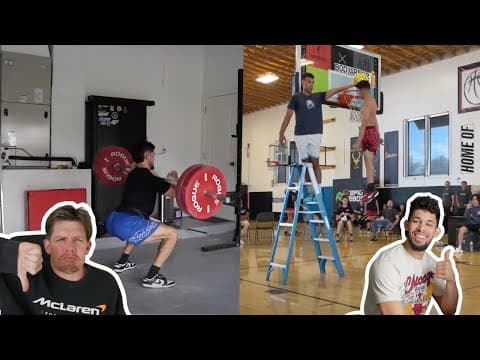
[0:01]Training to jump higher isn't all sunshine and rainbows. as much as we might make it seem. like there are a lot of things that we don't like about training.
[0:12]But there's also the things that we love about training and the other reason that we continue to train specifically for the vertical jump. In today's video, we're going to make a little sandwich of two things we like about jumping, well training to jump higher, and then one thing that we each hate about jump training.
[0:33]Who are you? Having said that, I am Isaiah Rivera. I have a 50.5 inch vertical. I am currently training to break uh my PB. and this is John. He coaches me how to jump higher and he has written all the programs over at THP strength, which if you want to get coached by the both of us and our amazing team on how to jump higher, go to thpstrength.com.
[1:01]We have a discount right now. There's also free stuff in the description.
[1:05]You have a 20% discount off the first month? Yeah, you get a 20% discount. Spring sale. 20% of your first month.
[1:12]Spring into jump training. Yeah. Anyways, we need Austin back for that. If you guys know what we're talking about, then leave a comment below and and let us know if you remember Austin's little stick every episode back last year.
[1:27]So, yeah, let's start with you. What are two things that you hate? Are we going to do back and forth? That's the plan. All right, so one thing you hate and I'll give one thing I hate.
[1:36]What I hate, this might be the single my least favorite thing. Actually, aside from getting hurt, but I I wanted to stay away from injury stuff. Um I hate week two and week three of training when I'm very fatigued. It is very difficult to get myself to train.
[1:57]The only reason I do it is because I have built a habit and I know the most important thing is just to show up. But there are little thoughts in my head that tell me to stop.
[2:08]So what is week two versus week three like for you? Is it is it worse week two than week three? Do you do you have a preference or is week three just like you've you're at the end? You can see the light at the end of the tunnel and week two is just like, I have another week of this? Are you kidding me?
[2:22]Yeah, that's definitely what it is. Like week one, there's novelty. I'm usually doing new exercises and new rep scheme.
[2:30]Uh, there's also I'm usually freshish going into it. Um, and it feels like I'm getting better, especially with like high volume stuff. I'm usually pretty banged up coming into it.
[2:47]And then it's like, ah, back to the stuff that makes me way better. But then week two comes in and it's hard and it's like, whoa, and I have a whole another, I have the rest of this week and the whole another week after that.
[2:57]Week three is I'm even more fatigued, but it's like, I made it this far, might as well finish.
[3:06]Survive and thrive, baby. And and something, uh, I'm trying to be better about this on every episode. The lesson, a takeaway that I would get from this is just get through the first two weeks.
[3:20]That that's so important. It's really get through the first three weeks, but if you get through the first two weeks, it'll feel stupid like quitting at week three.
[3:30]And at that point, like the hay's in the barn, like two weeks of consistent training where you really get after it and you watch your diet, uh, and you jump consistently is enough to see a pretty big improvement, specifically for guys with a lower training age.
[3:43]And the guys with the lower training age are usually the guys that have the problem of staying consistent and building that habit.
[3:47]If you can get a solid two weeks of training in, week three sucks, but you've like, you might as well get it over with and psychologically it's a lot easier than week two, and then week four is fun, you unload and it's pretty fun.
[4:03]So what would you, what would you say about like two week cycles loading and one week off? Would you prefer that? We've done it in the past.
[4:11]I do prefer them actually. I've thought about I I mean I've thought about uh often and Randy stuff earlier this year, I even thought about the benefit of that.
[4:26]Fresh off it. Um, I mean that's always a possibility. Yeah.
[4:31]You know what I said? No, no, that's what I'm saying. It's that's always me being soft is always a possibility.
[4:39]All right, so the first the first thing that I hate about jump training is I I actually did two things I like because I'm I'm really nice and I forgot that it was two things we hate. So I have to think of my second. But, um, the thing that I hate is lack of facilities.
[4:50]I it is one of the biggest, uh, I wouldn't say crutches, the opposite of a crutch. It's like the biggest crippling experience is when you don't have access to facilities.
[5:04]I think that is probably the hardest thing about getting into what we do at a very high level and I'm sure that there's like a lot of kids that listen maybe a lot of kids that listen to this that feel the same way.
[5:19]Like I only have dumbbells or I only have I mean, we have solutions for that, but for me personally, just being kind of like, almost spoiled in the sense of having really good facilities my whole life, like in high school, not all the time, but much of the year, I definitely had a track whether I was going to be on snow or not was like, you know, here or there, but I had somewhere that I could run.
[5:39]Um, I always had a weight room at pretty much my entire 14 onward. When I didn't have a track is whenever my consistency tends to get uh, less, like my training quality goes down. Maybe not consistency, but the quality goes down for me.
[5:54]So, I would say that's my least favorite thing for sure. Uh, what's your, what's what's one thing you love about jump training?
[6:32]You got a couple. De-load dunk sessions with friends. Yeah. You just like competing and crushing your the comp. You just I mean your friends.
[6:44]No, it's not about that at all actually. It's uh, no, I just like being around around friends dunking. I I don't know.
[6:58]I literally just explained it the best way I could. That's fine. We can keep it real short and sweet. If you want, like just like, hey, that's it is what it is. Like you you said, you meant what you said and you said what you meant.
[7:12]Yeah, no, I specifically think about um the moments leading up to a dunk session, like the morning of, like being excited. I got to, like when I when Austin was here, um, that was a huge part of what the, he loves Austin.
[7:31]Um, yeah, that was like a a big thing I I would look forward to on dunk days and then when Lewis was here, it was that same, like that exact same sensation. It's like waking up and it's dunk day and and it literally feel like Christmas. That's the best way I can describe it.
[7:45]Do you know I don't get that at all? Yeah. 0%. I know. Maybe it's just I'm not as good as you.
[7:54]No, in all seriousness, I think maybe it's just I'm not as good as you, so I don't like get excited as much. Like I'm like I will go.
[8:04]Thing is I felt like that when I was do do.
[8:14]Did I just get this tray?
[8:18]Maybe I was progressing really quickly, though. Like I was never, uh, in my shoes.
[8:26]Like you've like you've windmilled, you've east-bayed on 908. And if you're not able to dunk, that's probably very like it's not like I wouldn't be excited if like let's say I was out and I could only windmill, I probably wouldn't be very excited to go on on the basketball court. Do you realize like 99% of the people on our training.
[8:50]I don't think so. I think most people are are I'm not saying like the skill level.
[8:56]I'm saying relative to where you're at, like people are usually like PRing especially if your training age is low, like constantly hitting like PRs and stuff like that. So you think I'm in like a unique cohort of people that are training through plateaus and don't care.
[9:15]Yeah, I think that's rare. I think that's really rare. It's not even it's not even a plateau. It's like compared to your best. It's like you're at a low point. You know what I mean? Like that would be that's psychologically really difficult for most people, I feel like.
[9:30]Yeah. You and for me, like when I get hurt, like I get like, it's not fun.
[9:36]I don't know, for me it's just part of the process. Like I think that I and maybe this is like the other thing that I enjoy, I guess you could say is I like working hard. Like I really enjoy it. Like I genuinely enjoy the work and I think that a lot of people don't feel that way.
[9:51]Um, the lack of facilities makes me enjoy it less, but dude, even just little things like I really enjoy being on a track when it's sunny and the birds are chirping. And that sounds absolutely ridiculous and something like out of like the the whatever, some like 1980s film, but it really genuinely is enjoyable for me.
[10:12]Like being outside, it's like the reason I like golf, dude. I like being on grass around water and it's kind of quiet and peaceful and you're doing something that that has purpose. And that's that's fun to me. I like improving and I like challenging myself and Yeah.
[10:30]I don't like, you know, the having to worry about what other people think.
[10:34]And when you're on the track, like, dude, it's just like you and your thoughts and your feelings and no one else is around and it's nice. And it's kind of like it is really peaceful and really enjoyable. That was one of the things I really enjoyed about coaching at Duke was like, you know, it was easier for me to I always had track access, regardless of whether I was hurt or not, it didn't matter. Year round, it was never going to be snow, it might rain and be cold, but I always had track access. And uh, that was just super enjoyable.
[11:03]I think that that's one of the things that a lot of people don't really lean into and maybe should, you know, like with the sprinting and and the full warm-up and stuff. That's one of the best things if you can get to it, it's one of the most enjoyable things.
[11:16]This reminds me of like I I would compare you to people that like fishing. Like I never, so I I fished a lot when I was little because in Utah everybody like, you know, I would I would do scouts and stuff and we go on on camping trips and that type of thing.
[11:33]I don't really like fishing. But no, I'm going to I'm going to get I'm going to get to it. And I never understood how people found fishing enjoyable, um, because it wasn't exciting to me.
[11:46]Like I like doing stuff that like gets my heart pumping and like it gets excited and when people would always describe fishing, they're just like, oh, I just like being in nature and it's relaxing and like that type of thing.
[11:56]And how those people describe fishing is how it sounds like you feel about training. Like you just like being out there and it's like, it's almost like a Zen type of thing. Not really though. I hate hiking. I hate fishing. I hate all that shit.
[12:12]The the specific thing I think I like about it is it's and maybe this is relatable to like people that like hiking and fishing is one it's nostalgic of something that like it brings me back to kind of like periods of my time that were really enjoyable, like competing in track.
[12:26]And I also enjoy the trying hard aspect. Like those brief periods of very, very intense effort, I feel like a very productive for. I relate to that.
[12:35]That specifically. But what I I just don't understand how you don't get excited, though, about that. Like when I, yeah, like when I wake up, because it's that right there what you just said is like that trying very hard for a short period of time.
[12:48]Like a max output activity, even now just thinking about it, I'm like, my palms are literally sweating as I just said that. For okay, I'll say this for two foot, yes.
[12:57]For two foot, yes. For one foot, no. Because one foot doesn't work that way. One foot is not like that. One foot is not like sprinting. One foot is not like it is not like try harder do better. One foot is more about rhythm, it's about feel, it's about finesse. It's like it it's very, very different. When I was doing a lot of two foot, I would get excited. I wouldn't be sweating like a lot of the time, like that excited because, you know, sometimes I just be low-rimming.
[13:24]And I was often times nurturing and what made it not fun is when you're hurt. Like if I'm healthy and I feel good, two foot, I get that. Like the first time I was going for an East Bay off one, I would get that or windmilling I would get that. And then like nervousness more so than excitement.
[13:41]I'd be like, I'm in good shape. Like I'm in really good shape and I'm excited. Then I would have that. But for two foot, I would get it a lot because two foot is like just fun. What I didn't like about that is that often times, I would push too hard, too much, too soon and then walk out of the session injured and that made it not worth it. Like I if I injured myself.
[14:00]So it's probably it's probably a thing where you've been conditioned to not feel like that. Cuz like if you think about it, times where you have felt like that, you overdo it and it leads to injury and you take steps backwards.
[14:13]It's probably just conditioned your brain to like, hey, don't get excited. Don't get excited because you have to stay within the boundaries of like health. Yeah. Yeah. versus, yeah, that make that makes sense.
[14:27]Like when I was my best, it's always it's more fear because it's less predictable than two foot. Like, dude, two foot I know I'm going to jump within 99% of my best every single time I step on the floor. And I know it's going to be technically perfect and I know it's going to be good, right?
[14:43]Where I got demotivated from two foot was when I had these physiological barriers, like anatomical barriers. I couldn't get into internal rotation, which made me load my low back more and my hips more and made me leak a lot of energy and my outputs are crazy, but I'm leaking so much energy that I don't jump that high compared to someone that's like half as forceful as I am.
[15:08]So, you know, like in terms of metrics. That's where I lost a lot of motivation with two foot and that's what made me lean into one foot so much. It was just debilitating knowing, I have to be as strong as Isaiah to jump or as powerful as Isaiah and train two to three years just to get to the point where I'm jumping as high as like this is going to sound bad, but like, you know, some I have specific names in my head that I'm like, dude, I would dominate you in the in it literally every single lift in the weight room and every single sprint and every single plio, but you'll get more dunks than I will simply because you have better mobility and like you can get into positions better than I am and no matter how hard I work, I'll never be able to have that.
[15:42]Like that was so debilitating for me that I was like, fuck this. I'm I'm so over this. Like I want to do one foot. And one foot's more fulfilling because I can try half as hard and be way better because I'm not limited by mobility, you know what I mean? Like at that point, there's other variables that I can like lean into and maybe I don't get as excited, but I'm less demotivated than training your ass off and getting trounced by someone who trains a quarter as much as you because they have better mobility. Like that is debilitating.
[16:13]It's interesting like, um, the way I fell upon dunking. I think we've talked about this in the past, but part of and this is what like being around, I think specifically my dad is what led to this.
[16:27]Because my dad for the my stepdad for those of you that don't know was a an elite Olympic weightlifter in college.
[16:37]So he knew Yeah. So he knew what it took to get to the tippy top in the athletic world, right?
[16:44]Like in terms of work, talent, genetics, like all like he was very aware of that.
[16:49]And growing up, sports was about finding it wasn't even like what you enjoy necessarily. It was more so what are you most talented at naturally. And I did a lot of a huge reason why I played so many sports was my dad pushing me to like try different things.
[17:06]To see what you naturally excel that. And and I naturally and the thing is I would enjoy the things that I was naturally better at. I always say that to people.
[17:16]It's like the sport finds you, you don't find the sport.
[17:19]Yeah, yeah, yeah. And then dunking it was interesting. I did, there was a little bit of pushback because the thing I was naturally best at was baseball, but I didn't like it as much as basketball. But I was still pretty good at basketball.
[17:31]But then dunking was the perfect storm of that of like, whoa, this is the most fun thing I've done. And this is the thing I'm like, I seem to be pretty naturally good at as well.
[17:42]Um, so it's it's I get hesitant to give people that advice, though, because I see I want people to dunk.
[17:51]I want I want people to to experience that. I mean, I'm kind of like the most of our athletes, you know, I'm not I'm not the best dunker and I know that, but I enjoy just getting better and learning new things. That's really important.
[18:06]Yeah. And uh, maybe I'm slightly more inclined to be decent at it. But like I'm not you, you know, I think there's one of there's only one of you in the world or maybe let's say three of people like you, right? That's not the majority of people. So that's not the reason why Maybe that's the reason some people dunk is they want to be the one, number one. But I think a lot of people just want to be their best, you know what I mean? I think most people are probably I think most people are a mixture of what we said.
[18:34]I think it's people that are not genetic freaks that love it, that love to work hard, that love to dunk and then that love the I think the community aspect of it is huge. Like Right.
[18:47]That is my favorite thing about dunking like what we're about to do on on Friday, like where it's like a bunch of guys like get getting together and stuff and then you meet up and like have a dunk session and then you go freaking eat dinner like right after and like hang out, like I love that about dunking.
[19:02]It reminds me when I was little and like I'd go to the basketball court with my friends and we just play basketball all day. Like, that was like, yeah, like when I think of like memory like memories from being little it's that.
[19:15]It was always like doing something athletic, doesn't even have to be basketball. It was like anything that required movement and athletic and competing and like that that type of thing with your friends. Is like, yeah, that that's my favorite thing about dunking. Wow.
[19:30]This was really really insightful. There's very few times where I come into a podcast and like I'm genuinely intrigued by something that we say or like talk about.
[19:39]But this is a really interesting one. And we've talked about it before, but maybe not into the same like detail where you're like, I just don't get it. I'm like, dude, we're different people. But um, you know, I I always say this as a in many areas of life, but different strokes are different folks, you know what I mean? Like we're all not going to swing the golf club the same way. Um, also I don't know if a lot of people know this.
[20:00]On THP, we have a map. Like we have literally because I I genuinely feel like you should Yeah, somebody to like find a training partner or like find someone to dunk with on the weekends. But when you sign up for THP, it's literally one of the pin posts on on the school community and then there's literally a map where you can put where you live and then you can see all the other THP athletes near you. So I highly recommend It gives you a lot of purpose when you train for something. So even if someone's far, like time it up with a deload week. Like we have a guy, his name is Bishop. I was I was talking to him last night. He's coming to the session on Friday.
[20:43]Oh, I didn't know that. And he lives in South Carolina and he's literally driving down to Orlando for this dunk session. And that that type of thing is perfect like when you have something to train for, like plan it out, right? Like if someone's on the next state over or something like that, like go plan to drive or buy a flight and time it up with your deload weeks and and go meet up and and dunk with someone because you will It's different. And you'll always hit your personal best. You know who might be able to come is Cam Gilmore. If it's a Friday night, I'll I'll let I do you want me to text? Oh yeah. I will text Cam. I texted him yesterday because I was like, hey, can you help me with this? I actually have a story time coming soon guys and I'm really excited about it. Um, it's about the last month of training and Yeah, I figured I would share my progress not so much on my story. I mean, occasionally you'll see little tidbits. But I've been capturing every everything, not everything, I've been capturing a lot of what I've been doing and taking notes and today.
[21:30]He should title it. He should title it. I trained for 30 days to dunk. Here's what happened.
[21:34]Yeah, yeah, literally. And kinda exactly. I I actually, yeah, that is what happened. And, um, yeah, I'm just getting to the end of that. I wish you would have tried dunking right before.
[21:44]I think I would have been really demotivated to train the next 29 days. At least you have a a starting point for now the next 30 days. Yeah, yeah, I know where I'm at. Um, and it'll be good feedback for you guys. I'm trying to do I realize you guys like stories.
[21:58]You guys like, uh, listening to stories. Everyone likes stories. People everyone likes stories. So, not everyone. But a lot of people like stories. That's how we share things in our nature. It's in our nature.
[22:10]So hopefully you guys will enjoy that. But I feel this is a good place to cut it off. We we got kind of what we meant to, but we did a good job. Isaiah the video before. Yeah, I think we covered that for sure. So, yeah, thank you guys for listening. Um, I hope you enjoyed it. As always, go to thpstrength.com for your student coaching and we'll see you guys tomorrow. Ciao. Adios. Bye bye.


