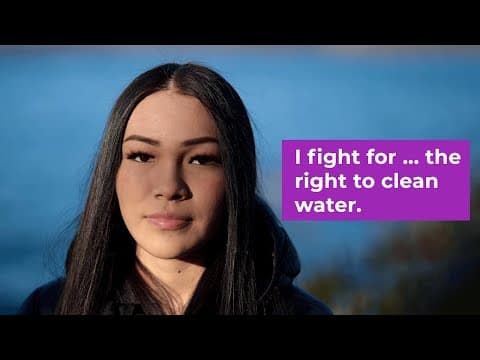
[0:00]We go out and pray for the water because the water is sick and it's it's contaminated and we we basically just do the water ceremony to um pray for it for hopefully one day that they um that the water is clean.
[0:27]My name is Autumn Pelcher. Um, I'm the chief water commissioner for Nishik Nation. I'm 16 years old. Um, I'm from Mann Island and I I'm currently living in Ottawa.
[0:39]I'm doing this work as we can't just pray anymore. We must do something and we need to do it now.
[0:45]Water is a basic human right. Everyone deserves access to clean drinking water, no matter what our race or color is, or how rich or poor we are.
[0:52]When I was 8 years old, I was um attending a water ceremony in a First Nation's community. I asked my mom to go to the washroom and all over the wall said, don't drink the water, not for consumption, boil water advisory.
[1:10]And we had to use hand sanitizer after using the washroom. And I was very confused as to why it was like that. So I asked my mom, what is all of this mean? Why can't we drink the water? Why can't we wash our hands?
[1:15]And then she explained to me what all of it meant, what a boil water water advisory was and that the community that we were in has been on a boil water advisory for over 20 years.
[1:30]I visited a First Nation's community. I think last summer and it's Awa at First Nation. They're a northern community in Ontario.
[1:39]And I had a chance to speak with the youth there and honestly, some of the things they had to say were really, they were heartbreaking. They were really sad.
[1:46]One of one of the kids said to me that they that they she feels bad that her grandparents who are both over 70, have to walk every day 2 km with buckets of water to get their water from a well that everyone in the community has to share.
[2:00]And honestly that's terrible. Like you I went there and you wouldn't even think that you're in Canada. It's it's they're living like I said, they're living in third world conditions and we're in a first world country. It should not be like this.
[2:15]In 2016, I was um at the Assembly First Nations in Gatno, Quebec and I kind of, I guess you could say I told off the Prime Minister when I was 12 years old.
[2:28]And that's honestly one of my one of my big proudest moments that I constantly look back to because I felt like I really made an impact when I when I spoke to him.
[2:37]I was told to not say anything to him just to give him the gift, but um there was something in me that like this is my opportunity to say something. So I took I took the opportunity and I said I'm very unhappy with the choices you've made and broken promises to my people.
[2:52]And then he said I understand that. And then I started crying. He said he will protect the water. And so with like with that, I'm going to hold them accountable to that as long as he's Prime Minister because that's a strong promise to make, especially to a person like me.
[3:12]I like to say that's when you know something is wrong is when a child speaks up and that's when you you have to do something to fix it because we shouldn't have to be speaking up.


