[0:00]When we investigate land cover using the instruments aboard Landsat satellites, we collect sets of data for different wavelengths. Some are in the infrared, and others correspond to blue, green, and red visible light. We can combine any three of the images to create different depictions of Earth's surface. What you're seeing now is a Landsat image of Florida, made with data from the blue, green, and red visible wavelengths. We call this a natural color image because it looks approximately like what we would see with our naked eye if we flew far above Florida.
[0:51]But we could choose data from other wavelengths and map them to blue, green, and red colors to highlight different features of the land surface.
[1:09]With this particular depiction of the multi spectral data, for example, we can see much greater contrast between trees and shrubs and sawgrass marsh than was apparent in the natural color image. We call certain combinations of wavelengths false color images, because they do not replicate what we see with the naked eye. Yet, they allow us to create images where we can highlight or enhance different surface features.
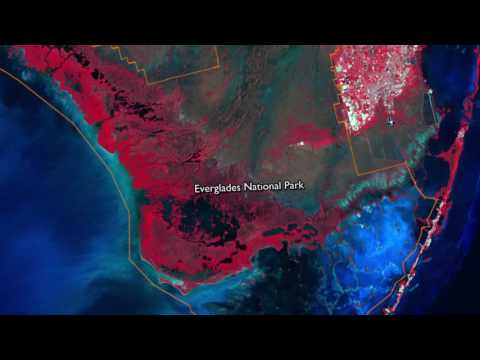
[1:42]The following depiction approximates the type of image that you can get from color infrared film. It turns out that vegetation, growing active vegetation, reflects a lot of light in the near infrared, and so areas with healthy growing vegetation jump out as red in these images.
[2:09]You can easily distinguish the healthy agriculture more clearly than you can in the true color image. Here, you can look at these three different depictions of the multi spectral data we use to create these images. And you can see how the surface cover appears different with some features enhanced in the different depiction.


