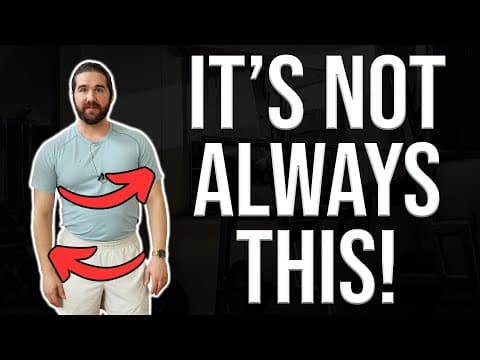
[0:00]So the other day I'm at the gym, and I saw something pretty weird. I'm in between sets of front squat or deadlift, trying to look busy on my phone, but really just trying to catch my breath. And out of the corner of my left eye, I see someone doing a really strange exercise. And that was a 90-90 hip lift. But that wasn't just any 90-90 hip lift. It was actually a 90-90 hip lift with a left arm reach and a left knee shifted forward. Now, if you're someone that's brand new to this channel or you just happen to click on to this video, you probably have no idea what I'm talking about or why this is weird. But if you're someone that's watched this channel or other channels that are similar, then you know that this is actually a bit out of the ordinary. And the reason is because usually we're going to be doing a 90-90 hip lift with a right arm reach and a right knee shifted ahead of the left in order to address what's known as a left AIC pattern. And if you don't know what a left AIC pattern is, it's a term that was created by the Postural Restoration Institute to describe a pattern of muscular activation and movement and posture and positioning in which we tend to stand on the right side of our body in this right stance position, and the left side of the body tends to come forward. Now, in this case, I was observing this person, as I have many other people, who have a pattern that is exactly opposite to this. Well, not exactly opposite, because there are actually a few shared characteristics between this left AIC pattern and the pattern that I'm going to talk about in today's video. But there are a few important differences here that you need to take into account because if you don't and you just use those same PRI standard exercises, adductor pull back, 90-90 hip lift with hip shift, et cetera, et cetera, you're actually not going to make any progress in the right direction. And in fact, you could be doing the exact opposite of what you want to do to actually see the results that you want. So, without further ado, we're going to break down what this pattern is. We're going to show you how it is similar and how it's different to the left AIC pattern, and then we'll finish up by talking through some exercises that you can use today to get real-time results. All right, so without further ado, let's jump right in. All right, so to start off, let's go ahead and review what a left AIC pattern is. And then we're going to compare and contrast this left AIC pattern to the pattern that we're talking about in this video. So when we're talking about a left AIC pattern, it all starts here with the diaphragm. And the diaphragm in a descended and inhaled position tends to cause extension on the left side of the body that then tilts the pelvis on the left side forward relative to the right. This extension on the left side of the body then orient the pelvis towards the right, and then causes a counter rotation chain reaction through the middle part of the trunk to make the left side relatively more expanded and the right side relatively more compressed. As we do this, we get a shift in the center of gravity over towards the right leg, so that the pelvis comes closer to the right leg into adduction, and further from this left leg into abduction. What that ultimately starts to look like is someone who's stuck standing on their right leg with the pelvis turned towards the leg and then the trunk counter rotated. This is the right stance position of gate. Now, in this scenario, what we often want to do is get on to the left side and restore a left stance position of gate by working positions that directly oppose everything I just described. So what you'll often times see is exercises like a 90-90 hip lift with a hip shift, right knee coming forward or right arm coming up to be able to turn the body back towards that left side through the pelvis, then to get that counter rotation back into right trunk rotation to open up expansion on the right side and create compression on the left side. Now, unfortunately, that's not going to work for everyone. And if you're in the pattern that we're about to go over in a second, this is certainly not going to work for you. Now, before we talk about why this won't work, let's talk about a couple of similarities that you're going to see here between that left AIC pattern and the pattern we're talking about here. So we said that in a left AIC pattern, this left side gets opened up like this, which is expanding the left side and relatively compressing the right side. And that compressive position is going to be normal when we're in a right stance phase of gate. But if we think about fluid inside the body and how it flows, it's going to tend to flow towards where we have more space. Let's use this squishy toy to visualize this, imagining that if I compress this right side enough, I'm going to get a shift of fluid over towards that left side. Now, if I'm in that right stance position and I clamp down enough, I'm going to create space here on the left side. Now, if I create so much compression on the right side that I'm super oriented to the right in the pelvis and super squished down through that right side, I might start to even have trouble bearing weight on the right, and I might get my center of gravity pushed over here to the left so far that I start putting down weight into the ground through that left side. And in this pattern, that's exactly what's going on. We still have a tight compressed right side, but we get so tight that we're shifting the fluid elements over to the left, and that shift of fluid elements to the left transfers that center of gravity towards the left leg, and it then becomes more comfortable to stand over that left leg as opposed to the right leg. Now, in this case, what you're going to see is so much compression on the right side that the spine actually starts to counter rotate back towards this left side. If you look at someone with this pattern from the back, they're often going to have the appearance of a more prominent left side because the actual vertebrae are twisted back towards the left versus the right.
[6:05]So they're going to have more extension here on the right side than the left side, completely opposite of what you'd expect to see in that left AIC pattern. Now, the reason that this is important is because if you do right arm reaching activities to turn the pelvis and rib cage more to the left, you're just going to reinforce this same shift of the center of gravity over towards that left side. And this means that you're just going to make more compression happen in this right lower quarter and the back of the right pelvis, making it even harder for you to re-establish the ability to load down through that right side. So the good news here is that as a first step, what we can do is take some of our traditional PRI type exercises and begin to flip them. So if we get into a 90-90 position and do a left arm reach to start to turn the trunk and pelvis back towards this right leg, we can actually get the spine to rotate towards the right and open up a little bit more on this back of the right side. As we do that, if we can restore internal rotation at the pelvis and get the back of this pelvis to open up, we're going to start to be able to more confidently load into that right leg. Now, the really important part here is that as we do this, we do need to take a little bit of an attitude from this left AIC type program and involve our left abdominal obliques. What we need to do here is we need to actually pull the obliques in to shift those fluid elements over here into the right side of the abdominal cavity, which is going to then open this side up a little bit more as we're rotating towards that side.
[7:42]That's going to create a spacious expanded position within this right abdominal cavity, which will then create space for us to compress into. So by doing this initial movement of reaching towards the left, pulling those left abs in to translate the guts over towards this right side, we are going to get into external rotation first, expanding this side. And then we'll be able to create internal rotation to compress down and produce force without collapsing and shifting all the fluid elements back towards the left. So now that we understand the underlying differences between this pattern and the left AIC pattern, let's go ahead and jump into a sample exercise progression that could work for you to be able to re-establish balance within that abdominal cavity and regain the ability to load through that right side. So earlier in the video, I mentioned that with this pattern, we can take traditional PRI exercises and just flip them around, and often times we can get pretty good results. And while that's true, there's a couple of reasons that I think we can do a little bit better. And the biggest of those reasons is the change in shape in the rib cage. And specifically what I'm talking about is that as we get more and more compressed on this right side, we go from this nice rounded kind of a shape like this to a more flattened out shape. So we can see we get a little bit wider side to side on this right side, but a little bit more narrow front to back. And the reason for this is increased compression in the muscles on the front and the back of the right side, as well as the diaphragm. All of this tension together on the right side creates this shape, and if we just take our PRI exercises and flip them, often we'll just be rotating this whole system as a unit like this, rather than actually creating that shape change back towards a more cylindrical shape. So instead what we want to do is we want to take this kind of a shape and use gravity as well as external constraints to our advantage, and use something below here on the rib cage, while we're in a right side lying position, to flatten that rib cage out, as well as get those guts to move from left to right. So we're going to go through a variation here where we do just that. So we're going to start off here with a foam roller under the right side, and that's going to take that really narrow front to back kind of a shape and wide side to side kind of a shape, and it's going to start to bring it back to that cylinder. Then we're going to take a kettlebell in the left hand. We're going to take off our watch so that we don't scratch it. We're going to hold that kettlebell up into this position, and then we're going to do a series of breaths. We're going to first exhale and allow ourselves to sink into the foam roller as we gently engage the left ab wall. This can be a little bit uncomfortable at first because it's almost like you're laying on a pointy edge of the rib cage. So if that's the case, just do as much pressure as you can and use this right arm to modulate that amount of pressure if needed. Then from here you're going to take a nice breath in, will remaining heavy on the foam roller. That's going to allow expansion to happen front to back on that right side, rather than just getting pushed up off the foam roller. You're going to want this to be a nice easy gentle breath in so you're not over engaging that right diaphragm. Nice gentle breath in, feel front to back expansion on that right side, then exhale, sink down.
[11:54]Twisting the palm back down towards the foot. Nice inhale. Exhale. We're really sinking down, once again, engaging that left ab wall a little bit. You can keep the legs into a straightened position with the top leg in a bent position with the bottom leg. It doesn't matter quite as much for this particular activity, uh but just make sure that you have some semblance of contact and support with the ground. If you feel like you need even more support, you can take your top foot and put it against the wall. Now, one of the things that's a bit counterintuitive about this situation, is that we actually do need some abdominal activation on the right side. Many times in this pattern, we've got a right side bend kind of a position, which then shifts fluid elements to the left, so we do need to expand the right side first. But once we're in that position, we're again, due to that shape, going to want to compress the outside of that rib cage to then get more of that cylinder shape front to back. Now to address that, we want to use a right sideline oblique type exercise, but with a few important modifications. The first of which is that we're not going to be crunching up into this position like we would normally. But instead, we're going to stay a little bit longer from the pelvis up to the rib cage. We're going to maintain that length as we're pushing up and away from the ground with the hips. What we can also do is we can also shift our left knee slightly forward relative to the right, which is going to help turn us back towards that right side and further open up that right low back area. So once we're in this position, we're going to drive down through hand, forearm, elbow, as well as knee, and we'll do that all on an exhale. And as you'll see here, I'm still maintaining length between the rib cage and the hips. I'm not crunching together like this, but instead I'm staying long. I'm going to do an inhale on the way down, exhale on the way up. Inhale on the way down, exhale on the way up. You want to go nice and easy with the breaths, easy quiet in through the nose. And then aside through the mouth as you come up. So this standing activity we can use to reinforce this cue of pulling the left abs in and translating those guts over towards this right side. We're going to do this first by setting up with the feet about 7 to 10 inches away from the wall. Then from here we'll do a slight tuck of the pelvis backwards as we exhale and get the ribs to come down. Now, once we're in that position and we're not quite so extended, we've already started to get guts coming over towards the right. We can think about letting this right hip relax down, and then we can think about bringing the left arm forward to start to turn this trunk back towards the right. We're also going to be exhaling as we do this. Exhale and reach. We'll pause here, hopefully feeling that the low back and lower aspect of the rib cage has come closer to the wall without crunching down at all. So we're then going to inhale in that new position and feel this expand into the wall. Then we can repeat the reach on an exhale with the left arm. Now, we should feel like we get the ability to bear weight through that right leg back in addition to that weight that we already had in the left leg. We can then repeat this for a series of reps, and at the end, when we're done, we want to push down through the ground and through both heels, making sure we feel the left heel as well as the right heel to come up the wall. Then we can walk away and get used to this feeling of being able to come back over towards this right leg without feeling like we tighten up and get shifted back towards the left. Now, one of the other things that's important to understand about this pattern is that many times because we get so compressed on that right side, we start to actually get that right side turning back towards the left. And if we do that enough and we turn back towards the left, the back of this right hip can get very gummed up here where those deep hip external rotators and lower glute fibers are. This is going to decrease our ability to achieve internal rotation in the pelvis, which is necessary for our ability to be able to achieve that right stance position without any sort of compensations. And one of the compensations you'll see here that's really common is a right hip hike, which is just substituting for that lack of internal rotation. Now, unfortunately, if we're turning to the right and we're hiking that hip, not only do we further tighten this lower area here, but we also continue to encourage that shift of fluid elements over towards the left side, making it harder for us to load through that right side without a compensation. So what we need to do is we need to take those skills we learned on the wall, getting those left abs to kick in and shift fluid elements over towards the right, and then we have to do something to be able to restore that internal rotation position of the pelvis and the upper leg. Now, we have a couple of options here. We could choose a squatting variation or a hinge based or deadlift based variation. But usually what I find is a deadlift variation with a slight emphasis on trunk rotation to the right seems to be the best first step. So to do this deadlift, we're going to stagger this right foot back relative to the left. We're also going to think here about keeping the pelvis pointing forward. Now, the reasons for this are quite involved, and this is something we're going to get into inside my program total body restoration. So if you want to dive deeper, go ahead and join the waitlist now, but we're going to use a left arm reach here to encourage a little bit of right trunk rotation as we come down. We're going to be bringing this kettlebell down towards the inside of the right knee, but I want you to think about keeping your pelvis square as you shift back. So you're not trying to turn your pelvis towards the right leg, you're trying to keep it square, coming straight back, bringing this kettlebell to the inside of that right knee. We'll take a nice breath in here. Exhale, shifting straight back. We're going to feel that right heel, and we'll feel that right glute engage a little bit, while it's being stretched and loaded at the same time. And while we're doing this, we want to see if we can reach our sit bone back and keep this right lower back area a little bit more open. That spine's going to be turning towards this right side, which is going to help open this area up, but we want to make sure we're not crunching down there as well. So then once we're in this new position, we're going to take a breath in. Then we'll exhale, we'll drive down through the right inner heel, as well as the inner part of that foot up to the base of the big toe, and we're going to extend the hip by pulling that sit bone down to return to the start. We should feel hamstring and glute engage on this side if we're doing it correctly. So, what we're going to do, we're going to pull those left abs in a little bit, which is going to start to shift that center of gravity to the right. We have our hips square here, the kettlebell's coming in front of the knee as we're shifting back, keeping the hip square while the trunk's rotating right, that really helps to open up this area, and the breathing sequence is going to be nice breath in. Exhale back, feel hamstring and glute on the right. Inhale in the new position. Exhale, push down through the ground in through that inner aspect of that right foot. All right, so there you have it. This is not a left AIC pattern that we're dealing with, but actually something different. The similarity is that we are going to tend to be more compressed on the right side and expanded on the left side, but instead of bearing weight through the right side, we're going to tend to bear weight through that left side. This means that we need to apply different exercise techniques to get back to a more symmetrical and neutral position, and once we do that, we can progress to other activities in the gym, so we can move and feel our best. Now, if you want to move and feel your best and understand all the assessment techniques, all the breathing strategies, and much, much more, then go ahead down to the link in the description and click to join the wait list for total body restoration. This is going to be a 12-week group coaching experience. I hope to see you there. All right, so that does it for this video. As always, like, comment, share, subscribe, watch more of the videos, help the algorithm out, all the good stuff. Until next time, peace.