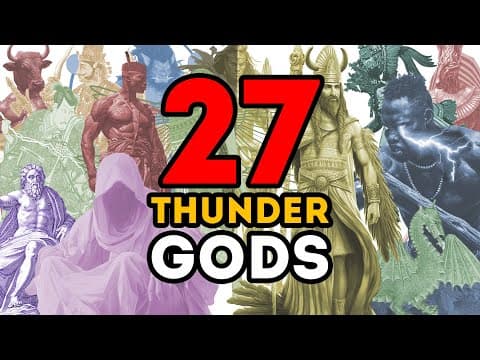
[0:00]Raijin. Raijin is a prominent figure in Japanese mythology. His domains are over thunder, storms and lightning. Raijin is most often depicted as a powerful and fearsome deity with a demon face standing on a cloud with a circular set of drums with which he unleashes his mighty thunder. He is often shown alongside his brother, Fujin the Wind deity, who uses his bag to create strong winds. The two of them are said to have stood against the Buddha, and it took 33 gods to defeat them in battle. Perun. Perun, as we mentioned in our God of War video, is one of the most important gods in the Slavic Pantheon. He is the God of thunder, war and justice. As his role of the God of thunder, he wielded a mighty axe or hammer, like a later god in our list, but could also fire thunderbolts through his stones or arrows. Despite the Christianization of the Slavic regions, elements of Perun's mythology persisted, sometimes blending with Christian beliefs. Slavic Christians created a new saint called Elias the Thunderer, mixing Perun's mythology with Old Testament tales of the prophet Elijah riding across the sky in a chariot of fire. Amadioha. Amadioha is the thunder god of the Igbo people, who come from Southern Nigeria. As well as thunder, he also has domain over lightning and justice. He is an Alusi, a type of deity that lives in the ancestral realm with Chukwu, the supreme God of the Igbo Pantheon, who, along with five other Alusi, Amadioha, is considered an extension of. He is one of the most fearsome of the Igbo gods, striking wrongdoers with his thunderbolts and is often accompanied by his sacred animal, the White Ram. Enlil. Enlil held a prominent place in the Pantheon of Sumerian and later Acadian and Babylonian mythologies. He is a God of storms, along with being a God of the wind and Earth. His most powerful weapon was his breath, which he used to summon winds, storms and heavy rain. This made him the most powerful elemental deity. In the Epic of Gilgamesh, the hero Gilgamesh and his companion Enkidu kill the Bull of Heaven, and Enlil decides to kill Enkidu as penitence for the Bull. Zeus. Zeus reigns supreme on Mount Olympus as the king of the gods in Greek mythology. His domain over the sky, heavens and thunder came to him as a result of the Titanomachy, a 10-year war between the Titans and the Olympians and their allies led by Zeus. He sits alongside his wife, the queen of the gods, Hera, in a golden floored palace at the top of Mount Olympus. In contrast to our modern viewpoint, Zeus was mostly seen by the Greeks as a wise ruler, repeatedly having to intervene in disputes between the gods. Ukko. Ukko holds a central role in the ancient Finnish mythos, being the god of thunder, heaven and the supreme God, or Golden King, in the Finnish Pantheon. Some of his most iconic weapons are the stone sword, a fire sword and his most powerful, the Ukonvasara, a boat-shaped axe. He lives in the center of heaven, providing beneficial rain to worshipers for their crops, but he could also use his iron hailstones to protect his people and strike their enemies dead. Taranis. Taranis is a thunder god venerated in the ancient Celtic religion, particularly the Gauls. His name comes from Irish Torann, meaning thunder. A mysterious figure he was said to represent stormy weather and established a sacred trio alongside the Irish deities, Esus and Toutatis, though this is sometimes disputed by scholars. Lei Gong. Lei Gong, or the Thunder Duke, as he is called in Chinese, has domain solely over thunder, but he has a retinue of deities to assist him with other aspects of the weather. This includes his wife Dianmu who uses flashing mirrors to cast lightning, and Yuzi who causes rainfall with his sword. Often portrayed with an ugly face, claws and blue skin, he strikes a fearsome appearance, but he is also very clumsy. One legend tells of the time he got stuck in a tree, so a young boy rescued him in exchange for a reward. Lei Gong gave him a magical book that let him cast thunder or cure disease. Lei Gong then protected the boy from then on in honor of his rescue. Sugaar. Sugaar, also known as Maju, is the pre-Christian Basque deity of thunder and lightning. He is considered the consort of Mari, the supreme goddess in Basque mythology and the goddess of the Earth and nature. Most often depicted as a serpent or a dragon, Sugaar is believed to move through the clouds, creating storms and thunder with his presence. Tlaloc. Tlaloc is a significant deity in Aztec mythology, and he is primarily associated with rain, thunder and agriculture. He was often prayed to for good weather to create a bountiful harvest. However, Tlaloc's role was not solely good. In Aztec mythology, there are five ages or five sons, with us currently being in the Fifth Age. Once each of these ages was destroyed, the next would be created. Tlaloc is said to have ruled over the Third Age, but ended it in a rage with his lightning and fiery rain. Thunderers. In the mythology of the Iroquois nations, the Thunderers are a group of powerful and sacred brotherly entities associated with thunder, lightning and storms. The oldest brother is known as He-No or Hinon, and he leads the Thunderers, often helping humans, especially those who burnt tobacco in his honor. He often defeats monsters and serpents for people, including his nemesis, the giant snake, Oniare. The Thunderers are also part of Blackfeet mythology, where it is said they are able to turn into huge birds. Shango. Shango is a prominent deity in the Yoruba religion, which originates from the Yoruba people of Southwest Nigeria. Shango's domain is over lightning, dance and justice. He is an Orisha, a type of ancestral deity or lesser god, below the supreme God of the Yoruba Mythos, Olodumare. He is said to bellow with a voice of thunder and can breathe fire. His main weapon is a double-headed battle-axe, but he could also use his Bata drums to summon a storm. Kanehekili is a deity in Hawaiian mythology, specifically associated with thunder, lightning and storms. He is the brother of the Hawaiian goddess of volcanoes and fire, Pele. Kanehekili has a body that is white on one side and black on the other. The last independent king of Maui, Kahekili, was tattooed on one side in honor of this, to show that he belonged to the thunder god. Ajisukitakahikone. Ajisukitakahikone is an important god, or Kami, in Japanese mythology. He presides over thunder and agriculture. He is the son of the Creator God, Izanagi, and the goddess of death and creation, Izanami. He is often portrayed as an ill-tempered baby who screams so loud that the gods have to climb up and down a ladder to soothe him, which explains the sound of growing thunder. Hevioso. Hevioso is the African Vodun, or Voodoo, God of thunder in Benin. Alongside being a God of thunder, he is also seen as a deity of rain and heaven. He is seen by many as the Vodun equivalent to the Yoruba God Shango, but he often is pictured with more of a minotaur-like appearance with a bull's head and the body of a man. It is said that he is incredibly powerful, but has a strong temper. Worshippers invoked him when they had a terrible injustice or crime committed against them, hoping that he would strike them down with his lightning. Indra. Indra is a major deity in the Vedic tradition, and one of the principal gods in Hinduism. In the Rigveda, he is the king of the gods, or Deva, with powers of lightning and rain. He often rides in a chariot pulled by horses with his charioteer Matali driving, shown here offering Indra's chariot to the God Rama. Other times he is pictured atop his white multi-tusked elephant, Airavata. He wields the sacred weapon, Vajra, which is a rounded club with the ability to shoot lightning bolts, which he uses to slay the serpent demon of drought, Vritra. The portrayal of Indra changes in post-Vedic Hinduism, his status is demoted to a demigod, and Indra is eventually seen as a role rather than a divine being. Hadad. Hadad, also known as Baal, is a deity from Mesopotamian mythology. He is the God of thunder, hurricanes and fertility. He is seen as both a giver and destroyer of life. He could use the weather to water crops and feed the people, or use his thunder and storms to wash away his enemies. Hadad's sacred animal was the bull, so he was often seen wearing bull horns with an axe and thunderbolt in his hands. He famously battled the god of the dead, Mot, which resulted in Hadad's death and resurrection and eventual surrender by Mot to Hadad. Thor. Thor is a prominent deity in Norse mythology, known as the God of thunder, sky and protection. Thor is typically depicted as a huge red-bearded warrior who wields his war hammer, Mjolnir, which would not miss the target if thrown. Thor is seen as a protector, both of humans in Midgard and of the Asir gods in Asgard. In Norse mythology, Ragnarok or the end of the world is inevitable. During this time, the Norse believe that Thor will battle Loki's son, the giant serpent, Jormungandr, and will eventually defeat and kill him. But Thor will take nine steps and succumb to Jormungandr's poison and die too. However, it is said that Thor's sons, Modi and Magni, shall survive Ragnarok, and will wield Mjolnir in his stead. Surprisingly, some believe that Thor was not originally associated with thunder. This comes from the fact that he was not directly shown to change the weather in either the Poetic Edda or the Prose Edda, which are two important sources used for knowledge of Norse mythology. However, Thor's name comes from Old Norse Thior, meaning thunder, and there are other sources in which Thor has a relation to lightning and other aspects of the weather. Like many mythologies, mostly based on oral tradition, it can be difficult to discern the truth. Summanus. Summanus is an ancient Roman God primarily associated with nighttime thunderstorms. Summanus, as the God of nocturnal thunder, stands in contrast to Jupiter, the Roman counterpart to the Greek God Zeus, who, as well as being the king of the gods, was the God of diurnal thunder. Summanus is often associated with the more mysterious and violent aspects of storms that occur during the darkness, which reflects his position in mythology as scholars know very little about this god. Chaac. Chaac is a deity coming from the Mayan civilization, particularly those of the Yucatan region of Mexico. He is the God of rain, thunder and lightning. He throws his lightning axe and serpents at clouds to expel rain. He is often depicted with a human body, long fangs and covered in reptilian scales. Human sacrifices were thrown by Mayans into watery pits known as Cenotes, as offerings to Chaac, with any lucky survivors being seen as oracles by the Mayan people. Takemikazuchi. Takemikazuchi is another thunder deity in Japanese mythology. Besides being a God of thunder, he was also a sword God and patron of martial arts. Takemikazuchi is famously associated with the foundation myth of Sumo Wrestling. According to the myth, he engaged in a legendary sumo match against the deity of wind and water, Takeminakata, establishing the beginnings of Sumo Wrestling. He is also often pictured atop the catfish Namazu, who he is eternally tasked to subdue. When Takemikazuchi loses his concentration, the giant catfish is said to cause earthquakes with his thrashing. Suri. Etruscan mythology is one of the more mysterious systems of belief in history. Suri stands out as the God of the Sun, thunder, volcanoes and the underworld, but little is known about him. He has been linked to the Greek God Apollo because of his solar aspects, and his sacred animals were wolves and goats. But little more can be said about this mysterious deity. Astrape and Bronte. In Greek mythology, the twin goddesses Astrape and Bronte are personifications of lightning and thunder, respectively. They are the stewards and shield bearers of Zeus, with the bright-eyed lightning goddess, Astrape, carrying and taking care of his thunderbolts, and her sister, the stern-faced Bronte, bringing him the booming sound of thunder. Set. In Egyptian mythology, Set is a complex and morally questionable deity associated with chaos, storms, deserts and foreign lands. One of the most well-known myths involving Set is the conflict with his brother Osiris. Set, motivated by jealousy and a desire for power, kills Osiris. This then leads Osiris's son Horus to seek revenge against Set for his father's murder. This divine conflict between the two is a central theme in Egyptian mythology. Eventually, after a long and harrowing series of events involving assault and a lettuce, Osiris is resurrected, and with the help of his reborn dad, Horus is declared the victor over Set. Tarhun. Tarhun is a Hittite and Hurrian God associated with the sky, storms and fertility. He was the most important God in the Hittite Pantheon, sitting next to his wife, the goddess of the Sun, Arinna. A powerful and fearsome God, he is said to have slayed many demons with his club or axe. Because of this, Hittite kings such as Muwatalli II, claimed him as their personal God, and a city Tarhuntassa was named after him.
[14:12]Susano-o. Susano-o comes from Japanese mythology and is particularly important in Shintoism. He is known as the God of sea and storms. Susano-o is one of the three most important Shinto deities, along with his siblings, Amaterasu, the Sun Goddess, and Tsukuyomi, the Moon God. They are the children of Izanagi and Izanami, the primordial deities who created the Japanese islands. This also means that he is the brother of the previously discussed Japanese Thunder God, Raijin. Susano-o was strong, but bad tempered. He fought often with his sister Amaterasu. This reached a climax when he destroyed her rice fields and flung a flayed pony into her weaving hall, causing her to hide in a cave, plunging the world in darkness. Because of this, he was exiled from heaven. He later redeemed himself somewhat when he came upon an elderly couple and their pretty young daughter. They were sobbing because the foul eight-headed snake demon, Yamata no Orochi had eaten their children. Susano-o then promised to kill Orochi in exchange for marrying their daughter. He laid a trap for the monster using wine as bait. When Orochi neared the wine, Susano-o chopped the beast into many pieces, finding a legendary weapon, Kusanagi, in its tail. Thanks for watching Darkness and Lore. If you have any mythology or history requests or anything else to add, please leave a comment below.