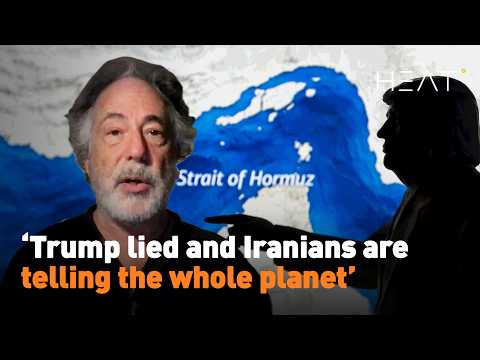
[0:00]Energy analysts say the strikes from Iran and Israel on energy infrastructure, including gas fields and oil refineries could take years to repair. We turn now to Pepe Escobar, he's a Eurasia-wide geopolitical analyst, author and editor at large at Asia Times. Pepe, great to see you. Good to see you. This unprovoked war of aggression by the United States and Israel against Iran has already taken a massive toll, as we've been seeing over the past few weeks. It's taken a toll in the number of people who have been killed. It's also taken a toll on the regional economy in that part of the world as well as in the global economy as well. Then we have President Trump issuing a threat saying that he will bomb Iranian power infrastructure if the Strait of Hormuz is not reopened within 48 hours. Then he backs down on that and says that threat has been delayed by five days. He says there's been constructive talks with Iran, but the Iranians say there's been no dialogue whatsoever. The stakes are very, very high here. Uh, where do you see, uh, this play, how do you see this playing out? Well, he was desperate. He looked at the bond market as well as the oil market and of course the stock market, and the numbers are absolutely horrible, so he had to back down. Five days is to, you know, he's building at, he's trying to buy some time. We don't know what's going to happen after five days, and I confirmed with my best Iranian sources and this was admitted live by the Speaker of the Parliament Ghalibaf. There are no talks whatsoever. Trump is not talking to anybody, uh, political leaders or anybody from the IRGC. There is a spin by Zionist sources that there is a dialogue involving Witkoff and Jared Kushner. They don't know with whom, it's absolutely impossible because at the moment, there is a total cohesion among the different, um, let's say, uh, organs of the new Iranian government. From new Ayatollah Mojtaba Khamenei to the Parliament, to the IRGC, political leaders and military leaders. So Trump essentially lied, and the Iranians are telling the whole planet, the president of the United States lied. If we go back to how this started, Pepe, uh, there's pretty much agreement among analysts and commentators that the United States and Israel, for that matter, thought that this was this was going to be a very quick military, uh, assault that it would be over in 48 hours, that the Iranian government would collapse. They did not anticipate the kind of response that they're seeing from the Iranians. Uh, was it a blunder and if so, how big a blunder was it? Well, the blunder will go down in history as one of the biggest blunders of the young 21st century. This war was basically concocted by, um, Bibi Netanyahu, by, uh, Jared Kushner, married to Ivanka, uh, Trump's, uh, uh, daughter Ivanka. By the way, she is the brains in the relationship, not Jared. Uh, Jared is making money out of this because this involves, uh, his dealings with Saudi Arabia. Saudi Arabia already paid two billion dollars to Jared when he left the first Trump White House, so he could set up his affinity partners. And now he's making more money, five billion dollars from the Saudis once again, uh, in projects in case Iran, there is a regime change in Iran. So they, essentially, these are the people who convinced Trump to launch a war with no preparation, with no planning, and against the advice of his own military and most people at the Pentagon with the brain. So it's no wonder, it could never last 48 hours and on Monday he'll do a mission accomplished and the stock markets will go, will go to the roof. No way, what happened is that they never calculated that Iran was ready for this war for at least 20 years. Iran started preparing for a war like this in the mid 2000s, at a time many people remember that the Americans wanted to bomb, bomb, bomb Iran in the words of John, the late John McCain. So they are ready and half an hour after the decapitation strike against Ayatollah Khamenei and the political leadership, they started their counter punch, and it has been relentless. Soon they're going to be in their eighties, uh, mission part of true promise for their operation. And obviously this caught the American Israelis completely unprepared because they never had not even a plan B, they they never had a plan A. How to launch a war, a high-tech war against an adversary that shoots back. This is not Libya, this is not Afghanistan, this is not Iraq. We're now in the fourth week of this conflict and we're already seeing the impact on countries around the world. We've seen sharp rises in the price of oil, in the price of gas as well as you've pointed out. The developing world, uh, has been especially hard hit. What is your assessment of the impact that this conflict is going to have on global growth? It's already having an in an the the top two victims are Europe and Asia. Europe simply has no backup plan for the lack of gas for the fact that gas from Qatar for for Europe, forget it. And they shot themselves in the back because they refused to have gas from Russia. So there's there's no there are no options left, like, you know, Meloni, Prime Minister of Italy, she's going to Algeria in desperation to see if the Algerians have enough gas to sell to Italy. They don't.
[6:26]Everything is already sold, so the situation for Europe is horrible. And for many of Asian nations, for Japan, South Korea, especially, uh, the fact that, uh, oil is not exactly blocked in the Strait of Hormuz. You have to pay a toll. The Iranians basically nationalized the Strait of Hormuz. If you follow a set of procedures, your tanker can cross. Number one, the settlement has to be in Petro Yuan, in Chinese currency. Number two, you have to pay the toll. It can be a, there are several numbers, up to two million, uh, dollars per tanker. And number three, you navigate very close to the Iranian shore line, uh, in Iranian territorial waters. So if you follow these three, this procedure, there's no problem you can cross. So the straight is closed for American and Israeli linked ships and, uh, ships that are linked with hostile nations, including, uh, some European ones, uh, as delimited by Iran. So there is a toll boost working, and this changes the equation completely. So we have Iran installing a toll booth in the most important choke point on the planet, and there's nothing the United States can do to unblock it. They cannot invade it, they cannot bomb it, they cannot, uh, send their ships to the Persian Gulf because they will be sitting ducks. And that accounts for the desperation on the on the Trump camp. And looking at the broader, uh, consequences of this conflict, of this attack by the United States and Israel, uh, we've also, uh, seen a rupture in the relationship between Europe and the United States. The European nations say they want nothing to do with this war. What are the longer-term implications of these differences between the US and Europe? The long-term implications are that the fracture inside NATO and inside the European Union will go bigger and bigger, and the fracture between what we call Atlanticist circles, and that includes the EU and NATO and United States, will also go bigger and bigger. And in terms of the national security strategy of the United States, uh, Europe is an afterthought. It's not important. They're worried about the Western Hemisphere, which is, uh, State Department code for, uh, Latin America, and of course, pressure against China in what they call Indo-Pacific. This is something, it's a Pentagon concept. Doesn't exist, Asia, Pacific. These this is what what's important, and they were thinking, when they were redacting the national security strategy, that the Middle East, which is actually West Asia, could be sub-contracted to Israel and the Persian Gulf monarchies. That's not going to happen after this war. Whatever happens after this war, we're going to have a completely different equation all across the Persian Gulf in West Asia. We still don't know what's going to be, we're going to see an enfeebled Israel, there's no question about that, and we're going to see the Persian Gulf monarchies, at least some of them, starting to think about maybe we should think about a different umbrella to protect us, and that's where Russia may jump in. Pepe Escobar, thanks so much for joining us. Thank you. My pleasure, Anand. Cheers.


