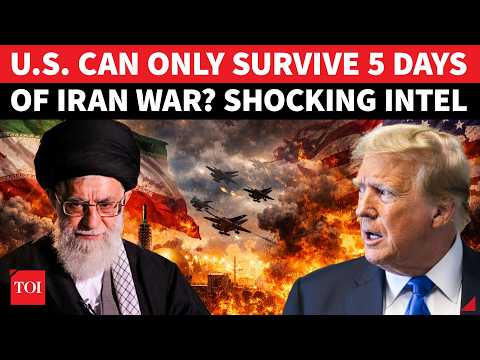
[0:05]A chilling assessment from Israeli intelligence is raising urgent questions in Washington. According to a report by the Financial Times, US forces could sustain only four to five days of intensive military strikes against Iran if a conflict erupts. Even with the deployment of the aircraft carrier USS Gerald R Ford and its strike group, reports suggest America's ability to wage a prolonged air campaign would be sharply limited. The warning comes as President Donald Trump intensifies pressure on Tehran, renewing threats of a very bad day should nuclear negotiations fail. For decades, it had been the policy of the United States never to allow Iran to obtain a nuclear weapon. Many decades. Since they seized control of that proud nation 47 years ago, the regime and its murderous proxies have spread nothing but terrorism and death and hate. They've killed and maimed thousands of American service members and hundreds of thousands and even millions of people. with what's called roadside bombs. They were the kings of the roadside bomb. And we took out Soleimani, I did that during my first term. It had a huge impact. He was the father of the roadside bomb. And just over the last couple of months with the protests. They've killed at least, it looks like 32,000 protests. 32,000 protesters in their own country. They shot them and hung them. We stopped them from hanging a lot of them with the threat of serious violence, but this is some terrible people. They've already developed missiles that can threaten Europe and our bases overseas and they're working to build missiles that will soon reach the United States of America. After midnight hammer, they were warned to make no future attempts to rebuild their weapons program, and in particular nuclear weapons. Yet they continue to starting it all over. We wiped it out and they want to start all over again. And are at this moment again pursuing their sinister ambitions. We are in negotiations with them. They want to make a deal but we haven't heard those secret words. We will never have a nuclear weapon.
[3:08]My preference is to solve this problem through diplomacy. But one thing is certain, I will never allow the world's number one sponsor of terror, which they are by far, to have a nuclear weapon. Can't let that happen. Washington has surged military assets into West Asia, two aircraft carriers, more than a dozen warships and waves of advanced warplanes signaling readiness. But behind closed doors, concerns are mounting. Israeli officials reportedly fear that even a short burst of strikes could ignite a broader regional war, one that risks American casualties and unpredictable political consequences at home. US media outlets including the Washington Post and the Wall Street Journal report internal Pentagon discussions warning of the dangers of escalation. General Dan Kane, Chairman of the Joint Chiefs of Staff, has cautioned that even limited action could spiral into a costly and prolonged entanglement. At the same time, diplomacy hangs in the balance. A third round of nuclear talks between Washington and Tehran is scheduled for Thursday in Geneva. Iranian Foreign Minister Abbas Araghchi says both sides have reached mutual understandings on elements of a potential deal. US Vice President JD Vance has acknowledged progress, but insists major differences remain. Tehran has repeatedly declared its nuclear program peaceful, vowing never to build a weapon. But Iranian leaders have also issued stark warnings. Even limited US strikes would trigger a decisive response. American bases across the region and Israel itself could come under immediate fire. The stakes could not be higher. Four to five days of air strikes. That's the window Israeli intelligence believes Washington could sustain before the risks outweigh the gains. In a region already on edge, one miscalculation could ignite a firestorm stretching far beyond Iran's borders. As negotiations resume and warships patrol tense waters, the world watches, holding its breath between diplomacy and disaster. A new window of opportunity has opened under which we had the second round of the negotiations with the United States earlier today here in Geneva. We are hopeful that negotiation will lead to a sustainable and negotiated solution which can serve the interest of relevant parties and the broader region. At the same time, as demonstrated during the aggression of 13 June 2025, Iran remains fully prepared to defend itself against any threat or act of aggression. The consequences of any attack against Iran will not be confined to its borders. Mr. President, the United States and some European states persist in the imposition of unlawful sanctions, military threats, the engagement in force posturing. And the issuance of explicit references to the possible use of force by the United States, including significant military deployments in the region. Such actions constitute a continuing violation of the prohibition of the threat or use of force as enshrined in article 2, paragraph 4 of the Charter of the United Nations and must be brought to an immediate and unconditional end. Lasting agreements can only be achieved through mutual balanced commitments and respect for the legitimate rights of nations. The treaty on the non-proliferation of nuclear weapons explicitly recognizes the inalienable right of all state parties to develop, research, produce and use nuclear energy, including enrichment for peaceful purposes. This right is inherent, non-negotiable and legally binding. It is not conditional upon political considerations, nor can it be suspended or reinterpret interpreted arbitrarily. Any attempt to portray this right as revocable, fundamentally contradicts the letter and spirit of the treaty.


