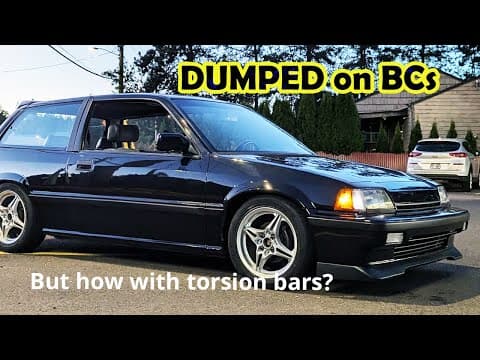
[0:00]Hey, it's Marcus from Hillto coming to you with another video. Um, today we've got this 87 C8, it's a civic up on the lift. And this car is equipped with Tokiko uh blues with ground control coil over in the rear. And I believe some form of upgraded torsion bars here and then Tokiko stretch up front. And we're going to be installing these BC racing coil um in this system. Now, the big deal about these is, they're coil over damper in the front. Um, where the standard car has instead of coil springs, it's got torsion bars. So this situation actually creates a lot of stress for people. They don't want torsion bars, they want coil over, mentally, that's what they understand and that's what they want in their car because they think they can adjust it easier that way. So the coil over have gotten to be pretty popular um, as a choice of suspension for these cars. But there's still a lot of unintended questions such as, do I still need to use the torsion bars with these coil over? Uh, if the answer is yes, then you still have to adjust and work with the torsion bars. So buying coil over suspension gets you nowhere in terms of saving energy uh, dealing with torsion bars. So, we're going to find out a little bit more about that. In a subsequent video, I'll do some driving and let you know how these BC racing coil over actually handle. So here we go. Get ready, heel toe is on the case. So let's get started in the front because I think that's where most people are going to run into their troubles. Anyway, so let's investigate what's going on here. Um in the existing application. This is the strut has already been uh adjusted downward so you can see that this bolt normally would go through the little D-tend that's here on the bottom. But you can get a little extra suspension travel by dropping the strut down into the knuckle more. That's actually kind of a trick that people do to lower these cars a little bit more. Um because you can adjust the height with the torsion bar underneath and I'll show you that in a second. Um but you run out of damper travel. So when the car is on the ground, you basically run out of travel in here. So now uh you can see here there's no bump stop below but it's actually up in the top. Uh and so the travel is sort of limited by how much stroke you have and dropping this down give you more stroke so you can lower the car a little bit more. And then up here we've got um some old what our Medieval Pro camper caster plates. We actually produced these uh here at Heto many many years ago. I think it was like more than 10 years ago now. But these are pretty awesome for adjusting the alignment of the vehicle. Unfortunately, these are not compatible with the BC racing damper that have their own upper mounts. Uh you need to get a special um conical washer for the top of the springs to use the BC racing damper with the spring and these upper mounts. So these are going to have to go as part of our installation. Now the standard height, uh the height of the vehicle is adjusted with this adjusting nut right here. I think I'm just going to install this the way that I think people are going to approach it themselves and sort of organically go through the process of putting this stuff in. So that means I'm going to take all these parts out, put the coilover in and Um on the ground I'll compare them side by side so you can kind of see the difference. So I'm not going to take you through every nut and bolt, you know, process of this. I'm trying to make the video a little bit more concise than a full DIY because I don't think you all need that. I think you know how to use wrenches. Here's the current status. I have the strut out of the driver's side here and put the taco damper on the bench compared to the BC racing one here. Part of what I'm trying to do here is make this sort of like easy for folks to understand who aren't a custom two torsion bar suspension that we have in the car. Trying to explain these two damper to you, it it involves folding together hoping that you know how this stuff works in a double wishbone car and I've talked to enough of you to know that you might only have a mild understanding of that. But bear with me, we're going to go through this and um being Hill to my goal is to try to help you understand this stuff so that you buy and understand appropriately what you're working with. So questions down in the description will give us an ability to have a discussion about it and I could put like a Q&A in the description so that anybody watching this video can kind of like bread crumb their way through people's understanding. So here we go. We got the two stretches side by side.
[4:46]Now, if I had a double wishbone suspension car, I would look at this and a factory one and I would say, all right, cool. This is a lot shorter. That's going to give me lowering, right? That's going to lower the car just by bolting this in. And it's adjustable here at the lower bracket, so I can adjust the height right here and I don't have to mess with my preload and you know, for like an 88 and up CRX or or Civic and you know, almost anything after that, that makes a lot of sense to folks, which is great. Um, but here, we have to understand that there's no spring here, right? The height of this damper doesn't change the height of the car at all. There there is no height adjustment available on this assemble. Now by putting a spring here, right? It kind of gives you the thought of like, well, if I change this color here, I'll change the height of the car. In a certain sense you will, you can kind of force it to do that. But now I kind of have to explain you a little bit more about why this is problematic thinking about this as your height adjustment mechanism, okay? So let's go over to the car. This is the height adjusting nut. And what this does is it adjusts on this stud up above here mounted to the sub frame and And it fine tunes the baseline height of distortion tube. So that's how you set the height of the car is with this adjusting nut. I already um put the BC in at the top, right? So I've got it set up in there and I've got the damper stuck in the strut mount in the knuckle here.
[6:23]Now, if this were a double wishbone suspension car, right? And this knuckle attached to an upper control arm. Then I just loosen the the control arm uh mounting points to relieve bushing tension and then just raise it and then I've got a new new neutral setting for the height of this um damper assembly. Likewise, if this was a strut suspension car that had a coilover damper here, I could do the same thing. Just raise it up and then bolt it in place and then we would be good to go. But that's not the right thing to do here. And the reason why is because there's another spring involved. The torsion bar underneath the car here is attached to the control arm, right? So here's a control arm that I would, you know, be jacking up and be jacking that up, I'm actually twisting the uh the torsion bar. If I raise this control arm, I'm actually putting a twist on this torsion bar and I'm preloading it. So preload, right? People talk about preload a lot and I mentioned in this BC coil over how you can adjust the spring height, right? By uh you know, you're just high down here and you don't affect this, but you could add some pre-load here by pre-compressing the spring. But pre-load is one of these things that's widely misunderstood in uh, you know, your typical, you know, street tuner sort of conversation. So I'm not necessarily going to be getting into pre-load in this video except to say that if you're going to preload the torsion bar in the car and put this coil over in there, it's going to end up feeling pretty stiff because when you add pre-load to the suspension system while it doesn't necessarily change the spring rate or the amount of force required to compress the spring a certain range, what you're doing is you're taking a lot of initial compression out of the spring so that even more force is needed to get the spring to move. In other words, if I put, you know, for argument sake call 500 pounds of pressure here, then it's going to compress the spring a little bit. And if I put 800 pounds, then it's going to compress the spring a little bit more. But if I preload this that initial 500 pounds, then I could put 500 on and it's not going to move. Right? So that initial feeling of of of pressure isn't going to actually do anything on this spring. I would need to put an additional 300 pounds to get to my 800 and then a 500 pound pre-loaded spring would move a little bit because you know, you put an an exceeding amount of force on it. So not to get trapped into the pre-load conversation, that's what's going to happen if you just back up the control arm here and attach the knuckle. So that's not really the right thing to do. We want to make the damper longer to attach it into here. Technically, to get this installed correctly because then we're not adding a bunch of pre-load to the torsion bar which is going to, you know, effectively raise the wheel rate a little bit there and then we've added this spring on top. If you're thinking that I could just move this knuckle up or down if I use the torsion bar adjustment but if you remember, we're already pretty much max low. The way the torsion bar is set now, it needs to be re-index uh in order to get the knuckle up even higher. So this is kind of where we're at. Cooler is installed in the front. So, I did match the overall height of the factory strat or I guess I could say the the torque strat with the adjusted bolt height. The lower control arm is already adjusted to the lower height. So if I put this car on the ground, wouldn't necessarily expected to be any lower at all than where was when I first put this in. Why? Because I didn't adjust the torsion bar. In order to adjust the height on these cars, you've got to adjust the torsion bar. I don't necessarily agree with taking the torsion bar out. I don't feel like that is the right thing to do. Um, especially if you have the stock torsion bar, combining it with this coil spring is going to give you the higher spring rate that you're probably looking for. This actually might end up higher than it was because it has the spring in here as well. The wheels' not going to go up inside the fender as much because it's got the torsion bar and the spring. So, I'm fully expecting this not exactly to be the height that I wanted to be. If I'm trying to lower the car more than it was, you're going to have to do something with the torsion bar. The rear is a totally different animal. Um, if you're used to like an EF or an EG or or any kind of, you know, front rear double wishbone or multi-length control arm Honda, then you know that the rear is not that different from the front. Well, in this case, it's extremely different. So, let's go back to the back and review what's going to have to happen back there. All right, so here is the rear suspension on the third gen Civic. Please don't pay too much attention to the horrible fabrication on this exhaust system. I was in a pinch and had to get something done. Let's not talk about that. Let's talk about suspension instead. So, here we have this beam axle here and as you know, lower probably has informed you that this is hollow. There's a torsion bar inside here. It's connected here and then about halfway through on on this side. So there's like a little bit of a linkage over here that allows some movement. So it's somewhat of a semi-independent rear suspension. The uh axle is located by these trailing arms here and here and then a pan hard bar which goes laterally across here. So the trailing arms keep the axle positioned forward to backwards in the right spot and rotates this way and the pan hard bar is meant to keep it from moving back and forth. It's controlling the lateral movement of this axle.
[12:06]So, uh when you take the suspension out and you move this up so as to lower the vehicle, what happens is is this oil goes like that and has the effect of lengthening this horizontal vector and then it pushes the axle this way. So the adjustable uh pan hard bar is necessary to bring the axle back to center after the car is lowered. And we do want this car to get a little bit more low with these coil over that we've got here from BC racing.
[12:38]Um, but I'm not exactly sure how high it's going to be because you know, we got to get we got to get to work here. So what we're taking out is the Tokiko Tokiko Blues and this ground control setup. Now, ground control made this setup a long, long time ago and something that you might find a little bit odd about this is usually you'll see this adjusting sleeve on the bottom, right? slides over the damper. and then mounts up into the top and that's just how they work, right? But ground control couldn't do that in this vehicle and the reason why is because they're using their standard spring here and it's too small to mount up in the factory spring seat. Here you can see the factory spring seat. Um this is how big the original spring normally is, right? And their spring is too small to go up in there. So what they've done is inverted them Um this leaves goes all the way up into the top where the shogontornally sits and the spring just sits on the bottom. It's same basic principle. They've just turned it upside down because they didn't want to make an adapter for the spring. Now, uh BC Racing has made such an adapter. So because this adapter is meant to go up in that spring seat, then you can use this as a conventional coil over with the threaded body and
[14:02]And uh it's it's double-threaded too, so you can lengthen and shorten this just like the front. And the spring sits down here and mounts up in the seat up in the car. Now, how do these mount in the car? Obviously, you've got the lower bolt right here and you've got the the top nut that's up inside the car, right? So we'll have to get that from up in the top. So the way to do this is actually to put the car on the ground, right? compress the tires just a little bit and that will relieve pressure on that nut so we can take it out. Then when you raise the car, the axle stays on the ground, right? And then the suspension just sort of like stays with with the axle and uh then you can switch it out. All right, I've got the axle supported with a couple of jack stands, just evenly on the sides there. This nut at the top of the shock or strut or whatever you want to call it is what's holding everything in the car. So if I take that nut and that nut out and then raise the car, it's going to leave the axle sitting down here on the jack stands so that I can replace those damper.
[15:15]Okay, you can see it came loose and everything fell apart, but the axle started picking up two, which is because the control arm, the uh the trailing arm is still attached in the front. So it's being picked up by those the bushing tension there. So I'm going to go ahead and put the car back down a little bit and rest it on the uh jack stands and get these damper out and show you side by side with the BCs and how I'm going to end up adjusting those to go in the car. All right, I got the rear damper out of the car. I got them aligned next to the BC racing damper so you can kind of see how they look side by side. And I'm trying to wrap my head around how to adjust these. I actually spent a fair minute uh trying to measure and wrap my head around this, but what ended up being true is the uh spring seat collars had to be adjusted up a bunch, otherwise they were contacting the bracket on the axle.
[16:14]So, spoiler alert, uh I ended up moving the adjustment collars all the way up and I have some measurements for you that I will publish towards the end of this video. We'll mark it down in the chapters below. Now, it's really easy to think of the spring setting the height here as well and it does. But again, the the spring seat goes up into the body here, not to the top of the damper. So it's still an independent height adjustment with the spring versus the versus the strut here. So it's not like a conventional coil over setup where you know, it's all together in one piece because the upper mount is effectively built into the car. I really don't want to over complicate this. I'm kind of thinking out loud when I'm uh telling you about this right here, but it really would be nice if they gave you some baseline settings um on how this goes in. Uh I know that Tan does that. The Medieval Pro set that we offer has some baseline settings in there so you don't have to like, you know, guess. The cool thing is is because the axle supported with these jack stands when I put the car down, the tires don't actually hit the have to hit the ground to hit our spring, you know, our height.
[17:34]I can gauge the height at the fender well once the car is down and bolted together. So you don't even have to take the wheels off to put the rear suspension in, which is kind of unique and cool, I guess. All right, um, like I said, I'm going to put the damper in there with the springs at whatever height. I'm going to play with a little bit and let you know what setting I end up with in the end so that you can, you know, have a baseline since BC doesn't give you one.
[18:15]All right, something that I forgot about is that when you're lowering the car down on top of the struts, you're trying to line up the hole in the body with with the the strut top, you know, just the shaft. And it's like a really small thing that you're trying to aim to that up there. And because the axle doesn't go straight that hand bar is pushing it side to side.
[18:39]Um, I think it's actually easier to attach the shocks and the top first, the struts in the top and then you have the ilit hanging down there and then you can more easily align the ilit up with the with the axle. So I'm going to do that instead.
[19:20]All right, that's looking pretty cool, isn't it? Right there at the tire and uh I think that that's the look that most people are probably going to want to go for with this kit. Uh so I've got the strap mounted in there. It's only hanging on by a bolt here so I could finish adjusting things around, but um yeah, the uh the shock is mounted in there. The spring is mostly seated up in the top. Getting that aligned perfectly is a little tricky and it's actually harder to do when you're suspended by the axle because you can't really move the car side to side. Um really to fix that, we need to adjust the pan hard bar. So the panhard bar coming a little bit, let's see, which direction are we need to move it a little bit to the right. And so making this bar shorter is going to help adjust that. But that's basically where we're at. So, um, in the in the description, I'll put uh a layout of the measurements that I did to get that particular height and that is the height too because, um, it's resting on the axle and there's free space between the jacking here. So it's completely resting on on the axle, right? And so to get this measurement here, I'll I'll give you all the references for that. Uh now the front, I still need to play with some more because I actually found out when I bolted the wheel on that the wheel is contacting the brake line bracket. So I can't get the wheel completely bolted on, which means I can't completely put it down on the ground. Uh so, uh I'm going to play with that next. Now that the rear is kind of at a nice dumped stance, I'm going to play with the front and uh catch back up with you there. But you can see, you know, this is all basically ready to snug down and um and looking pretty cool. I think that that that height there is is pretty sick looking. Now we just got to try to get the front there too. See, that car looks pretty cool. Front and rear lowered pretty aggressively. And that's not cool. Got the rear more or less where I want it.
[21:41]Pretty low, but the front is not low. And I think we already know why. I think it's because what I already said, because there's two springs in there, the torsion bar and the coil spring, it's keeping it propped up. And uh we need to re-index the torsion bar. We have we have to make that lower control arm come up higher without preloading the spring. If I uh come over here and you know, push on this, it's got some compliance, but it's pretty firm. Um, you know, this suspension setup seems like it's going to be firm enough, right? I don't I don't want to make it more than that by preloading the torsion bar. So, if you're going to install a BC racing coil over kit in this torsion bar chassis correctly, you've got to re-index the torsion bar. And I do think it's a little ironic that I think most of you watching this video are considering this coilover setup because you don't want to mess with torsion bars and here you are you're going to have to do it anyway. So, but hey, worry not because he's here, Marcus is here and I know how to do it and I'm going to show you how to do it next. So, this video is a little longer than I expected, but it's also better.
[23:18]All right, back underneath the car and here I wanted to illustrate um something interesting I found. First of all, here's the left side torsion bar tube. The torsion bar mouths into the back of this and the front of it mouth into this torsion arm here. This is called a torsion arm, right? So, so when the bar is slid into this tube and held in the back and held in the front, then this arm is going to be at a certain angle, right? Uh what we're trying to do is remove the bar, move the angle, put the bar back in so that it's at a new higher height, right? That's how you're going to get the arm up to shorten the suspension up above so that the car is lowered, right? But you got to reindex this, right? That's why they call it reindexing because the bar is indexed one way. There's a key way to lock it into one position and we want to remove it, reindex it one to and put it back in. Now, something interesting here, this knob here nut, this is the height adjusting nut. And what this does is it adjusts on this stud up above here mounted to the sub frame and It fine tunes the baseline height of distortion tube. So that's how you set the height of the car is with this adjusting nut. Now, something I found interesting is that the right side one is already indexed, right? The car is sitting correctly right and left, but look at how many threads are showing here on this uh adjusting stud versus here. It's all the way up inside there. Now, it's up inside because this is actually a pretty tall nut. But what you find is that this um this side has already been indexed, so I don't have to do this one. In order to adjust this down, I just need to come in here with this electric impact and go like this. Right? Now when I put the car in the ground, this is going to rotate, hit the nut, you know, because this this arm is going to rotate up, right? It's going to turn turn the torsion tube, the whole tube is going to turn. and uh the car is going to be lower. So, um, I don't really have to reindex this side. Um, or so it would seem. But this side I definitely do have to. The first step in uh taking out the torsion bar is to make sure that the uh the bar isn't under any tension. So when all this is bolted together, it's kind of hard to know, but if you can push up and down a little bit on this, you get some movement out of it, then you know that it's not really. I disconnected the suspension in the top up there and uh you know, when you go when you go to the adjusting nut, you should be able to loosen it a little bit and then have some free space, right? That's what you want. You want it to be able to be loose without um without, you know, having any any pressure on here because basically this is what carries the load when there is pressure on the bar. So the next thing you're going to do is pull that cap off and the cap off in the front. Okay, the cap is off and I can see the end of the torsion bar here and it looks like this is actually a 26 mm bar, which is a really uh rather upgraded bar size for this car. I think they normally come with 19, but at some point this torsion bar was upgraded, which is super cool. So I want to take this clip off of here and knock the bar forward so that I can reveal a clip clip on the front. The clip on the front, I'm going to pull that off too and then drive it back this way.
[27:26]I don't recommend hitting the back of the bar because you can mushroom it out and then it won't want to move at all. So, it's much better to put like a the ball of a hammer here and then hit it like that to drive it out. Uh you can use an air hammer in the front or two, that works out great also. Um, but uh yeah, don't hit it directly because then you can end up having problems.
[28:06]All right. Now I got to take this clip out and drive it back through the other way.
[28:18]The front on the left side is particularly tricky because there's not a lot of room between the torsion bar and the oil pan. So, that can be kind of an aggravating area. Especially if the torsion bar is stuck. Um, these do get rusty and nasty, so you know, if yours is like that, I'm sorry. There's nothing I can really tell you other than you just have to try all the traditional stuff. But, um especially here on the on the left side, it can be problematic. So if this is your first time doing it, I would start on the right just because there's a lot more room to work and and to figure out what you're what you're do.
[29:06]It's it's pretty far out, but now I think I'm going to need a punch or something.
[29:13]All right, here we go. Super long extension.
[29:20]There it is. You Yeah, you can see here the bar has come free and it's out now. And what is this? Power bars by sway away. Sway Away made this. Awesome. Um, so what we've got here on the front is you can see that there's a keyway, right? And that slides into a particular slot on the front of the control arm. And in the back, there's also a keyway here. Now, in order for us to rotate this one, we need to grind out one of these keys in the back. So what I'm going to do is it actually should engage, I think I said this backwards it'll engage in the front before it engages in the back. So, I got to reinstall it so that the keyway is in place.
[30:17]And they'll first grab, right? So that you can drive them in. And then you may have to make another slot in your torsion bar here. We have to move it one tooth. So some aftermarket bars, uh don't have the keyway already there and you have to make it. Uh sometimes the tube has the keyway and sometimes the bar does. These cars are all a little bit different and I'm not really 100% sure why that is, but in this particular car, there's no keyway in the tube. Maybe previous guy removed it already. I don't really know. But the point is is that you're going to try to get the front engaged and then before you can get the rear in, you're going to have to, uh, grind out a spline of this bar or you're going to have to grind out the tooth in the tube. But at the end of the day, the whole point is is that you're trying to move this bar that's, uh, torsion tube up and then slide it in at a new angle.
[32:34]Okay, this is the part of the video where I tell you that I lost all the rest of the content that I captured, um, on the torsion bar situation there. Um, under the Black Civic. So, I'm really sorry for that. But you know what? I think the point is made pretty clear. Everything from that point is pretty much put it back together the way you took it apart. The torsion bar is going to go forward enough that you can put the cirlip on on the outside near the front where the oil pan is, and then knock it backwards to lock that ring in place. Make sure it's centered, right? Get it back into place and put the clip on the back of the tube, on the back of the bar at the back of the tube, right? And then when you put the car on the ground, you're going to fine tune the height with those adjusting nuts underneath the car. So, when you loosen those nuts, it lowers the car. And when you tighten those nuts, it raises the car. So, that's how you're going to get your fine tuning. So, the height isn't really set with the springs of the coil overs or anything like that necessarily. I'm sure that you can fine tune with that, too. But, the next part of it is, check out the the dampers and where you have to set them to get the height that I have. All right, so here's a walk around of the car and you can see it looks really hot. Right? The tire gaps are really tight and uh the car is sitting nice and low. It's not crazy slammed, but it rides and drives really pretty well at this height with these settings that I have. Okay, now to get this height, here are the dampers and I'm also going to lay out the measurements for you. All right, and these are the dampers set to the settings in the car. This is actually another set that I that I used my notes here from installing to set the height, right? So on the front, we completely bottom out the bottom bracket on the damper tube. So this bracket unscrews and screws on. I have a completely bottom out all the way up here and you got about a six or six and an eighth inch spring height. So this is preload on the spring. This should be about six inches or just over it. And then the threaded section in between, this is about 3/8 of an inch in between here, right? So that is the setting for the front that I have with the Torsion bar indexed one tooth and adjusted to about the middle or bottom of the adjustment range. So that's about how low you can get with these damper. You really can't make them any lower because you can't make the damper any shorter. Um, so that's kind of the limit, right? Now on the rear, I did something similar. See, these colors I had too low in the initial part of the video and they were hitting a bracket on the axle. So it worked a lot better with these all the way up and actually at this height setting, the spring and spring seat and everything sits up in the car just so so that there's no drooping of the spring. Right? So what I've done here is this damper is threaded into the base and again, it's bottom out. You bottom out the damper in the base and then this threaded section here from the bottom thread up, it's two and a half inches. Right? So, here's a still of that and uh that way you can take some notes of your own and measure your damper the same way to get the same height that I did on my Civic. And I think that that height turned out really good. And uh honestly, like I said, the car rides and handles really great. That's a good way to set it up. All right, so I've got to apologize for, you know, sort of like the Lackster ending here. You've got the information. I'm now encouraged, I think to make a video specifically about just the re-indexing portion alone. This video is mostly just about putting the BCs in and how you set up the car the best way with those. If you've got some other setup and you'd want to share it, please comment it below. Um, but I think what I'll be doing is a much more concise one, two, three step of the re-indexing process without all the talking and stuff in between. Just for those of you who, um, just want to know step by step, how do I do it, right? In this particular case, I think that there was some good explaining to go along with it given the fact that there's a coil spring in the front and so there you go. Hopefully this was helpful. I think this is going to be helpful. People have been asking me for this video for a long time. I recorded it long ago, never edited it and here it is. So, yay, me for finishing it and we got to get on doing some more videos because, you know, I got this car recently back on the road. This car just freshly mega detailed, it's in gorgeous condition and of course the big elephant in the room, the CRX here, my right hand drive CRX which really truly is, you know, in need of being completed. More on these cars, uh, as my life continues. In the meantime, have a great day. Heto is in your corner and always remember, engage the curve.


