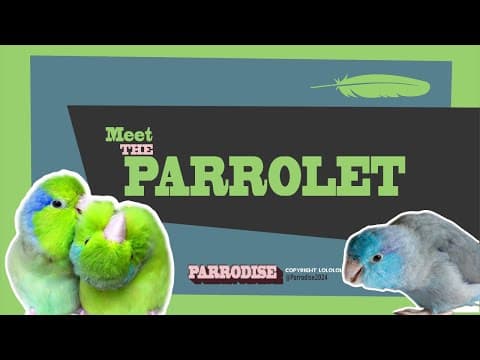
[0:00]Meet the Pacific Parrotlets, scientifically known as Forpus Coelestis. They are by far the most popular parrotlet species due to their availability and bold personalities. These pine-sized parrots are native to South America's Tumbesian region where they roam the dry tropical forests in small, lively flocks. Parrotlets can live around 15 to 20 years, but with the proper care, a healthy diet and lots of attention, they can live a longer life up to 20 to 30 years. Don't let their size fool you, parrotlets have the attitude of a much bigger bird. In fact, their closest relative is the Amazon Parrot.
[0:36]Although Amazons are much larger, the two share striking similarities in both appearance and temperament, packing bold personalities into very different sized packages. Both are full of energy, though parrotlets cannot talk like Amazons, they more than make up for it with their sassy personality. See those striking blue markings? This marking shows that it's a male. Males have bright blue markings behind the eyes, on the wings, and sometimes on the rump, while females lack these blue markings entirely or have very faint ones, usually behind the eyes. Beyond their wild green look, parrotlets come in a wide variety of colors. One of the most common variant is the blue parrotlet, this parrotlet lacks yellow pigments giving it a beautiful range of blue shades, from soft sky blue to a deep cobalt, and even soft pastel blues that can appear slate gray. Another eye-catching variation is the Lutino parrotlet, which has yellow or creamy white feathers with pink or red eyes due to a lack of melanin. The males typically have white wings replacing where the blue would usually be, whereas females have no white on their wings entirely. At the rarest end of the spectrum is the Albino parrotlet, a mix of blue and Lutino mutations. These birds are completely white with pink eyes, feet and beak. Because their coloring removes almost all visual gender indicators, sexing albinos by eye is nearly impossible. If you're drawn to cooler pastel tones, the turquoise parrotlet transforms the typical wild green into a beautiful blue-green blend, featuring a soothing pastel hue that many find unique and calming. Like with many parrots, these color mutations can sometimes hide or soften the typical gender-specific traits. So if you're unsure or planning to pair them, the most reliable and accurate method is via DNA tests. Parrotlets are highly intelligent and form strong bonds with their humans, but they need daily interaction to stay sane. While they can be kept in pairs, a solo parrotlet is usually better for bonding closely with a human companion. Their wild diet consists mainly of berries, seeds and flowers. But in captivity, offer a variety of fruits such as apple, bananas, grapes, orange and kiwi a few times every week. However, like most pets, never feed them avocado, alcohol, caffeine, chocolate, garlic and onions, as these are toxic and can cause death. Always keep these away from them. Unlike cockatiels, parrotlets aren't dusty, but they still benefit from regular baths or misting to keep their feathers clean and healthy. When it comes to housing, their cage should be at least 18 inches in width, height and depth, with bar spacing narrow enough to prevent escape. But a larger cage is always preferred, especially if your parrotlet spends a lot of time in the cage. When setting up the inside of the cage, add a variety of perches, foraging toys and chewable items, as these birds are extremely playful and active. Provide them with a rotating selection of shreddable bird toys made of natural fiber, leather and soft wood to keep them stimulated and prevent boredom. Remember to change or rotate their toys every couple of weeks to keep things fresh and engaging. Make sure your parrotlet has daily supervised time outside its cage for one to three hours. This allows them to stretch their wings, play, and bond with you. However, since they're small, fast, and love exploring, close monitoring is vital. Always prioritize their safety during these outings to prevent accidents or escapes. Bird proofing your home is essential before letting a parrotlet roam free. Block off tight spaces, close toilet lids, cover vents and remove unsafe plants. A safe, tidy space keeps your parrotlet protected and gives you peace of mind. Despite their small size, parrotlets come with a surprisingly big list of challenges that every potential owner should be prepared for. These tiny birds are known for their bold and fiery personalities, which can quickly become overwhelming without consistent training and interaction. Their strong-willed nature also means they won't hesitate to stand up to larger pets, making supervision essential in a multi-animal household. They are relatively quiet compared to other parrots. They don't scream or squawk, but communicate through chirps. While some chirps can be sharp or loud, they're still quieter than budgies, cockatiels, and even canaries. However, their silence doesn't mean low maintenance. Parrotlets are mentally and physically active birds that require constant stimulation to prevent boredom related behaviors like cage aggression or feather plucking. While their size might make them seem like beginner birds, their strong personalities and care needs make them a better fit for experienced owners or those ready to commit time and energy every single day. Overall, parrotlets are tiny parrots with huge personalities, with bold, playful and full of attitude that likes to cause chaos. But their small size doesn't mean easy care. These birds need daily interaction, mental stimulation and out of cage time to stay happy and tame. Without it, they can become moody, nippy or even aggressive. Their quiet chirps make them a good choice for apartment living, but their strong-willed nature and high energy levels mean they're better suited for experienced owners or those ready for a hands-on companion. If you're up for the challenge and committed to meeting their needs every day, a parrotlet can be a bright, funny and loyal feathered friend. And adopting one is a great way to offer a tiny parrot a big, loving home.