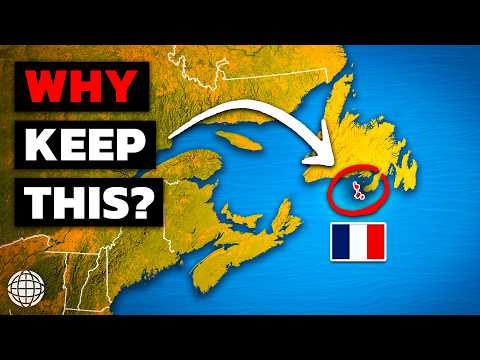
[0:00]North America is home to the massive countries of Canada, the United States, and Mexico. And hidden in a tiny corner is France. These are the islands of Saint Pierre and Miquelon. They're the last remnants of a huge colonial empire, and they're the only reason France is still technically a North American power. But why does France own them? And more importantly, why do nearly 6,000 people call these scraby rock strewn islands home today? Well, to answer that, let's take a look at where exactly Saint Pierre and Miquelon is.
[0:37]To understand Saint Pierre and Miquelon, you have to realize that the name is slightly misleading. It implies two islands. In reality, we're looking at an archipelago of eight islands, though only a few actually matter for human habitation. First, you have Saint Pierre. This is the smallest of the main islands, covering only about 26 square km. It's a volcanic rock dominated by a protected natural harbor that faces the rising sun. And this harbor is key because without it, nobody would live here. The island itself is a relatively low-lying, but rugged and scarred landscape oflite rock that speaks to its volcanic past. It's here that the vast majority of the population lives, huddled together in a town that looks like it was airlifted from Britney and dropped onto a North American rock. Then you have the Miquelon part of the equation, which is where the geography gets fascinating. Miquelon is actually composed of three former islands that have been stitched together by the Atlantic Ocean. To the north, you have Grande Miquelon. To the south, you have Langlade, sometimes called Little Miquelon. And connecting them is one of the most treacherous and visually striking geographic features in the North Atlantic, the Dune. Now, the Dune isn't just a beach, it's a 12 km long sandy isthmus. Centuries ago, Miquelon and Langlade were separate islands, separated by a shol that was a nightmare for sailors. Over time, however, ocean currents deposited enough sand to create a permanent land bridge, fusing the islands together. But this bridge came with a cost. The water surrounding this isthmus are a graveyard. Before modern navigation, hundreds of ships were wrecked in the fog trying to shoot the gap between the islands, only to find that the gap had closed. Today, you can drive across it, viewing the wreckage of holes poking out of the sand, a grim reminder that while the geography here is beautiful, it's not kind. Of course, geologically, Saint Pierre and Miquelon are not distinct from Canada. In fact, they're the strange siblings of Newfoundland. In fact, if we rewind the clock hundreds of millions of years, these rocks weren't in North America at all. They were part of a microcontinent near ancient Africa, attached to the supercontinent Gondwana. When the ancient Lapetus Ocean closed and the continent smashed together to form Pangea, these rocks were welded onto the side of North America. And when Pangea eventually ripped apart to form the Atlantic Ocean we know today, this fragment stuck to Canada, rather than joining what would become Europe or Africa. This means that when you step onto the granite and volcanic rock of St. Pierre, you are walking on land that has traveled thousands of miles across the surface of the earth to be here. But while the ground beneath your feet is ancient, the forces currently shaping it are very much alive, and they are wet. The physical geography of Saint Pierre and Miquelon is defined less by the land and more by the water that surrounds it. The archipelago sits right at the edge of the Grand Banks, a series of underwater plateaus where the water is exceptionally shallow, sometimes only 50 to 100 m deep. This location makes the islands ground zero for a massive hydrological collision. From the north, you have the Labrador Current, bringing freezing cold water and icebergs down from the Arctic. From the south, you have the Gulf Stream, bringing warm, tropical water up from the Caribbean. When these two Titans collide, two things happen. First, they churn up nutrients from the ocean floor. This mixing creates one of the richest biomass zones on the planet. Plankton explodes here, which feeds bait fish, which feeds cod. Lots and lots of cod. This biological geography is the reason Europeans bothered crossing the ocean in the 1500s. But the second thing this collision creates is fog. Saint Pierre and Miquelon are some of the foggiest places on Earth as the warm moist air over the Gulf Stream hits the freezing air over the Labrador Current. It condenses instantly. The result is a thick, impenetrable fog that can linger for weeks. Now, the climate here is classified as oceanic, but only just barely. It's windy, wet, and raw, and the islands are battered by the North Atlantic gales that strip trees bare. In fact, Miquelon and Langlade have the only significant forests in the archipelago. Boreal forests of spruce and balsam fur that grow stunted and twisted, famously known as crooked wood, shaped by the relentless wind. Basically, it's not an easy place to live. It possesses almost no arable land for farming. It has no natural resources like oil or precious metals readily available on the surface. By all conventional metrics of geography, these islands should be uninhabited bird sanctuaries. And yet, if you look at the harbor of Saint Pierre today, you'll see paved roads, French bakeries, and nearly 6,000 European citizens. But living in that kind of environment requires certainty. You need to know exactly where your resources are coming from. And honestly, when it comes to your health, you need that same level of certainty. You don't want to be lost in a fog of confusion, doom scrolling symptoms at 2:00 a.m. And that's why I use today's video paid partner, Zocdoc. We've all been there, you're lying in bed, it's way too late, and suddenly you're searching a weird symptom. Instead of spiraling at 11:00 p.m. and convincing yourself it's something dramatic, imagine if you could just book a real doctor right then and there. That's the beauty of Zocdoc. I did this not too long ago, an old shoulder injury was interfering with my sleep and it was causing me a lot of anxiety as I laid there awake. I knew I had to see someone about it. But instead of calling my doctor's office in the morning, getting put on hold and waiting, I was able to book instantly. Zocdoc is a free service that helps you find and book high-quality in-network doctors across more than 200 specialties. My favorite feature is the verified patient reviews. You can read real feedback to ensure a doctor takes your insurance and is the right fit, often getting you an appointment within just 24 to 72 hours. They have over 150,000 providers across all 50 states covering everything from primary care to dentistry to dermatology and I care. You can book in-person or video visits, see real-time availability and schedule instantly with no phone calls required. So, if you've been thinking about booking an appointment and getting real care this year, you can check out Zocdoc by visiting zocdoc.com/gbg. Thanks to Zocdoc for sponsoring the channel. It's the best way to secure a permanent solution for your health. Before the French Empire in North America, nothing was permanent. Everything they built was eventually erased, except for one tiny foot hold. There was a moment in history when French North America wasn't just a couple of rocky islands. It was a colossal colonial Empire. At its peak in the early 18th century, New France stretched from the frigid shores of Hudson Bay all the way down to the sultry Delta of New Orleans. It covered the Great Lakes, the St. Lawrence River Valley, and the vast interior of the continent. It was an empire of fur, faith, and fort, and it was much bigger than the original 13 British colonies. Of course, if you look at a map of North America today, that colonial empire is entirely gone. Erased. Well, almost, because France still has a foot hold on North America in St. Pierre and Miquelon. So how did France lose an entire continent but keep these two fogbound rocks? The story begins in the 1500s, while the Spanish were looting gold in the south, the French discovered a different kind of treasure in the north, cod. You see, the Grand Banks were teeming with fish. In Catholic Europe, where eating meat was forbidden on Fridays and during Lent, cod was as good as currency. And long before permanent settlements were built in Quebec or Montreal, French fishermen were sailing to St. Pierre, drying their catch on its rocky shores, and sailing back to Europe with a whole full of fishy gold. So, for over a century, these islands weren't really a colony in the traditional sense. They were a seasonal industry. Men would arrive in spring, build temporary shacks, fish until their hands bled, salt the fish, and leave before the winter ice locked them in. But as France began to lay down permanent roots in Quebec and Acadia, today Nova Scotia, Saint Pierre and Miquelon became a strategic pivot point. They were the gateway to the Gulf of St. Lawrence, the centuries guarding the entrance to New France. And that made them a target. For nearly a century, Saint Pierre and Miquelon never seemed to have a permanent colonial ruler. Between 1690 and 1815, these islands changed hands between France and Britain nine times. Every time Britain and France went to war in Europe, which was often, fleets would be dispatched to North America to seize the other's islands. The pattern was brutal and repetitive. The British would sail in, burn the French settlements to the ground, and deport the population back to France. A few years later, a peace treaty would be signed, the French would return, rebuild their homes, and start fishing again. This cycle of destruction and rebirth happened so many times that the residents developed a grim resilience. But the most important event happened in 1763, at the end of the Seven Years War. The Seven Years War, known in America as the French and Indian War, was a disaster for France. They were soundly defeated by the British across the globe. When it came time to negotiate the Treaty of Paris in 1763, France had to make a humiliating choice. They could try and keep their vast Canadian territory or they could keep their tiny Caribbean islands like Guadeloupe and Martinique. To the shock of what is now modern French Canada, France chose the Caribbean. At the time, the sugar trade was incredibly lucrative, while Canada was famously dismissed by the French philosopher Voltaire as nothing more than a few acres of snow. And so, France seated all of Canada to Britain. The new France colonial Empire was over. But France had one specific demand, they needed fish. They insisted on keeping a foothold in the Gulf of St. Lawrence to support their fishing fleet. The British, feeling generous in victory and wanting to avoid future wars, agreed to let France keep two tiny insignificant islands, Saint Pierre and Miquelon. There were conditions, though. The British forbade the French from fortifying the island. No cannons, no walls, no armies. They were to be strictly a fishing station. And so, while the tricolor flag was lowered over Quebec and Louisburg forever, it stayed flying over St. Pierre. But the history of these islands is also deeply intertwined with the tragedy of the Acadians. When the British seized Acadia, today Nova Scotia, they initiated what would later be called the Great Upheaval by forcibly deporting thousands of French speakers. And many fled to St. Pierre, France's last bastion in North America, which means the population swelled with refugees desperate to remain under the French Crown. But the peace didn't last. During the American Revolutionary War and the Napoleonic Wars, the British attacked again. In 1778, the British not only captured the islands but completely leveled the town of St. Pierre and forced the entire population of nearly 2,000 people onto ships back to France. The island sat abandoned for years, ghost towns in the mist. It wasn't until 1816, after the final defeat of Napoleon, that the dust settled. The Treaty of Paris, again, confirmed France's ownership. A ship called the Revenge arrived carrying the returning families. They stepped back onto the scorched rock of their home, and they've stayed there ever since. There is one last bizarre chapter in their history that almost cost France the islands in the 20th century. During World War II, after France fell to Nazi Germany, St. Pierre and Miquelon were controlled by the Vichy regime, the pro-German puppet government in France. This meant that right off the coast of Canada, a major allied power, there was a territory technically loyal to Hitler. It was a geopolitical nightmare. The U.S. and Canada were nervous about radio transmitters on the island sending information to German U-boats prowling the Grand Banks. And so, on Christmas Eve, 1941, Charles de Gaulle's free French forces launched a secret invasion. A submarine and three Corvettes sailed into St. Pierre's harbor. They seized the government buildings without firing a single shot. The islanders, overwhelmingly loyal to the free French cause, cheered them in the streets. It was the first territory in the Americas to be liberated by the free French. But it caused a massive diplomatic incident between de Gaulle and President Roosevelt because, technically, under the Monroe Doctrine, European forces can't invade any country in the Americas. This almost led to an American invasion of the islands. Ultimately, it didn't due to some shrewd political maneuvering and a desire to focus on the bigger threat of Germany in Europe, but it's a fascinating case of geopolitical what if. And so, France maintained its tiny foot hold on North America, despite the islands being invaded and taken over time and again. Which then begs the question, why does France want to keep these islands today? And why do almost 6,000 French citizens live there at all?
[15:18]Imagine for a moment that you're in North America. The landscape outside looks exactly like the rocky coast of Newfoundland. In fact, on a clear day, you can see the Canadian province very easily. But when you go buy a coffee, the shopkeeper greets you with a "bonjour," rather than the "hello" of Newfoundland. The outlet on the wall is a two-prong European socket delivering 220 volts. And when you go to pay, they don't really want your Canadian dollars. While they might accept them, generally, they want Euros. And so, the first question most people ask when they visit is, why? Why does France, a country with plenty of its own economic challenges, spend millions of euros every year to maintain a population of 6,000 people on the other side of the Atlantic? The cod fishery, the original reason for the colony, collapsed in the early 1990s. There's no oil boom, there's no strategic military base. The answer here actually lies in the projection of French culture. For France, St. Pierre and Miquelon isn't just a colony, it's a statement. It proves that France is still a global power with territory in every ocean. Giving up these islands would be an admission of decline, of final surrender of their North American history. So, Paris pays, and they pay a lot. The economy of St. Pierre and Miquelon is largely artificial. It's powered by what are essentially subsidies from the French mainland. A huge portion of the workforce is employed by the state, the teachers, the doctors, the police, and the bureaucrats are all paid on French scales, often with a premium for living overseas. This money then circulates through the local bakeries, bars, and shops, creating a standard of living that is surprisingly high. But this subsidized existence almost came crashing down in the 1990s, not because of money, but because of a map. If you look at a maritime map of the region, you'll see one of the strangest borders in the world. In the late 20th century, countries began claiming exclusive economic zones, extending 200 nautical miles from their shores that allow countries to control the fishing and mineral rights in those waters. France looked at St. Pierre and Miquelon and said, okay, we have islands here, so we claim a 200 mile zone extending south into the Atlantic. Canada looked at the same map and said, absolutely not. Those islands are surrounded by Canadian waters. You get a 12-mile circle, and that's it. The dispute got heated. There were arrests of fishing boats, there were angry diplomatic cables. Finally, in 1992, an international court made a decision that pleased absolutely no one. They gave France a 24-mile bubble around the islands and then bizarrely, a long, narrow strip of water just 10.5 miles wide, extending 200 miles due south. It looks exactly like a keyhole. And this keyhole gives France access to international waters without passing through Canada's zone. But it completely cut them off from the richest fishing ground. It was a death blow to their industrial fishing industry, forcing the islands to pivot hard towards their current economic model, tourism and French subsidies. But before they relied on subsidies, the islanders had a much more exciting way of making money. If you visit St. Pierre today, you'll hear legends of the Golden Age. This wasn't the fishing era, it was the 1920s and 30s, the era of the American prohibition. When the United States banned alcohol, St. Pierre became the world's most convenient liquor cabinet. Massive warehouses were built along the waterfront. Ships from Europe would dump millions of gallons of whiskey, wine, and champagne onto the docks. Then, rum runners would speedboat the contraband down the US Coast. Locals even claim that Al Capone himself visited the island to secure his supply chain. Whether or not he actually stepped foot on the rock is debated. But the wealthy generated is not for a brief, wild decade. This sleepy fishing village was awash in gangster money. Unfortunately for the islands, the prohibition ended. The party stopped, but that spirit of being a smuggler's Cove still lingers in the local identity. A tiny place that knows how to exploit the rules of big empires. So this leads us to the final question. What does Canada think of all of this today? You might expect tension, after all having a foreign power's territory 25 km from your shore is usually a recipe for disaster. But in reality, the relationship is shockingly normal. In fact, it's downright friendly. For the people of Newfoundland, St. Pierre isn't a geopolitical threat. It's a place to go for a weekend, to eat authentic fois gras, buy cheap French wine, and practice high school French. The border is soft. Canadians don't even technically need a passport to visit for short trips. Just an official government ID will often do, though a passport is, of course, always safer. There are fairies that run back and forth like a commuter bus. The islanders come to St. John's, Newfoundland to shop at Walmart and Costco. Newfoundlanders go to St. Pierre to buy pastries and perfumes. It's a relationship of mutual curiosity. Canada tolerates the anomaly because it's harmless and charming. France keeps the anomaly because it's a matter of national pride. And so, today, St. Pierre and Miquelon are home to nearly 6,000 French citizens. They speak French, use the Euro, and they stay because they've always been there. It's their home. And generally, people don't like to leave their home. St. Pierre and Miquelon is a geographic part of North America that culturally refuses to be North American. It's a historic relic of New France that outlived the Empire that spawned it. And it's a geologic cousin of Newfoundland. For all these reasons, St. Pierre and Miquelon are one of the most interesting pieces of North America today. Speaking of bizarre areas, this week I'm tracing how a 90-ton rock from Montana found its way to just south of Portland, Oregon. It's a geographic mystery that has one seriously big answer. And you can learn all about it over on my travel channel. I hope you enjoyed learning all about St. Pierre and Miquelon. If you did, be sure to check out this video about America's distant territory in the middle of the Pacific. Thanks for watching, see you next time.


