[0:00]Here's exactly how I would become a data analyst if I had to start all over again in 2026. Now, I'm low key pretty lazy and I'm also very impatient. So I'd want to choose the fastest roadmap with the least amount of work required to actually land a data job. That roadmap is called the SPN method, but it still has a lot of work. Step one, I'd want to figure out exactly what skills are required. Because there's literally thousands of different data tools and skills that you could possibly be learning. And if you're going to master them all, it's going to take you so long. It's going to take you decades before you even feel close to ready. Once again, remember, I am very lazy and I'm very impatient, so I want to learn the bare minimum of skills required to land my first data job. So, which skills and what tools would I focus on? Ideally, I'd choose the skills that have the biggest bang for your buck, the lowest hanging fruit. So basically what that means are the ones that are used the most in industry, but also the ones that are the easiest to learn so I can learn them quickly. That way, I could have employable in demand skills really, really, really fast. Uh, so what are those skills you're probably wondering? Well, you can do the research for yourself by going through like hundreds, thousands of different job descriptions and keeping tallies and track of what data tools are mentioned the most often. But obviously, that's going to be a lot of work. The good news is, I already did all that research and work for you, so here you go. The most in demand tools that are also pretty easy to learn are Excel, Tableau, SQL. Literally that's it in that order. These are the top three data skills that you should be learning when you're just starting out in data analytics. And if you need any help remembering that, I came up with something called a mnemonic, I think is what it's called, to make it kind of easy. It's every turtle swims. E for Excel, T for Tableau, and S for SQL. And that's where I'd personally start if I had to start all over. I wouldn't really study anything else until after landing that first data job. Now, I can hear everyone in the comments already, well, what about Python and what about Power BI? And here's the truth, I love Python, it's literally my favorite data tool, but honestly, there is a little bit of a steep learning curve and it's only required in like 13% of data analyst jobs. It just takes so freaking long to learn, and remember, I'm not trying to be in this job hunting mode forever. I'm trying to land a data job quickly. So, learning Python, it's going to take a freaking long time and to me, it's just not worth the time investment at the beginning because it's not the most in-demand skill and it's not the easiest, so it makes sense for me to leave it till later. And at that point, I can probably learn it on the job, so I'm going to be getting paid to learn, and I'm all about that. So, sign me up for that. In fact, I did a video in the past about how to get paid to learn stuff in data analytics. You can check that out right there. Step two, I'd want to make sure I understand all the different data jobs available. Obviously, there's data analyst, and that is a great place to start. In fact, I think it's the best place to start. But there's actually so many more jobs than just that. They all have slightly different names and slightly different responsibilities, but a lot of the times they're doing pretty similar stuff to what you'd be doing as a data analyst. So the first two I want to talk about are data scientist and data engineer. If you're just getting started, I would not try to get those jobs because it is hard to land those roles. It requires a lot of programming knowledge and math knowledge to land those roles, and I just think they're really hard to land. So, instead I'd focus on things like data analyst, financial analyst, health care analyst, marketing analyst. Almost anything that has the word analyst in it or that might have the word data in it, I would at least consider. Now, there's so many different jobs here and I can't possibly tell you every single one, but let's just start with the big ones. So financial analyst and business analyst are two of the most common analyst roles I've been seeing on job boards quite a bit. In fact, I run my own job board, we'll talk about it here in a second, but on that job board, financial analyst and business analyst roles are pretty much more common than data analyst roles. The financial analyst roles, you're going to be dealing with like PNLs a little bit more, profit and loss statements, a little bit like more kind of data plus accounting, a little bit about forecasting and just like how much cash you have on hand. A business analyst role, that's like half business, half data analyst kind of meet in the middle. So their jobs can be quite varied in what they're actually doing, but a lot of the times they're just like approaching business problems with like Excel or with Tableau or with SQL or something like that. The next most common one is health care analyst and it is kind of self-evident, but basically you're doing data analytics with health care data. A lot of the times you'd think that this is like looking at medical charts and different medicines and procedures and stuff like that, but honestly, unfortunately, a lot of the health care analyst roles are more about the operations of health care like appointments and billing and scheduling and stuff like that. There is a huge demand for health care analyst roles and I don't see that demand going away anytime soon, so this is a great role. Especially if you have health care experience in the past if you've worked maybe as a nurse or some sort of medical tech, this could be a great fit for you. Marketing analyst, once again, very self-evident in the name, but basically you're doing data analytics on marketing data. If you've ever worked as a marketer, if you know anything about ads, if you know anything about social media or like website analytics, this is a great place for you to start. Now, there's so many more jobs I can't even talk about right now in this video. So, here's a big list on the screen right here and if you're listening to the audio version, I'll have a link in the show notes down below. But there are so many different data jobs, you guys, so pause this video, take a screenshot of this and start looking for these jobs. The reason you want to start looking for these roles instead of data analyst roles is one, less people know about these roles, so they're going to have less applicants. And two, a lot of the times your domain experience is going to be very valuable for these roles. So for example, if you've been an accountant before, a financial analyst role is a really good fit for you because you already have that accounting experience. So when you go to apply to financial analyst jobs, they can look at your resume and be like, oh, this person's already been an accountant, they're going to understand this data set better than most. And that's something that I'd have to take in as well. So in my previous life, I was a chemical lab technician, so I'd be probably looking for data jobs that maybe have to do with laboratory data or companies that deal with some sort of chemicals. Now, there's also a bunch of like these in between jobs that are like half data jobs, half domain jobs, and they're a little bit more entry level. They require less skills, maybe they only require Excel for example. You've probably never heard of these jobs and that's totally okay. I made a whole separate video, so you can watch that on YouTube right here or I'll have a link to it in the show notes down below. And that will basically explain these roles that are a little bit more entry level than even a data analyst role. They don't pay as well as a data analyst role, but you could probably land them today if you know Excel. So once again, check that out. And honestly, if I had to start all over again, I might go for one of these roles first because when I was a chemical lab technician, I was making like $15 an hour. And these roles are like closer to $25 an hour, so I might want to start with one of these roles, get the word data on my resume and then start applying for data analyst jobs after I get data on my resume. Step three is I need to figure out a way to convince a hiring manager to actually hire me. Why would anyone want to hire me? I'm a chemical lab technician, I've never been a data analyst. I don't have very many data skills, like, why on earth would someone hire me? Um, and you've maybe felt this way before. I call it the circle of doom. It's basically like, I can't get data experience because I can't get a data job because I can't get data experience, and it's this never ending cycle of doom where it's like, how the heck am I ever supposed to get a job when I don't have experience, but I can't get experience because no one's going to give me a job. And honestly, it's the absolute worst. If you're in the circle of doom right now, let me know in the comments and I'm so sorry, that is not a fun place to be. But here's the truth, is you could actually create your own experience and you do that by building projects. Now, a project is basically like a real world, life example of you analyzing data. It's almost like you have some sort of proof that like, hey, not only does my resume say that I can do Excel, that I can analyze data and SQL, that I can make a Tableau dashboard. But here's some tangible proof via a project that I can. And it's one thing to know the skills, it's another thing to show that you know the skills. And those are different things. So think about it, if I'm like interviewing with a hiring manager and I'm tell the hiring manager, hey, yeah, I know SQL, I've been learning SQL. They're going to be like, well, can you prove it to me, right? And if I can have a project where like, I'm like, yes, I can, look at, here's some health care data that I analyzed. You know, here's some financial transactions that I analyzed. Here's some manufacturing sensor data that I actually analyzed and I created this dashboard for you in Tableau. See how powerful that is? All of a sudden, the hiring manager is like on the defense at the beginning, like, I don't know if this person actually can do what we need them to do. to, oh my gosh, this person already has done what I need them to do. Here's the evidence, I like this person. I mean, it's hard to do, but put yourself in the hiring manager's shoes. Let's say that you were a hiring manager for like the next Fast and the Furious movie that's coming out and you need to hire a stunt double. Let's say you get two applicants. Applicant A, you know, on their resume it says that they can jump over a car. Great. Applicant B's resume also says they can jump over a car, fantastic, but they also send a video of them jumping over a car. Who are you more likely to hire? Uh, option A or option B? It's option B, right? Why? Think about it for a second. Because they gave evidence that they can do what the job description says, they took the risk out of it. Because now that I'm on the other side of, I hire people, right? I'm a hiring manager now and I hired some wrong people this year, and it has bit me in the butt, it has cost me honestly, thousands of dollars because I didn't hire correctly. And so, when you are, you know, trying to convince a hiring manager that you are the right person, if you can lower that risk with projects, all of a sudden you're breaking the circle of doom, you have experience, and you're letting the hiring manager know in a undeniable way, hey, I've got this. Don't worry about me. So I would need to start building projects. And if I didn't know where to go or how to start building projects, you always got to start with a data set. And you got to find a data set somewhere online. So, one of the best places you can find data sets, well, there's a bunch of different options. I actually did a whole another video about it right here, you can find in the show notes. Um, but the short answer is Kaggle. Kaggle is a great place to find uh, a data set like 90% of the time. And usually, that's like good enough. So that's where I'd start. And then in terms of like what to do in the project, first, pick, should you do it in Excel, should you do it in SQL, should you do it in Tableau? Uh, just pick whatever one you're maybe the best at. And then start to answer some business questions about the data set. Think about how many, what's the max, what's the average, what's the relationship between these two columns, what happens over time? Those are some of the questions that you can just ask at the beginning and you can just answer maybe two or three or four of them and all of a sudden you have a project. And you have evidence, all of a sudden, you have experience and I would be qualified, or at least I would be able to talk to a hiring manager with like some sort of defense, like, no, I am good, you should hire me. So I need to build projects. Step four, I would need to create a home for these projects, right? Because if you do these projects, but they're not tangible, then they're not tangible and how are you going to convince the hiring manager that you're the person, right? So if your project is just in your head, it doesn't really count. If it's just on your desktop, it doesn't really count. That doesn't do you any good. You need this to be public, you need this to be easily sharable, you need this to look good and look pretty and make yourself look good, right? This is really key to have a portfolio. So a portfolio is basically a home for your projects and you'll want to have maybe one to, I don't know, 10 different projects. That's a big order, it depends on the quality of your projects. One really, really, really good project could be better than like seven mediocre projects. It really just depends. So, where should you build your portfolio? There's a couple different options, um, and I teach all these different options inside of my program, the Data Analytics Accelerator, and I actually give them templates to just do this really easily. Probably the most common place to have a portfolio is GitHub, uh, but I don't like GitHub as a portfolio for data analysts. Um, I can hear you guys in the comments, oh, GitHub's awesome for data scientists, data engineers and programmers. Yeah, I get it, okay? But a lot of you guys at the beginning, you're not going to be writing code. GitHub is literally meant for code. Now, you can kind of reverse engineer, hack it and make it for anything and it could work as a good portfolio, but it's really hard to navigate and it's really hard to look good inside of GitHub. Just trust me on this and try one of these other things instead. I really like to use LinkedIn. LinkedIn, that's a great place where recruiters are, right? Like it's like 97% of recruiters are actively using LinkedIn every single day. So, why not be where they are, right? Because those are the people that can change your life. Those are the people that can all of a sudden reach out to you and offer you a job. So I like using LinkedIn. There's a featured section on there, there's a project section on there. We like to use LinkedIn articles to to make these projects go and that's what I suggest. That's what are the things I teach inside of my boot camp. The next thing I also teach inside the boot camp is Carrd.co, I think, I'll I'll put a link right here and in the show notes down below. But basically it's just a website builder, a simple website builder. Um, I think it costs like $9 to $20 a year. And it's so worth it, you guys. Your portfolio looks looks so good and you can build it pretty quickly. So, our students inside of our boot camp actually just get this template from us right here that they can literally just fill in the blanks with their information, so it doesn't take them like the, I don't know, a couple hours that it might take you to set up. But I really like Carrd, I really like LinkedIn. You could do it on Medium, you could do it on any sort of Squarespace or Wix or other website builder. Also, if you like GitHub, there is an alternative called GitHub pages. GitHub realized, hey, people are using this as a portfolio. We're not really built to be a portfolio. So let's build a like separate product that makes portfolios really well, and that's called GitHub Pages. And I really recommend that, it's just a little bit of a steep learning curve if you're not really knowing about GitHub or you don't know about markdown. Markdown's kind of like a programming language, it's kind of not, but, uh, regardless, it's a little bit more technical. So I'd want to make sure I have a portfolio ideally in LinkedIn or Carrd. Step five, I'd need to make sure that my resume and LinkedIn are working for me. And these are really the only two tools you get when you're trying to land a data job and you need to invest in them. They need to be like little mini employees running around working for you, okay? And let me talk about what I mean by that. Number one, when you're applying for jobs, your resume either is going to pass what's called the ATS, the applicant tracking system, or it's not. Every time it does not pass the ATS, there's kind of two scenarios. One, your resume couldn't really be read very well and it's not ATS compliant, meaning there's some formatting issues on it, or two, you didn't fit what the job description or the ATS was looking for. Number one, you want to just make sure that you have a really good ATS friendly resume. We give our students all a bunch of templates that they can choose from, but the key here is basically no pictures, one column, no tables and make sure it's like pretty simple. Like don't try to do too much with your resume. Next, these ATS's, they're honestly not very smart, even with AI, they're kind of dumb. Basically, what they're looking for is they're looking at your resume and they're looking at the job description and they're trying to figure out if you're a match or not. Now, what would make you a match? Think about it, whatever's on the job description should match your resume. And so if you're applying for a data analyst role, well, I'm sorry, you live in a world where they want to hire someone with experience. There is no non zero experience jobs anymore. The lucky thing is we talked about earlier how to create experience. So, if you're applying for data analyst jobs and you don't have the term data analyst on your resume anywhere, you're probably not going to pass the ATS. So, you can kind of hack this system here. You can put it next to your name at the top of your resume. You can put it in like your objective statement at the top and or you can put it in your experience section and have a data analyst job. That could be one that is just you making projects on your own. You can hire yourself, start your own company, all of a sudden you're doing data freelance data analytics. Just you need to have the word data analyst or whatever role you're trying to apply for. Financial analyst, marketing analyst, business intelligence engineer. You need to have that somewhere on your resume and if you don't, you're not likely to get called back. So I'd want to make sure that my resume said data analyst like three or four different times. Now, on a similar note, if the job description is asking for SQL, I'll want to make sure that I have SQL on my resume multiple times. So, once again, I want to put it in my skill section. Maybe I put it in my statement, my objective at the top. Uh, maybe I try to put it in my bullet points in my experience section. Maybe I have a project section now in my resume, I'd want to put it there. You want to add as many keywords as you can. If you don't have the word Excel, the word SQL, the word Tableau, Power BI, Python, whatever, whatever terms you're trying to go for, if those aren't on your resume, you're not going to get interviews. So, I'd want to make sure that I put SQL, Tableau, and Excel in as many places as I possibly can on my resume along with that data analyst style. Next, I'd want to do the same thing with LinkedIn. I'd want to make sure that all of my experience section on LinkedIn is filled out. I want to make sure it has bullet points, I want to make sure I have a really good about section. I have a really good headline, a clear profile picture, a good cover photo on LinkedIn, and make sure every single part of my LinkedIn profile has information. Why? Because, once again, 97% of recruiters, these are the people who hire you, are on LinkedIn every day. And if they're on LinkedIn every day, I think I should probably be on LinkedIn every day as well. I can't tell you how many times people go through my program and they do our LinkedIn section. They update their LinkedIn and all of a sudden they have people reaching out to them recruiters. Hey, would you be interested to interview for this role? Would you be interested to interview for that role? And all it does is take some LinkedIn optimization. Once again, you want to keyword stuff on your LinkedIn. In as many places as you possibly can, add skills. Add whatever's in the job description, put that on your LinkedIn. The other thing to kind of consider on your resume and LinkedIn and this is a little controversial, so, uh, if you don't like it, I'm sorry, but this honestly helps you. Can you change any of your previous titles? Can you go through your titles and can you make them sound more data analysty? Can you add the word analyst anywhere? Can you add the word data anywhere? The more that you have data and analyst on your resume in your title section of your experience, the better. So maybe you were a program specialist. Can we substitute the word analyst for specialist? Would that be the end of the world? The term analyst is pretty broad, so I feel like it's safe to do, and honestly, like most titles are all over the place. Like a title at one company does not mean the same as what it would be at another company. They're all made up. There's no such thing as like real titles, to be honest. So, I think if you can do this, you should and I honestly, I would elect to do that. So chemical lab technician, maybe it'd be chemical lab analyst. That feels like a little bit of a stretch, but here's the key, if it feels like a stretch, just remember you're just tricking the ATS. You can explain it to a human. Oh, that was actually more of like a lab like technician role, but I did do a little bit of Excel analysis on that job. Humans can understand nuance, computers ATS's cannot. So, I'd probably update my LinkedIn and resume those ways. Step six is I would need to start applying for jobs. Um, obviously this might be really obvious, but I'm not going to land a job if I don't apply for jobs and the same is true for you. So, if you're applying to only a few jobs and you're not getting any bites and you're like, why can't I land a job? The answer is apply for more jobs. Now, I hate saying that because I'm also not a fan of just the spray and pray method where you're literally, you know, bombing your resume out to hundreds of thousands of people. Like I don't think that is a good method either. I think that there is kind of a middle ground where you're applying probably unfortunately, in today's economy for hundreds of roles, but you're doing so in a targeted manner with human centric motion in mind. And what I mean by that is 67% of jobs come from being recruited or referred. So that's why I really wanted to update my LinkedIn earlier, right? So I can get recruited, but let's talk about referrals. Referrals are amazing. This is when someone at a company will refer you to a role at that company. And hiring managers and recruiters love that because if you're friends at a company and they're doing good work, they probably like your friend and they would probably be glad to hire more people like your friend, and hopefully you're just as good as your friend. So, networking is really key here. You need, you need, you need to be networking. If you're not networking, your job hunt will take, I'm not even being dramatic here, 10 times longer. Networking is literally the key to landing a data job quickly. Now, how do you do that? We talked about updating our LinkedIn profile, that's a great start. I would also tell you to start documenting your journey on LinkedIn via posts and comments. Um, that's what we teach our students. I know that's scary for a lot of you, but I've literally seen it work wonders for so many students who had zero job experience and they were able to land a data job because of that. If that sounds scary, no worries, you can go to your neighbor, you can go to your cousin, you can go to your mom's friend's aunt and just be like, hey, what do you do for work? Pull out your phone, go through every contact in your phone, write down what every single person does for work and where they work. And then ask, would they ever hire a data analyst? Do they, do they have data analysts working at their company now? If so, send them a message. Start with the people who in your network already are in the data world or in the tech world. They can be really good resources for you. If they're actually your friends, if they're actually your family, they're willing to help you. They will be willing to help you. You just need to ask the right way. So a really easy way to not be intrusive is just to be like, hey, I know that you're, you know, a program manager at IBM, do you enjoy it? Just start the conversation that way. Oh, yeah, it's great. Yeah, it's awesome. You can be like, yeah, cool, I'm like looking to become a data analyst. Do you know any data analysts at IBM? Oh yeah, I know this guy. That's very cool. I can introduce you if you'd like. Oh yeah, that would be great. See, I didn't even ask. I didn't even ask for anything, right, in that scenario, but I got what I wanted. So if you're not networking, it's going to be hard. You need to be applying for jobs. Also, I recommend varying where you apply for jobs. LinkedIn, great place to apply for jobs. Maybe check your local listings. Those will don't get as many applicants and could be really, really easy to land interviews. Also try other job platforms. I'm not going to list them all, but I'm biased, you can try findadatajob.com. This is my free data job board where I post a lot of different data jobs. I also have another one that is premium, it is paid. It's called premiumdatajobs.com. Those ones, they always have a recruiter or a hiring manager that you can reach out to today. So, that's why it's a little bit special, that's why it's paid. Check out both those, but just make sure you're going to different job boards and trying different application methods because it is a little bit of a luck, a little bit of a numbers game. Now, if I've done steps one through six, I'm probably ready for step seven, which is start landing and preparing for interviews. And interviews are how you seal the deal. That's how you actually get job offers, right? But you shouldn't be stressed, I shouldn't be stressed about interviews until I start landing them. Because there's two different separate skills here, the skills and the process of landing interviews and then the process of passing interviews. And those are two different things and you should prepare for them and work on them at different times and in different ways. So, I would not be stressed about an interview until I've landed an interview. Once I've landed an interview, I will cram. Uh, and there's a lot of different things you have to think about in an interview, but basically, most data interviews have two main parts. The behavioral part and then the technical part. The behavioral part, they're going to be asking questions that usually start with, tell me about a time. Tell me about a time you had to be a leader, you had an issue with a co-worker. And these questions are basically like, let's look in their behavior in the past to predict what they might do in the future. It's like, once again, the recruiter and hiring manager here are trying to figure out how risky you are and hopefully not how risky you are. Once you've you've shown that, hey, I'm a normal human being, I can work, they might ask more technical questions. And a lot of the times this will be maybe Excel specific questions or SQL specific questions. It kind of just depends on the role and the company. There's so many platforms you can try to prepare for these these technical interviews. Just to list a few, Analyst Builder, Stratascratch, Datalemur. There's like so many different data analyst prep interview prep courses and classes and online things that I don't only want to talk about it right now. And you shouldn't worry about it. I'm not worrying about it until I land interviews, but once you do, those are right there for you to practice. So, that's how I would hopefully land my first data job if I was starting from absolute scratch this year. And if you enjoyed this method, we call it the SPN method. What it means is, it is not just learning skills. That's the S part of the SPN method. If you're just learning skills, you're not going to land interviews, you're not going to land jobs because you're missing out on the other two-thirds of the equation for landing your first data job, the P and the N. The P stands for projects and a portfolio. So that's what we talked about earlier. You need to have projects, you need to have that proof and have it in a portfolio. And the last part is the N, which is the networking, which is if, like I said, if you're not networking, you're not going to land a job. So if you like this roadmap and you actually want to follow it, please watch this video over and over again until you can finally figure out exactly what I said. If you'd like a hand-by-hand guide walking you through all the steps, literally giving you step-by-step instructions on, this is how you network. This is what your LinkedIn should look like. Here's a bunch of projects that you can do. Here's the template for the resume and for the portfolio, then consider joining the Data Analytics Accelerator. This is my all-inclusive data analytics boot camp where I'll take you from zero to data analyst. Literally, this has worked for so many different people in my program from so many different backgrounds. We've helped teachers, truck drivers, Uber drivers, warehouse workers, accountants, therapists, music therapists, like whatever your current role is, we can probably help you transition into a data analyst. If you want to check that out, I have a link in the show notes down below. It's called the Data Analytics Accelerator. I'll be your coach and my team will help you land that first data job. We're super excited to help you.
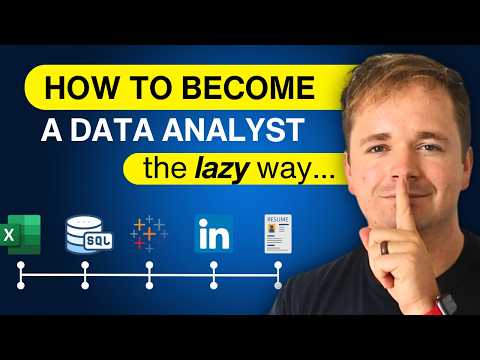
How to Become a Data Analyst in 2026 (starting from 0)
Avery Smith | Data Analyst
28m 34s5,805 words~30 min read
Auto-Generated
Watch on YouTube
Share
MORE TRANSCRIPTS