[0:00]This is the tallest building in Africa. It's located here in Egypt's new capital. And what these two things have in common is that they're both empty and expensive. Here's the Taya Misra Bridge. It's the widest bridge in the world for the sole reason they wanted to hold the Guinness World Record. And these investments, among many others you're about to see, were all made to save the Egyptian economy. But they did the opposite. They were the catalyst for what happened in March 2024 when Egypt did four things no country ever does voluntarily. It devalued its currency by 38%. It raised interest rates by 600 basis points. It signed a new deal with the International Monetary Fund worth 8 billion, a fund that exists only to help countries manage a financial crisis. And lastly, Egypt sold this huge chunk of its Mediterranean coastline to the United Arab Emirates for 35 billion dollars. This is the story of Egypt's decade-long collapse, a collapse that started in July 2013 when a general named Abdel Fatah al-Sisi took power in a military coup. Initially, things were looking good for Sisi. The Gulf countries, Saudi Arabia, the UAE, and Kuwait, sent 23 billion dollars in aid over the next 18 months. But then he started investing it in completely insane projects. In March 2015, Sisi announced he was building a brand new capital city right here, 45 kilometers out in the open desert, starting from literal sand. This new capital was going to be built in just five years and cost 45 billion dollars. And in 2024, the estimate for just phase one alone climbed to 58 billion dollars. What has been built, though, is the East Nile Monorail Line, a 53-kilometer-long driverless line connecting the new capital to Eastern Cairo. The prioritization here is what's so baffling. Greater Cairo has 22 million people. Those people are mostly concentrated in the old city, in Giza, in Shubra, in working-class neighborhoods East and South. To actually connect these people, to make Cairo more efficient, a 2019 plan identified Metro Line 4 as the single highest impact transit investment Egypt could make. It would serve one and a half million passengers a day in the densest, poorest, most transit-starved parts of the city. But line 4 is still under construction. Full completion is years away. Meanwhile, the East Nile Monorail Line, which runs to a practically empty city, opened just a month ago. It's fair to say they've prioritized the wrong infrastructure project. And honestly, that's not even the worst economic decision Sisi has made. He's made many others that are much worse, and I will show them all, don't worry, but there is one that is particularly important because it was a double-edged sword. See, Sisi took Egypt in a military coup, we know this, but that had a price. So he handed over the entire economy to the military. This is why all the mega projects in the Sisi era were built by the Egyptian military through the Armed Forces Engineering Authority. The new capital, for example, is 51% owned by the military. The bridges were military built, even the pasta you buy at the supermarket in Cairo is increasingly likely military-made. The Egyptian military runs an economic empire so opaque that nobody actually knows how big it is. Sisi is, of course, claiming it's negligible, at around one and a half to 2% of GDP. Independent researchers, however, put the real number somewhere above 40%. The brands the military runs range from bottled water to gas stations to cement, and they now even hold exclusive rights to tender for Egypt's wheat imports. But things start to get really shady when you take into the anti-competitive practices these companies are allowed to partake in. It turns out these companies don't even pay taxes, customs, or value-added tax. They use conscript labor, which in other words, just means they force civilians to perform work for them for free. They receive contracts without competition, and they're audited only by other military officers. What this creates is an environment that's extremely hostile and unfair for outside companies operating in Egypt. When the military opened two new cement plants in 2018, cement giants decided to leave the country because it was simply impossible to compete. Look, the problem with these foreign companies leaving is that they bring in hard currency. Either as initial investment to build a factory, for example, or as ongoing revenue from foreign customers who pay in dollars or euros. Those dollars get converted into Egyptian pounds to pay local wages, rent and suppliers, and the Egyptian Central Bank keeps those dollars. That's how the country builds foreign reserves without having to borrow them. For a country whose entire economic crisis is fundamentally a dollar shortage, this is catastrophic. It's why the Egyptian pound has collapsed four times in a decade. There simply aren't enough dollars coming in, and every departing company makes it worse. This was one of the catalysts that led to Egypt borrowing money like it wasn't going to be here tomorrow. Egypt's external debt in 2013, when Sisi took power, was around 43 billion dollars. By the end of 2023, just 10 years later, it was 168 billion dollars. It almost quadrupled in a decade. Borrowing this kind of money is supposed to be because you're investing in things that will pay it back. Ports, factories, exports, etcetera. Egypt, as we know, didn't do any of that. And today, interest payments alone are eating between 75 and over 90% of its total government revenue. Egypt is now the IMF's second largest borrower on Earth. All of this meant the Egyptian pound was always going to lose significant value, because when no one has confidence in a country anymore, the currency reflects that. But Egypt obviously did not want that, so the Central Bank defended the currency at a rate that was completely fake. They were saying officially that one dollar was worth 30 pounds and 85 cents. But you couldn't actually buy dollars at that price. The banks didn't have them. So a black market emerged. By early 2024, the black market rate had hit 70 pounds to the dollar, more than double the official rate. Kristalina Georgieva, the IMF managing director, said publicly that Egypt was burning through reserves defending their pound. Her metaphor was that it was like putting water in a bucket that has holes, which is a perfect analogy. The actual effect on the ordinary Egyptians was catastrophic. We have to realize, Egypt imports most of what it consumes: wheat, fuel, medicine, machinery, and when your currency loses 80% of its value, all of those things cost five times more than what they used to. And Sisi's response to this complete disaster was one of the most memorable lines any head of state has given in recent memory. In May 2022, he said Egyptians should be willing, if necessary, to eat leaves from trees for the sake of the nation's progress. That's absolutely crazy. But all of these things I've just listed are Egypt's own making. They could have all been avoided. The sad thing for the Egyptians, though, is that these poor decisions were amplified by outside factors they couldn't control. See, tourism collapsed from 13 billion dollars to 4 billion dollars due to a certain virus we've all heard about. Russia's invasion of Ukraine also hit Egypt specifically hard, because Egypt is the largest wheat importer on Earth, and 82% of its wheat came from Russia and Ukraine. And then, on October 7th, 2023, Hamas attacked Israel. Israel invaded Gaza, and the Houthis in Yemen started firing missiles at every ship going through the Red Sea. Within weeks, more than 2,000 vessels had stopped using the Suez Canal and were sailing all the way around the Cape of Good Hope instead. This was a huge problem for Egypt, because they own the only way to get through here, the Suez Canal. Before all of this happened, in 2023, the Suez Canal generated 10 billion dollars in revenue. In 2024, it was just 4 billion dollars, a 61% collapse in just a year. The canal is a geographical monopoly that basically prints money for Egypt, because the alternative is sailing that extra 6,500 kilometers around Africa. So, Egypt's revenue got cut in half by a civil war in Yemen that they didn't even have any influence over. Considering all of this, credit default swaps were pricing Egypt as the second most likely country on Earth to default by February 2024. The only country considered more likely to go under was Ukraine, which was actively being invaded. Egypt was weeks away from default, but the world couldn't let Egypt collapse. Because here's the thing: 108 million people live here. When not affected by war, the Suez Canal handles 12% of global trade, and Egypt's Mediterranean coast, if it collapsed, would launch millions of migrants directly at Europe. Egypt is in the most cynical possible sense too big to fail, not because it's powerful, but because it's dangerous. So the bailout came together. And the lead donor might not have been on anyone's bingo card, as it was the UAE. But that's because their donation wasn't really a donation after all. It was more a really bad real estate deal, at least for Egypt. See, Egypt would give the UAE development rights over 170 square kilometers of prime Mediterranean coastline in exchange for 24 billion in new cash and 11 billion of existing deposits converted into investments, making it the largest foreign direct investment in Egypt's history. The moment the deal closed, dollars came rushing back into Egypt, and then on March 6th, everything else happened at once. The pound was floated, rates went up 600 basis points, the IMF deal expanded to 8 billion, the World Bank threw in 6 billion, the EU came in with 7.4 billion euros, and 200 million of that was specifically, explicitly earmarked for migration management. Europe was basically paying Egypt to stop boats from coming. Egypt is just too geopolitically load-bearing to be allowed to fail in the way Lebanon or Sri Lanka did. So what's more likely than collapse is what I'd call a permanent slow bleed. Think of it this way: every structural problem that caused the 2024 crisis is still there. Debt service is still eating 75 to 90% of government revenue, the military still runs 40% of the economy, the bank of projects still don't generate returns. The population is still growing by one and a half million people a year. The new capital is still empty. The private sector is still being crowded out. None of that got fixed in 2024. It just got funded for another few years, which means the next shock, whatever it is, lands on the same fragile structure, and there will be another shock.
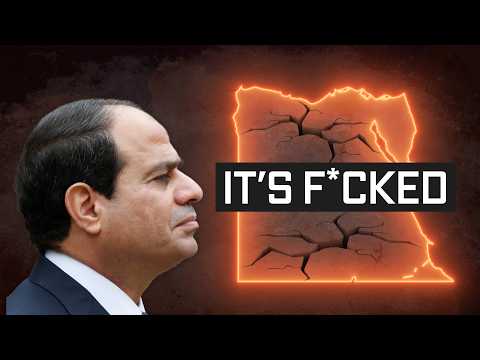
How To Destroy An Economy
OBF
10m 57s1,826 words~10 min read
YouTube auto captions
Transcript source
YouTube auto captions
This transcript was extracted from YouTube's auto-generated caption track. The transcript below is server-rendered so it can be read, searched, cited, and shared without opening the original YouTube player.
Pull quotes
[0:00]And what these two things have in common is that they're both empty and expensive.
[0:00]It's the widest bridge in the world for the sole reason they wanted to hold the Guinness World Record.
[0:00]And these investments, among many others you're about to see, were all made to save the Egyptian economy.
[0:00]They were the catalyst for what happened in March 2024 when Egypt did four things no country ever does voluntarily.
Use this transcript
Related transcript hubs
Watch on YouTube
Share
MORE TRANSCRIPTS


