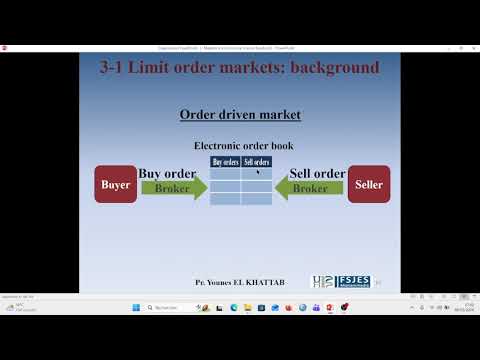
[0:08]Okay. In today we are interested in the structure of modern stock exchange, modern capital markets. And when I say modern capital markets, it means simply that we use computerized computerized system in order to trade. We have an automated trading system. Of course, you know well that the de development of uh communication and information technology has an impact, direct impact on stock exchanges ability to organize the transactions by organizing that virtual uh interaction, or virtual meeting between buyers and sellers. And of course here we focus on the order driven markets where the electronic order book play a key role, uh simply all the buy orders, all the sell orders are centralized on that level, and the electronic order book process the orders, and if there is a matches in terms of quantity, if there is a match in terms of quantities, in terms of of volume, the order can be executed. Of course, we are here in continuous trading system, limit order markets means simply the continuous trading system. If you introduce your order in the electronic voting system, the order could be executed immediately, of course provided that there is a sort of match in terms of prices and in terms of quantities.
[1:55]This is a simple description that describes the organization of transaction, the limit order market, continuous trading system, of course. As you can see here, we have the electronic order group. Buy orders are contained by the brokers to the market. Sell orders are conveyed to the by to the market by the brokers, and both of them, buy order, sell order are introduced in the electronic order book. We're talking here about an order driven market. So, the key component of an order driven market is the electronic order book, because all the trading activities flow flow through the electronic order book. All the orders are centralized in in the electronic order book. In this case, we have a direct contact between buy orders and sell orders. Why? Because the brokers simply convey the orders to the market. This is their main mission. At the end of the day, the orders are introduced in the electronic order book. We have a buy column, sell column, which means simply there is there is a sort of direct interaction, direct contact between the buyers and sellers. While talking, of course here about if you're actual contract in chat virtual interaction, simply because we are in automated trading system. Now, please compare that with the price driven markets. Price driven market, as I have already mentioned and explained, like the bond market. the negotiable debt securities market, and so on. In such kind of transaction in such logic, price driven market, the key component, the key player is the dealer. The dealers play the role of market makers. They make the market because if you want to execute your transaction, you have to execute it against the dealer. Whether you are a buyer or you are a seller, because this is the main mission of the dealer. The role of the dealer is to provide liquidity for the market, that is, make it easy for traders to buy and sell securities. You execute your buy orders against the dealer, you execute your sell orders against the dealer, because the dealer displays states his buy bid and ask. And of course you will sell securities to that dealer at the ask at the the bid price, the bid price of the dealer, of course, proposed by the dealer. And you will buy securities from the dealer at the ask price. Of course, bid and ask are provided by the dealer, are proposed by the dealer. So, since we have that key and make the difference, please distinguish between the dealer and broker, the dealer will provide liquidity by display displaying his or stating his buy order is bid, so the proposed buy price and ask, the proposed sell price. And any transaction should be executed against the dealer. There is no direct contact between the buyers and the sellers. Buyers and sellers should execute their transaction against the dealer. So, instead of having that centralized trading system based on the electronic order book, where there is a sort of interaction between buyers and sellers, here there is a sort of intermediation of the dealer. The dealer execute the orders against the customers. I'm a trader in bond markets, I need to contact mainly dealers dealers in order to have an idea about their prices. Whether I am buyer, I am interested in the ask price, I am seller, I am interested in the sell price. So, I will, in this case, contact many dealers by phone and try to find the best bid and ask that will make you execute my transaction in favorable conditions. So here, we are in the sort of decentralized market. There is no centralized trading system. Why? Because we have an a particular number of dealers, that make that market, make the bond market, make the sell market. And I can execute my transaction against that against them. Of course, there is no centralized trading system, and I have no direct contact with registered virtually or physically. There is no contact between the trader, buyers and sellers because all of them execute their transaction against the dealers.
[8:14]All the transaction should be executed against the dealers. The dealers make the markets, provide the liquidity for the markets, make it easy for you as a trader to sell and buy securities, and all this your transaction should be executed against the dealers. There is a other form of hybrid market where we have simultaneous use of the electronic order book and the market maker. This is the example of the New York Stock Exchange. The New York Stock Exchange, instead, those who make the market are called the the specialists. Specialists are the equivalent of dealers in New York stock exchange. Those specialists could execute orders against the potential buyers and sellers, but in the same time, they could centralize the order in a specified electronic order book that they manage. So, there is a sort of simultaneous use of electronic order book as well as the market making through the market specialist. We can find some specialists in New York Stock Exchange, who focus their activity on a limited number of stocks. One, two or many stocks. So, if I want to buy stock A, stock B or stock C, I need to contact the specialists who who manage the electronic order book related to that stock, and so on. No, as a recap, keep in your mind that we have three major role three major structure or microstructure of markets. We have order driven markets, where the major component is the electronic order book. Price driven markets where the key player are the dealers. And hybrid market, the example of New York Stock Exchange, where we have the specialist that play the role of dealers, but it simply in the same time they manage the electronic order book for a particular number of stocks. When we study the order driven market, that is the continuous trading system, please keep in your mind that when we talk about limited order market, this is a continuous trading system, that allows you to execute your orders at any time. Provided that the there is a condition of match. So there is a match in terms of quantities and the prices. Now, the question is how can we classify the orders in the electronic order book? Which order has the priority in terms of execution. Here we talk about the priority rule, how to classify the orders. There are two logics of of uh I will say uh priority rules or classification, how can the system classify those orders by using two rules. First option, price time criteria. Second option, price origin time. Let's start with by the first option. Price time in the first phase, the orders are sorted, arranged or classified the electronic order book according to their prices. Buy orders are classified from the highest price to the lowest price, this is a decreasing order. And sell orders are classified in an ascending order, starting from the lowest price to the highest price. So, this is the first criteria. We classify, or the system classifies the orders according to their prices, because the first criteria of classification in the electronic order book are the prices. Here, we will simply started by the most interesting offer from the seller's point of view, starting from the highest to the lowest price. And at the cell side, we will start it by the most interesting price from the buyers' point of view, that is the lowest price. That's why we classify the orders at the cell side from the lowest to the highest price, in a in an ascending order, and we classify the orders in terms of prices at the buy side in an in a decreasing order, starting from the highest price to the lowest price. Now, we can trace a particular situation. If the order are similarly priced, similarly priced, that is they display the same bid or the same ask. What is the solution here? Simply, we will use the second criteria, time. In terms of time, we apply that rule, first first come, first served. The second option of orders classification in the electronic order book is price, origin, time. So here we have three criteria, price, origin, and time. When the order arrive to the market, we have a series of orders received by the system. The system classifies the those orders according to the price criteria. Ascending order for the sell orders, decreasing order for the buy orders. If the orders are similarly priced, they have the same price. The second criteria is the origin. So I I don't I I identical prices, if we have the same prices, identical price.
[14:10]We use the second criteria, which is the origin. So all four traders, traders who have not the right to intervene directly to the market, they have no the status of dealers, their orders have priority over brokers' orders. So, this is the second criteria. Now, at identical prices and origin, we use the third criteria, time, first come, first served.


