[0:00]First up, how to keep your knife sharp. It's far harder working in the kitchen with a blunt knife than it is with a sharp knife. The secret behind keeping a sharp knife, sharpen it before and every time you use it. First, grip the steel, feel really comfortable about holding the steel. Imagine you're holding a tennis racket or you're playing squash. You've got to be really comfortable with it. Now, 45 degrees, confident grip, confident grip with the knife. This is the butt of the steel, really important you keep your fingers behind that. You never grip a steel with your fingers over that, because the knife comes back in, you've just lost a finger. Always grip behind. Nice long strokes, so we get the whole of the blade over the steel. Stroke. And we start from the bottom to the top. So there across. There across. Stroke, stroke over the top of the steel, and then come back underneath. Then back underneath. It is so dangerous working in the kitchen with a blunt knife. You can cause so much damage. Working with a sharp knife is 10 times quicker, more efficient. Now, that's ready to start chopping.
[1:10]To stop your chopping board rocking or slipping, a great tip is to simply wet a kitchen cloth, kitchen paper or tea towel and place it underneath. Now, you can chop with confidence. My next top tip is get the most out of your humble veg peeler. It's brilliant for slicing ultra thin ribbons of veg, perfect for Asian dishes. Great for making long delicate parmesan shavings to top soups and salads. It also makes wonderful chocolate curls.
[1:42]Your pepper mill is more versatile than you might think. Tighten the top screw to get finely ground pepper, ideal for soups and sauces. For general seasoning, you want it medium ground, so set the screw in the middle. And loosen it right off for coarse pepper, perfect for steaks and fish.
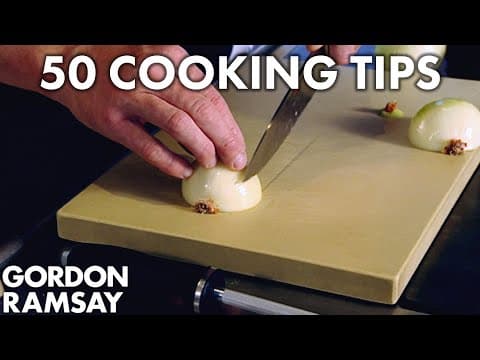
[2:04]Peeling garlic. For one clove, simply bash it with the back of a knife and the skin comes off easily. For a whole head, crush, separate into a bowl, cover and shake hard for about 10 seconds. Then simply pick out the peeled cloves. How to chop an onion? This is the root. That's absolutely crucial, leave that on there. If you cut that off, the onion will start to bleed and you'll start crying rapidly. Slice going forward, let the weight of the knife do the work. Three fingers, one in front, two behind and this part of the knuckle is going to guide the knife. Fingers on top of the onion, point the knife towards the root and try to get as close to the root as possible. Nice, long strokes. And then push the onion back together, push the knife halfway into the onion, slightly tilt the knife down, one at the top and then gripping the onion like a tennis ball, holding it together in place.
[3:09]With the weight of the blade to cut through that onion to get to the base of the root. Again, turn it round, up and down motion. And that's what we're left there, no waste, just the root. And look, there you got a really nice finally chopped onion. So much great cooking depends on starting with a high enough heat. If a recipe calls for a hot pan, put it on early so it gets smoking hot and always remember to pre-heat your oven at least 20 minutes before cooking. A clean cook is an efficient cook. My tip for a tidy cooking area is to always have a waste bowl next to you, it'll save you going back and forth to the bin. Never add salt to eggs before cooking them, because it ruins the texture and dulls the color. Instead, save your seasoning to the very end.
[4:05]The key to cooking meat is to make sure it's at room temperature before you begin. Cook straight from the fridge, the muscle fibers will be tight, which results in tough meat and always let it rest afterwards, so it relaxes becoming tender and juicy. How to de-seed chili. To get the seeds out, hold it upright and just rub the chili between your hands. The seeds, incredibly hot, just releasing them from the inside. Tapping it down. And then again, just a final little rub. Now, cut the top off and then just open up. And look. They come out like little miniature Smarties. And there. Cut the little bottom bit off. Amazing. Next, a great tip for using spare chillies. Use a string, tie together the stalks, then simply hang in your kitchen. In just a few weeks, you'll get your very own dried chillies. Great crumbled into dishes for adding heat on demand. Chilli's are surprisingly versatile. If you love them in savory dishes, my tip is to try adding them to melty chocolate ganache, for chocolate chilli truffles. Or sprinkled over fresh fruit like mango or watermelon. A great tip to prevent burning sensitive skin when working with chillies. To get rid of that spice and that heat on your fingers, a little bit of lemon, squeeze a little bit of lemon juice, and that instantly gets rid of the heat. Fresh lemon juice. Spice up your drinks. For a Mexican twist, add a dash of hot chilli sauce to beer, or use in cocktails to give your drink a very different sort of kick. First, how to zest a lemon.
[5:46]The important part is not to zest any of the pith. Watch the following technique and I'll show you how. With all these original graters, really important when we use this, we use the the fine zester. Not the big rough one, not the one for slicing, and not the other one for grating. This little one here. Onto a plate, because it's always easier to lift off from the plate than it is to the board. And the most important thing about zesting a lemon is nice long strokes. But twisting the lemon round. Every time we go down, we twist. Same with the orange, and same with the lime.
[6:26]Little tap. If you go too far, let me just show you. Look, you got that white bitter pith. That destroys the wonderful zesty flavor. And look, that's what we're looking for there. This really nice vibrant lemon zest. Delicious. Garlic is a key ingredient in so many spicy dishes. My tip for finely chopping and mincing is add a pinch of salt for abrasion, which helps break the fibers of the garlic down for a much better result. For getting the most out of root ginger, simply remove the skin using a teaspoon. It's easier than using a knife and you can get round the tricky bits. Or just keep the skin on and give it a good wash. Never throw out vanilla pods. There's a ton of flavor left in the skin. Stick inside jars of sugar and leave to infuse. Great to sprinkle on cakes, biscuits or porridge. When grinding up spices, if you have any leftover, you can store it in an airtight jar for up to two months. Great for a spicy kick to have at your fingertips. A great cheap staple, how to cook the perfect rice. Basmati rice, the king of all rices. Light, fluffy, delicious, and I'm going to show you how to cook it perfectly. Now, start off with 400 grams of rice. Rice in. Spot on. So what I'm going to do now is just rinse off the dust and the starch. Cold water, always. And just rinse the rice. That stops the rice from becoming lumpy in the pan and allows it to become really nice, light and fluffy once it's cooked. Rice into the pan. Now, to make a plain fluffy rice exciting, we're going to infuse it. Three cardamon pods. And just get the pods and just pierce them so it allows all that flavor to come out. Cardamon pods and then star anise. Now these are beautiful, whole star anise. It makes it really nice and fragrant. Salt and pepper. A lot easier to season the rice now than it is once it's cooked. You start to break it up when you season it once it's cooked. Now, basically, one part rice to one and a half part water. 600 mils, always start it off in cold water. Cold water in. Onto the gas. Lid on. Bring it up to the boil as quick as possible, turn it down and let it simmer for 8 to 10 minutes. And that's the secret behind cooking great rice, allow it to steam as it's cooking. Do not lift that lid up. Lid off.
[9:14]Mmm. It smells aromatic. Basically, all the water is absorbed, the rice has doubled in size and is nice and light and fluffy. Take the star anise out. The cardamon pods, they all should have risen to the top. Pods out, take your fork, fluff it through. Basically, it just sort of starts to open everything back up. Once you've forked it through, it becomes really nice and light and fluffy. And there. That is perfectly cooked rice. Always make the most of your leftovers. Use last night's rice in stir fries, scrambled up with eggs, or it's simple to make a delicious fresh salad. Remember, a good cook wastes nothing. A great tip for stopping potatoes, apples, and avocados from going brown when cut. Simply cover with water and add a squeeze of lemon, the acidity stops the flesh from oxidising, which is what causes the colour to change. Herbs are great for adding flavour without spending a fortune. To keep them at their best, simply place them in a glass of water and they'll stay fresh for up to a week. And if you've got extra herbs left over, save and waste by making an amazing flavoured oil. Place washed, dried stems in a bottle, cover with warmed olive oil, then seal and leave to infuse. Great for salads, pasta, and drizzling on veg. Cooking pasta, a great budget basic to keep in the cupboard. It can be easily undercooked or overcooked. Here's how to do it properly. First, water in, nice large pan to make sure the pasta has got sufficient room to cook evenly. Nicely seasoned, absolutely crucial. Olive oil in. That stops the pasta from sticking together. Bring it up to the boil. That's a rolling boil. The secret there is it stops the pasta from sticking together and it gently rolls it around. Now, this is angel pasta, nice thin pasta takes 3 1/2 to 4 minutes. So, into the pan, as it hits the water, it melts and then you turn it round. Tongs, as that starts to melt, gently twist that into the pan. Bring it back up to the boil. If you're bad at timing, then set a timer. Beautiful. To test it, lift a little strand. And you can actually feel it with your fingers, still nice and firm. Mmm. Al dente, not a bite, not a strong bite, but just really nice and firm inside, definitely not crunchy. And then, into a colander, drain the pasta. In, a light seasoning. Salt and pepper. A tablespoon of olive oil. Mix that through. That stops it from sticking together. And look, there you go, beautiful pasta al dente. Mmm. Cooked perfectly. A tip for making the most of spare bread. Blit's left overs into breadcrumbs, great for stuffing or crab cakes. Or cut into chunks and freeze for perfect croutons on demand. Or simply tear and use in a delicious rustic salad. Dried pulses like chickpeas or lentils are great for soups and stews and cost pennies. But don't season them until the end of the cooking, or the salt makes them go tough. For perfect boiled potatoes, always start them off in cold water and never boiling water. This way, by the time the centers of the potatoes are cooked, the outside won't be falling apart. And when you're cooking potatoes, always cook extra, so there's leftovers. They're fantastic to have on hand for making my delicious gnocchi and potato roasters, or a classic bubble and squeak. With how to skin and de-bone a fish the hassle-free way. This is basically a filleted side of salmon. It's been taken off the bone and now, skin off. Pick up your knife, a really nice broad, flexible filleting knife. Little sharpen, lift up the base of the tail and then just nick a little bit at the end there. Twist the knife, almost as if it's horizontally underneath the salmon. Pull the skin and you slice the salmon underneath. And let the knife do the work. Now, get your skin, flip it back over and check you're not leaving too much salmon on top of the skin. Pull it back and nice and slowly. Get the skin, wrap it around your fingers, pull the salmon towards you and then just all the way through. Lay that down.
[13:51]Nice, skinned salmon. Just like a perfect snake skin. Get your knife and just run the knife down and then with a pair of tweezers. These are fish tweezers, but you can use normal tweezers. Look for the head up and pull. And with the skin being removed from underneath the salmon, the pin bones come out a lot easier. The pin bones only go to just basically halfway along the fillet. One nice fillet of salmon. Beautiful.
[14:30]There's still plenty of flavour in the trimmings from a filleted fish. My tip is don't waste those fish bones. Add to water, wine, a bay leaf, and some chopped veg to make a simple but versatile fish stock at home. The perfect base for a delicious fish soup.
[14:48]A great tip for intensely flavoured, stress-free veg is to steam them in their own juices. Simply add to a pan with a knob of butter and seasoning, then cook on a low heat with a lid on to lock in the moisture. For crispy roast potatoes you can depend on, my tip is to par-boil them, leave them to steam dry, then sprinkle them with semolina or flour and give them a good roughing up. This ensures they go really crispy in the oven. A great tip for browning meat or fish is to dry it with kitchen roll before you cook it. Then you'll get a much better colour. Too much moisture makes the meat steam instead of sear and you'll lose that rich brown crust, like the one I got on those sticky pork ribs. My tip for amazing tuna carpaccio is to freeze it first, and it will slice beautifully. It's wise to save leftover wine for cooking. My tip is to freeze the remaining wine in freezer bags or ice cube trays. It's great in stocks and sauces. When you freeze soups or stews in tubs, the tip is not to overfill them. Leave room to expand in the container. A great tip for a cheesy homemade ice cream, buy a high quality vanilla ice cream and make it your own by mixing in berries, chocolate, or my favourite, rum and boozy raisins.
[16:12]A fantastic tip for leftover lemons and limes is to cut them into wedges, freeze and use them like ice cubes. They won't water down your drink and they'll also add flavour. First up, how to joint a chicken for your favourite real fast food dishes. Open up the legs and just pierce the skin there. Careful not to cut into the breast. Hand on top of the breast and pull the drum back. Pop out and then slice the knife straight across. There's the thigh, there's the drum. Get your thumb and feel the joint. And with the weight of the knife, just slice it straight through. Now, two beautiful thighs. Now, a bit of a chef's tip, halfway down the drum, just slice through onto the bone. And then from there, scrape up the tendons. And then hand down, nice and firm on top.
[17:15]Now, it's a beautiful bone presentation. As it cooks, it cooks evenly. Now, pull out the wing, feel where the end of the joint is and just slice in there. Through. A beautiful big, whole delicious wing. Now, this is the Rolls Royce part, two breasts, that's the breast bone there. Place the chicken on the board and then just slice down on the back of the crown. Everyone always cuts around, just tilt it upwards straight through. That way we get straight to the centre of the carcass and therefore there's no waste. And look, we end up taking off his plump chicken breasts. Nice. Two drums, two thighs, two wings, two breasts of chicken and one amazing carcass for a stock. And not an ounce of waste.
[18:11]A great tip to stop your skewers burning when you're making kebabs is to soak them in water first. Or for skewers with added flavour, strip your rosemary branches off their leaves and use instead. For no-fuss marinating, my tip is to place fish or meat in a plastic storage bag while they marinate. It's easy to store and there's less clean up. Lime juice or lemon juice make great marinades. My tip for getting maximum amount of juice from a lemon or lime is to roll it hard under your palm for a minute before juicing. Lemons are also useful for rice. Add a couple of drops of juice while you cook it to keep your grains looking nice, white and bright. I want to cook my steak rare, so by touching the steak, I want the same feedback as it is on the inside of my thumb. That's rare. As it starts to cook, it gets a lot firmer. Medium is there, semi-firm with a slight resistance. Well done is there. Rare. A great tip for getting meat or fish to cook faster is to score it, which allows the heat to penetrate quicker. This also allows marinades to be absorbed more deeply. For stain-free tupperware, code it thinly with oil, which acts as a barrier between plastic and food. It's so easy to make your own chilli sherry to use in quick stir fries or sauces. Take 450 mils of dry sherry, such as Fino, and using a funnel, pour into a sterilised bottle. Add five whole Thai chillies, seal with a cork or lid and leave to infuse for a couple of weeks. My tip for using any discarded chilli seeds is plant them to grow yourself some new chilli peppers. Plant in an egg shell or seedling trays. Start them indoors and move outside when they're ready.


