[0:00]And really quick. The 13 reasons why investing in real estate is so important. And I'll go back and tell you from my perspective, my dad has been in construction and real estate my entire life and as a kid, I didn't listen.
[0:12]So I know some of you may not want to hear it. I'm going to tell you it is a mistake because as a kid, I'm like, I don't want any properties. I don't want any rental income. I want to flip the money, get a Benz, spin a block. And then 15 years later, I'm like, damn, I should have listened. I would have had 45 doors.
[0:30]Yeah, kudos to Ja man. You know. I was trying to be like Ja Rule or something when the first album came out. Shout out to Ja, man. Kudos to Ja. Kudos to Ja.
[0:36]Yeah. Kudos to Ja. Shout out to Chris. Shout out to my brother Chris Gotti. Chris Solid. Good dude.
[0:41]Um, but this is why it's important. It's the same game, real estate and investing. They're tied together. Almost 70% of us that are Black or Latino will be classified as liquid asset poor.
[0:53]45.8% of our Black children under the age of 6 lived in poverty at some point.
[1:00]African Americans are 86% more likely than whites to be upside down in their mortgage and Latinos lost 58% of their wealth during the recession.
[1:09]And even when we when we get into entrepreneurship to think that that's going to fix everything, the household wealth is higher by 313% in comparison versus non-Black entrepreneurs.
[1:22]And kudos to the brother Claude Anderson, the part that scares me and him is that by 2053, the average wealth of Black Americans will be at zero.
[1:32]That does not seem like a long time, but me being 38, 35 years from now is not a long time. It's eight presidents and we've had one horrible one that just left. If we get a few more of those, that number may speed up. But what was the greatest economic bomb ever dropped on us that caused this? Put it in chat if you know and I'll give you a few seconds.
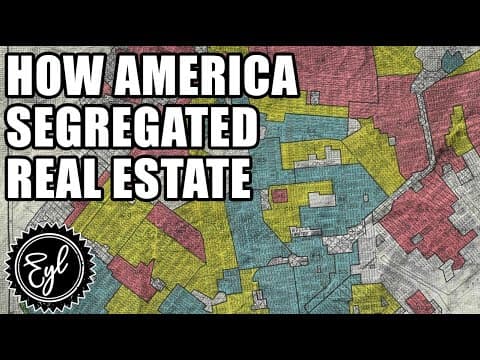
[1:51]For my people in LA and Chicago, you already know. Redlining. Redlining was the 9/11 of our financial freedom. Please write that down.
[2:00]So redlining covenants agreements that banned the sale of homes to certain neighborhoods, excuse me in neighborhoods to certain racial groups, I.E. us.
[2:09]So 80% of uh neighborhoods according to a 1937 magazine article reported that 80% of the neighborhoods in Chicago and Los Angeles were restricted by these covenants in 1940 and it was the number one factor that eliminated our wealth in this country.
[2:26]You often hear me tell my son in the market green means up and red means down. But here's the origin of this phrase. It comes from redlining and it applies to the stock market. If you listen, there are hidden codes throughout every business that originate in slavery that we told you about in episode 70 and this is one of them.
[2:43]So the maps were color coded to let you know which areas were for us and which ones were not. So the green areas represented in-demand, up-and-coming neighborhoods where "professional men" lived. These neighborhoods were explicitly homogeneous, lacking "a single foreigner or Negro" aka not us.
[3:00]Red were areas of infiltration that had already occurred where more Latino and Black people would be and these homes and these neighborhoods had a lower value as a result.
[3:12]And unfortunately Black households have nearly 57% of their net worth tied to the value of their homes, while Hispanic homeowners carry about 67% of their wealth in their homes. As a share of net worth, housing amounts to only 41% for white homeowners.
[3:31]The rest are made up in business, real estate. Investing in the market and life insurance and we're behind in all of those categories. So when I tell you tonight, this information is as important as investing, they are brother and sister side by side twins that should be paired together because not only are we behind in investing, but we are also behind in real estate.
[3:46]So I wanted to give you guys some context why these brothers are here tonight besides me being a fan of Envy back when, you know, he was screaming over the tapes. That's a storm day. But um, I want the thing I want you guys to take away, you have to pair everything.
[4:04]There's a holy trinity of freedom. Business, real estate and investing in the market. Once you have those three, you can actually have freedom. I love you guys. I love you guys.
[4:13]You have it. Quiet storm. Quiet storm. Yeah. It's in the dark.
[4:17]The Master Investor strikes again. Appreciate that, brother.
[4:21]Yes, yes, yes. Shout out to everybody on YouTube. We're getting off to a great start. 7600 people on the check-in. Don't forget to hit the like button. Greatly appreciated. Um, all right. So without further ado, we have two esteemed guests. EYL alumni in the building.
[4:33]First and foremost, yes, yes, yes. Flipping in J aka Caesar and of course, DJ Envy. And um, I mean they really need no introduction. If you follow real estate, you understand that they've been on the forefront for a number of years now. They seminars, you know, sell out all across the country. But um, they actually do it in real life. They have hundreds of properties, um, in Jersey, all over.
[5:01]Um, Detroit, um, Midwest, all over. And um, they're working on a school. They got a whole they got a whole system going. So, a lot of the guests that we actually have on the show that you guys are familiar with, um, working with the team. You got your mortgage guys to being, uh, Lord of the Slums, Fernando. Um, Credit Do. So, um, so yeah, so we thought that they would be the perfect people to talk about real estate. So, first and foremost, thank you guys for joining us. Appreciate it. Thanks for having us, man. Appreciate it. Nice to be back. Episode 33, legendary one. For sure. So, let's jump right into it. Um, I'm sure we all got some questions, so we'll just, we'll just, you know, tag team it from there. So, all right, we're in 2021 right now and um, everything was crazy with Covid, right?
[5:40]So, um, what is the frontier? Like, what are you looking at for hot real estate markets in in the year 2021 and in the future?
[5:53]It it all depends where you're trying to accomplish, right? When we first started the seminar, we were pushing more rental properties, right? Rental properties, rental properties. But the market has changed, right? Now the market is kind of over saturated. So, I think for probably about the next two years, it's definitely a great time to flip, right? You buy property under market value, add value to it and sell it for more.
[6:15]The reason for that is because there's no inventory, right? With the whole COVID mess, it kind of stopped all the foreclosures, right? So now you don't have that many bank on properties out there anymore, right? And we don't even know when those properties are going to hit the market. It might be in the year, another two years. Then you can't evict people in a lot of the markets around the country. So now you also have where people are looking for apartments and can't find none either. So it's like the perfect storm. And then now rates are so low, right? So, I think definitely right now is great to flip. Um, also if you are looking for markets as far as renting, um, I like Chicago. Um, I still, you know, I I like Cleveland, too. I like Ohio. And uh, Baltimore. That'll probably be your best markets where you could kind of do like the Byrd Method. Kind of like what when we started, that's what we used to do. We used to buy properties 40, 60,000, we had 40, 50. Now they appraised for 2 something. Uh, rent them, refinance, take the money out and buy more property. Let me let me just ask the following question on that. So, Chicago, shout out to everybody in Chicago, you're looking at like South, like the South side neighborhoods in Chicago?
[7:25]Yeah, Southside. Where Barack is building a library at. Right over there, right where they did by the water that area, yeah.
[7:28]Oh, right over there.
[7:31]What, what area? Hyde Park. Hyde Park. Hyde Park. Watch the Heights. Oh, what's it at the high park? Watch the Heights.
[7:37]Yeah, it's crazy. Hyde Park. Okay. Okay. Yeah.


