[0:05]Three years after Darby's Iron Bridge was unveiled to the world, an industrialist called Samuel Greg built a factory in the village of Style in Cheshire.
[0:19]And I've come here because I want to start unpacking now the impact of the Industrial Revolution on ordinary people, the way it transformed the fabric of our working lives.
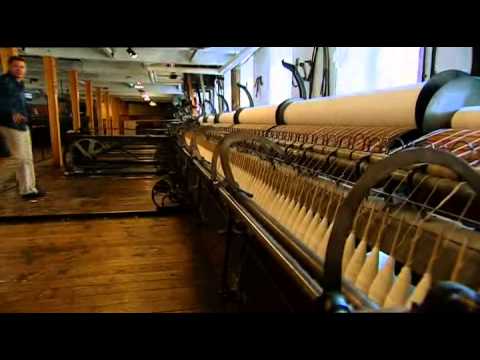
[0:33]Quarry Bank is an early industrial cotton mill, a building dedicated to the production of cotton thread and woven cloth.
[0:44]It owes its existence to the invention in the mid 18th century of machines of startling ingenuity designed to speed up the process of textile manufacturing.
[0:57]Spinning mules like these could spin 240 miles of cotton thread a day.
[1:06]Power looms wove cloth at speeds barely conceivable a generation earlier.
[1:19]These machines were the driving force of the industrial revolution, but no less extraordinary were the buildings created to house them, a new kind of building in Britain, a factory designed for the express purpose of work.
[1:33]A place where workers would assemble, where they'd work their shifts dictated by the factory bell.
[1:40]Nowadays, we take the idea of going to work for granted.
[1:49]Most working people in this country are employees. We work for someone else. We have our breakfast. We leave the house. We go to our place of employment, be it a factory, an office, a call center, whatever.
[2:01]And there we do our allotted nine to five, nine to six, with maybe an hour off for lunch. And the structure of our working lives is dictated to us by the culture of the workplace and by rules basically laid down by our employers.
[2:20]Well, that whole culture of working life that we now take so for granted, it was invented in the early decades of the industrial revolution here in the factories.
[2:30]For some, the offer of regular work, six days a week, rain or shine, was a blessing.
[2:37]Farm laborers and their families came to Quarry Bank.
[2:40]They took employment, grateful now that the wheels would turn regardless of the seasons, no fear of being laid off in the harsh winter months.
[2:50]But for others employed here, the factory system was more of a shock.
[3:02]They'd worked in textiles all their lives.
[3:05]Not in factories, but at home in cottage industries, spinning thread on spinning wheels, weaving cloth on hand looms.
[3:14]This in its day was skillful, highly paid, well-respected work.
[3:19]Come the machines though, the days of the handloom weaver were numbered.
[3:28]Machines like these were too big to fit in anyone's front room, and they needed a power source, water.
[3:36]Most of all though, to buy infrastructure like this, you needed capital, money.
[3:42]More than any humble weaver could afford.
[3:46]And so emerged a new player in the game, the entrepreneur, the mill owner, the capitalist, a man prepared to invest a fortune for high returns.
[3:59]And the hand loom weavers, forced out of the market, turned cap in hand to the factories for work.
[4:05]Here, they'd be no longer their own masters.
[4:10]Just cogs in the machine.
[4:19]You get the sense these places aren't designed on a human scale.
[4:24]The width of this room is dictated by the width of the spinning mule.
[4:27]The ceilings are low to maximize the number of stories to cram in as many machines as possible.
[4:33]The workers you sense were an afterthought.
[4:40]So, what was it like to work in an early industrial factory?
[4:46]Well, frankly, it was pretty brutal. Don't forget this was all in its day an experiment.
[4:54]Machines like these had never existed before, and the factory system was never designed with the workers in mind.
[5:01]The air on the factory floor was thick with cotton dust.
[5:06]It got into the lungs, it caused all kinds of pneumatic diseases.
[5:11]The looms were designed for speed, not safety.
[5:15]Accidents were common, fingers, arms caught in the machines.
[5:21]Shifts could last 14, 15, 16 hours.
[5:27]Dignity in labor, common humanity all sacrificed in the quest for profit.
[5:35]I suppose to modern eyes the most telling detail in this grim new industrial world was the presence of children.
[5:42]Some as young as six or seven, employed to scurry under the machines picking up scraps of waste cotton.
[5:51]Only children were small enough to do the job, but it left them stooped and broken.
[5:56]Most had physical infirmities later in life.
[6:06]There's a very revealing story of a poet, a man called Robert Sudy, who visited a mill much like this one.
[6:13]And he dared to question the presence of these scraps of humanity huddling under the looms, but the man who was showing him around, puffed himself up with pride.
[6:23]Far better, he said, for these children to earn their own bread than to be a burden on their parents, a burden on the parish, and how joyful in this temple of industry that they should learn the value of a hard day's work.
[6:36]There is no idleness here.
[6:39]No idleness, certainly.
[6:43]And in time, the factory system transformed Britain's economy, launching us into global dominance as the workshop of the world.
[6:54]But this glorious experiment came at a human cost.
[7:01]How great a cost we were yet to discover.