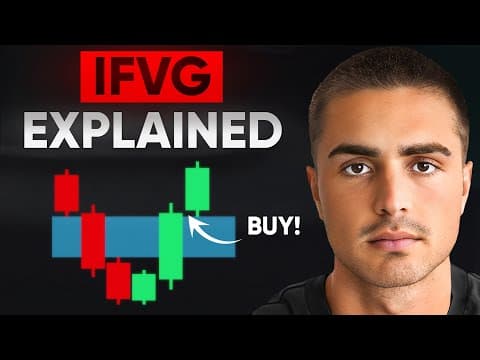
[0:00]This is going to be the only inverse fair value gaps video that you guys will ever need to watch. I've made seven figures just last year alone with trading and inverse fair value gaps have been one of the key confluences that you guys probably see using on a daily basis in my trade recaps. And it's super essential within my strategy for me to be able to take trades and make money within the market. So today, I'm going to explain what inverse fair value gaps are, where to find them, why they're beneficial to us and then also how to find entries using them. So with that being said, let's jump on the chart and let's get into it. All right, so the first thing that we need to do in order to understand or identify inverse fair value gaps is we need to know what fair value gaps are. So if you guys have seen any of my other videos, a fair value gap is essentially a three candlestick pattern, okay? So this is our first candle, this is going to be our second candle, and this is going to be our third candle. Now, I'm not going to go super duper duper in depth on fair value gaps because I'm assuming that you guys know and understand what fair value gaps are, if you guys have seen any of my past videos. Okay, this is going to be boom, first candle and we're just going to make these kind of chopped candlesticks. We're not going to add any bottom wicks or top wicks just for simplicity purposes. So right here, what do we have? This is a bullish fair value gap, right? So in this case, right, when would we be identifying a bullish fair value gap? Well, typically, we're going to be within an uptrend and we use fair value gaps as continuation confluences to show that the trend is going to continue in the direction that it's been going in, okay? So if we're on the five minute time frame and we see price push into a fair value gap and then we see buy orders out of it, what can we safely assume? That five minute trend is going to continue higher and we're going to want to target the high that it just put in. Going from internal liquidity over to external liquidity. Now, what happens if we end up disrespecting this fair value gap? Well, what can we safely assume? We can safely assume that hey, we are no longer going to continue this bullish trend. So, what does us disrespecting this fair value gap give us the opportunity to do? Well, it gives us the opportunity to be able to identify a change in market structure, right? Because we are disrespecting this bullish continuation confluence that should have continued the bullish trend that we were in on the selected time frame. However, if we disrespect this fair value gap, what is that going to tell us? That's going to tell us that, hey, this bullish trend is no longer going to continue and we're probably going to go lower now. And that's exactly what inverse fair value gaps help us do. So, it's identifying continuation confluences within the current trend that we're in with the assumption or without the assumption that they are going to get invalidated for us to be able to take a trade in the opposite direction. So, the following candle, or really any candle after that, right? If this candle closed like this, we can have another candle that moves up and then let's say the next candle. Boom, we inverse this fair value gap, right? We get a candlestick closure underneath this continuation confluence. What does that tell us about the market? Well, it says, hey, this is a bullish fair value gap, where if this trend wanted to continue bullish, right, making higher highs and higher lows, it would have respected this gap and it would have seen bullish orders filled out of it and we would have seen price continue in our direction to the upside. However, what happened here? We had a candlestick closure underneath this bullish fair value gap and then in turn, what is price probably going to do? Well, it just disrespected the bullish order flow that we were in. So, what is that telling us? It's telling us, hey, that's a break in market structure. So, that's telling us that the market is probably going to go down now. Now, this is a very key confluence when it comes to using it hand in hand with liquidity sweeps. Very frequently, you will see people like me, or other people online, they will be looking for a liquidity sweep, then a break of structure, right? Now with this confluence, we can add a full another confluence into our arsenal to be able to understand and identify market structure shifts before we even can see a break of structure because in this case, let's say this is where the low is on the uptrend. If we can get an invalidation of this bullish confluence first before having it to close underneath this low, then that gives us a significant advantage in being able to enter a trade. Maybe a little bit earlier instead of having it to enter it when we get underneath this low right here, and we'll be able to enter the trade right here. Now, let's show this example within the bullish scenario, so you're probably saying, I thought that was bullish. Well, no, we had a bullish fair value gap, but that was a bearish inverse fair value gap, okay? So, we're going to draw out the same scenario here. We got boom, we got the first candle, we got the second candle, we got the third candle. Boom, right? So this is a bearish fair value gap. Now, again, what is this bearish fair value gap telling us? It's saying that, hey, if price wants to continue this downtrend, when we get into this gap, we're going to want to see sell orders out of this, and if we see sell orders, then price is going to continue down lower, right? However, what happens if we get a candlestick closure above this gap right here? What happens when we do something like that? Well, if we get a candlestick closure above this gap right here, then what is that tell us? That tells us that, hey, this bearish order flow, this bearish trend just got invalidated. Why did it get invalidated? Because if we wanted to continue the bearish trend, then we would have respected this gap and we would have continued down, okay? So, if we wanted to keep this downtrend going, we would have respected this gap, but instead, what did we do? We closed above it and now what is that for us? That's a bullish confluence that price is going to go higher. Now again, this confluence is very useful when we are coming down or coming above a high time frame draw on liquidity. If we push above that and we have a fair value gap right here on the lower time frames and we inverse this fair value gap, what is that going to tell us about what the market did above these highs? It's telling us that, hey, we filled a bunch of orders above these highs and because we filled all those orders, we're actually going to be disrespecting the bullish order flow that we're in right now and then what's that probably going to cause? It's probably going to cause a reversal and those are typically the trades that we want to take the most, right? We're trying to catch the tops and the bottoms of all of these big moves, right? So if we come on here, if we want to catch the bottom, right? If we come underneath a significant draw on liquidity and then we have a bearish fair value gap right here, if price comes into this gap and then respects it, awesome. What can we safely assume that price is going to come down lower to the next draw on liquidity? But what happens if price comes down, we have the bearish fair value gap and then boom, we get a candlestick closure above the gap? That's signaling to us that, hey, this downtrend, at least on this current time frame, it's smoked and we're going to want to go higher. And we just filled a bunch of high time frame orders for price to go higher and then probably seek out a higher time frame draw and liquid. So now that we've identified what it looks like with our nice little Picasso paintings, let's go ahead and identify it on the real market and show you guys this happening in real time because it's really like one of the best confluences that you can use. And I'm seeing a great example of this right here. So, let's look at this, okay? Price comes down, sweeps out this low, sweeps out this low, right? So, what is inverse fair value gaps best use for? It's typically when we're trying to spot reversals, right? It's very similar to break of structure.
[8:16]So, if we put this right here, we see price comes down, we break structure underneath this low. We sweep out underneath this low. If I'm right here in the market and I'm trying to figure out, hey, where is price going to go? There's one key confluence that's going to dictate the entire direction of where price is going to go, right? Because we're in a interesting situation. We just broke structure to the downside, but also we're sweeping out lows. And on the high time frame, we're in an uptrend, right?
[9:07]So you're saying, okay, this could go either way. We could either continue this downtrend or we could go up. So what's the confluence that we're going to have to look at to be able to identify whether we're going to go down or go up? It's going to be this fair value gap right here, right? Because we broke structure to the downside, if we're going to continue this downtrend, then what are we going to do? We're going to respect this gap and we're going to get a candlestick closure down and then boom, we can target these lows, these lows down here, all the other draws and liquidity. But if we disrespect this gap here, what can we very obviously safely assume? That price is going to want to come up, take out this high, take out this high, take out this high, right? So if we just play this, boom, what does price do? We get a inverse of this bearish gap, making this a bullish confluence. And what is that now telling us? That's telling us, hey, we filled the orders here. We're disrespecting bearish order flow by disrespecting this gap. And we haven't even gotten a break of structure yet to the upside. So in this case, this is one of the best confluences that we can use to be able to identify a change in market structure because we haven't even closed above this high yet. You know, somebody like me, I mean, I would want to be scaling in here and trying to find a way that I can take a trade up to these highs, take a trade up to these highs, take a trade up to these highs. So, if we play the rest of this and just see where price goes, we can see that price immediately comes up, takes out this high, takes out this high. That's a prime time example of using inverse fair value gaps to your advantage to be able to identify a structure shift when we come down and fill orders.
[11:26]Okay, let's show another example. So again, let's look at this. Price comes up, takes out this high, all right.
[11:43]We take out this high and then whatever, we see price selling off a bit.
[11:55]We have a couple key points. We have this fair value gap right here and then we have this tiny little fair value gap right here. So we have two fair value gaps and this is an instance that I want to talk to you guys about because it's very important that you guys understand this. When we have two fair value gaps stacked on top of each other like this without a different candlestick in between. So we can see boom, right? The first candle color doesn't really matter, but if we have boom, a bullish fair value gap right here and then we get bullish candle, bullish candle and then another bullish fair value gap. Then these two fair value gaps are pretty much treated as one. And in order for us to qualify us inversing the gap, we need to take the lowest gap from that stack. I'll show you guys examples to the upside, but to the downside, we take the lowest gap of the stack, that's something that's very important. So, what do we see price do? We come up, we sweep out this high. Now, if price wants to continue this uptrend that we're in, what does price have to do? Price has to come down, fill this gap or fill this gap and then continue higher to take out this high and this high. But instead, what does price do? Price comes down, boom, big candlestick closure underneath this gap. We end up disrespecting it and then what do we see price come back up and do? We have this bearish fair value gap. So not only do we get a disrespect of a bullish confluence, but then we come up and then we respect this new bearish confluence that we've created and then what does price end up doing? Price goes down to take out these lows. Beautiful, beautiful, beautiful price action right there. Let me show you an example of stacked up fair value gaps going to the downside so you can see some good examples of this. So, this is going to be a good example right here, okay? What do we have? We have fair value gaps that are stacked on top of each other, okay? So we have this fair value gap, bearish fair value gap right here. And then we have this bearish fair value gap right here. What do we notice? We can notice that there's no retraces throughout this entire leg down. So if that's the case, then these two fair value gaps are grouped together and we cannot qualify this inverse fair value gap as a full inverse of this entire bearish structure. Because we have to think, if price were to retrace up into this gap and then respect it, does that break bearish order flow? No, it maintains it. So if this candle closed above this gap, but then following that, we saw bearish candlestick closure out of it. That would have still maintained the bearish order flow and then we would have been fucked if we tried to enter a long off of this candlestick, right? So that's why we always need to wait for the tops and the bottoms of all of these stacked up fair value gaps in a row with no different colored candlestick in between to be able to consider it an inverse. Okay, so if we're looking at this right here, we have this gap right here, but we know that we're not looking to qualify this as an inverse. For a bearish fair value gap to get filled and then continue out of it, awesome, we can use it. However, if we're looking for price to inverse it, that's a whole different story, so we need to only be looking at this gap. When do we inverse the gap right here? Awesome. Where can we safely assume that price is going to go? Up to this high and then potentially up to this high. What do we see price do? Once we inverse this gap, again, this gives us a significant advantage, rather than waiting for a break of structure, we can get an entry right here, rather than up here after we break above this high, okay? Boom, we get an inverse fair value gap and then following that, we move up, we get a retrace into equilibrium, we push past this high and then we go up and eventually grab this high as well. This is another prime time example right here, okay? We get this gap that gets inverse on this candlestick. In this case, it would have been better to go with the break of structure to the upside on this candlestick because that's showing a shift in market structure before we get the inverse. But again, I just want to show you guys as many examples of this as possible. Now, again, last thing that I want to tell you guys is when is this going to be useful to us in trading? When and how is this going to be useful to us in trading? Well, it's going to be very useful for us to be able to spot reversals within the market. Notice how pretty much every single one of these examples that I've shown you has been coming off of a liquidity sweep. So again, what I don't want you guys to do is just say, hey, this fair value gap didn't hold up. We inverse it, we're going to freaking change trends completely. We need to be able to identify how the market's moving and why the market moves the way that it does, okay? If the market has the potential to fill orders via a liquidity sweep, then we know that market has the potential to reverse. So if the market has the potential to reverse, what are we probably going to be looking for within our confluences? We're probably going to be looking for inverse fair value gaps that just breaks some structure, okay? So when we're looking for these reversal confluences, that is going to tell us when the market is shifting its structure. And then from there, I'm typically going to be looking for a continuation of the new trend that we just formed and then I'm looking to enter. That's literally all my strategy is. I'm looking for a potential to fill orders. I'm looking for confirmation that those orders are filled. And we just learned what one of those confirmation confluences is with a inverse fair value gap. And then I'm looking for a continuation of the new trend that we just formed. And what else do we know? We know about fair value gaps. So literally this video turned into a strategy video in two seconds by me breaking down exactly how we're going to be looking at the market. We're looking for potential to fill orders. We're looking for confirmation that those orders were filled through a market structure shift and then we're looking for a continuation of that trend. We can simply look for a liquidity sweep inverse fair value gap and then fair value gap getting filled and then boom, we're off to the freaking races for us to be able to take trades in the other direction and then we're catching tops and bottoms of every single move. And with that being said, I want to appreciate you guys. Hopefully you guys learned something from this. This is one of my favorite confluences to use on a daily basis. I'll catch you guys in the next one.


