[0:02]A grinning purple cat, a bouncing yellow sun, a classic combination for any animators out to attract the attention of small children.
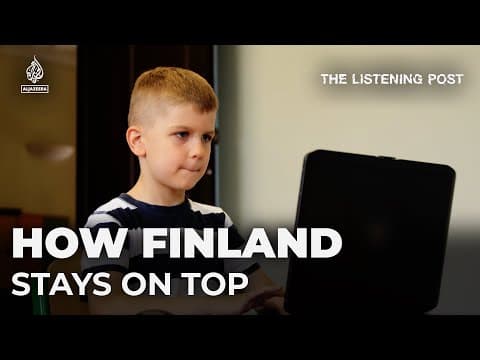
[0:13]But this video produced by Finland's National Audiovisual Institute has an important message about the media these kids are consuming. It's been designed to help pre-primary school children work out what's real and what's not. And what can be done if they're left scared or confused by what they're seeing? That's because in Finland no one is too young to start thinking about the reliability of the information they encounter. The approach that we are promoting is that you have to start with very young children before the school age. And and you start with basic elements of of media and understanding of what media is about. And then you build the understanding that there's always someone behind each picture and each story. And the the older the children get, the deeper you go into these different parts of media and and content creation and production. Media literacy is not one single subject. It's taught across all subjects. For example, in Finnish language and literature, we teach the basic skills, we talk about fake news, source analysis, media criticism. Then in maths, we might focus on statistics and algorithms. In art classes, students learn about images, how photos are edited. In history class, we discussed an air raid that took place during the Second World War and thought about how the same incident could be taught differently depending which side the country had fought on. It's very important that we don't just teach the subject matter, but also the analytical skills, who produced it and for what purpose? Spotting fake news is a very real part of daily education here in Finland. Sometimes it's subtly woven into everyday subjects, sometimes it's more specific. We're about to sit in on a class where 14-year-olds are learning all about miss, diss and malinformation, questioning and challenging claims like the moon is made of cheese. Today we're looking at identifying false information. Let's break down each case, one at a time. Shall we start with the moon is made of cheese? This is a cheese story. It had a lot of wrong things like there were loads of strange surnames and wrong places.
[2:45]We laughed a lot at these names. There was a scientist called Mozzarella Parmesan, a professor called Camembert Brie... Anyone found any examples of mis or disinformation? The students are very good at recognizing fake news. For example, when news about the war in Ukraine started appearing online, Finns in general have a very high standard of media literacy, we're not easily fooled. That's in part because media literacy is not a new concept for Finns. It's been part of the culture for more than a century, ever since the Nordic nation first gained independence from Russia in 1917. Almost a hundred years on, having walled itself off from years of Soviet propaganda. The fight against fake news is still being fought, first in the aftermath of Russia's 2014 annexation of Crimea. And more recently, with Putin's invasion of Ukraine, in particular, concerns about narratives challenging Finland's ambition to join NATO. And media literacy is now mandatory, a core component of the national curriculum. Teaching Finnish students to form a frontline of defense against any disinformation, including content infiltrating the 830 mile long border the two countries still share. During the period of Finlandization in the Cold War, the Finnish media were very cautious about their neighbor, the Soviet Union. People always had to ask themselves whether the news was really true. Of course, there have been changes since. Russia has taken on an increasingly aggressive global role. We're also spending an increasingly significant part of our lives on social media. So teaching media literacy and criticism in schools is so important. We were one of the first countries in in EU, probably in the world to actually have a specific policy for media literacy. There's no one single right way to promote media literacy. There are multiple ways and and different organizations can do the work from their own viewpoints. That way we feel that we can reach much more people than than we would be able to do if it was all done only by us, a governmental office producing only only materials by the government and and telling like the official story. There's no escaping the multi-faceted media education effort underway. So many different organizations are developing and delivering learning programs from schools, universities and libraries to government departments and NGOs. And one of the biggest players is the public broadcaster, Wylie. News Class is part of Yle's effort to boost media literacy. Mari Vesanummi is one of Yle's media producers. She works on a number of the news networks' teaching tools, including a project called News Class. We have 14 different news mentors working from around Finland. They go and meet the class, they tell them who they are, and then they go through like how news come about, like what you see on the TV, how does that happen. And once you go through the whole process, they they actually start thinking about these publication methods and that is really the way fake news can be detected.
[6:34]Like the lie detector, fake photos, memes, edited videos, tweets, Instagram stories, deep fake videos. The deep fake videos we produced have been really popular, and the reason why we put them out was that artificial intelligence is coming at a speed where we need to kind of let people know that it exists and how it works. We also offer different types of games that you can immerse yourself into and and think of what it would be like to be, for instance, a troll. Trolls, foxes, dogs. There's a whole menagerie of characters being deployed by game designers and developers to draw kids in. It's the more entertaining side of the educational toolkit, but that doesn't mean it's all just fun and games. Troll Factory is where you put yourself in the position of a troll and deliberately create as much harmful material as possible for online distribution.
[7:44]It's quite an unpleasant game, but students experience the harm of spreading misinformation, which is perhaps a good thing for them. We were tasked with being an internet troll for a week. We had to get as many followers and as much visibility for our account as possible by spreading disinformation.
[8:05]You get a lot of followers if you spread a lot of unpleasant things. Yle News Lab produced Troll Factory when Russian trolls were really on the news here in in Finland. It really makes you think, like, I do not want to be the Lord of of lies, which is the end result. When you think of kids who are gamers, if for some reason we manage to incorporate one media education game into this set of of gaming, it's only a bonus. Playing to students' strengths, the media literacy program is a point of pride. One of the many international indexes where this small Nordic nation consistently comes out on top. Having spent the last century schooling its citizens to fend off fake news, Finland is shifting its focus. Guarding against new trends, technologies and platforms to ensure that every pupil is prepared to fight false information, whatever form it might take. Thanks for watching. Hit that like button. Leave us a comment to let us know what you think about anything that we covered this week. And don't forget to follow us on Twitter. Does anyone really call that X? Facebook and Instagram for updates from the show. Links are in the description.


