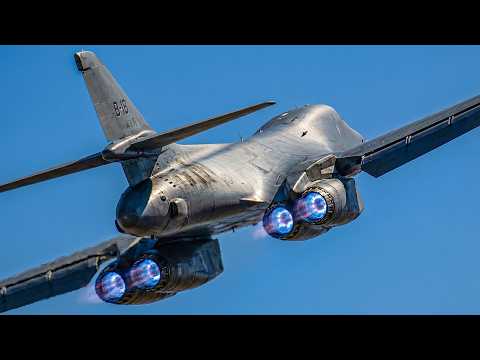
[0:04]A Cold War relic just became America's most dangerous bomber. Right now, 45 B-1B Lancers are being transformed into something the world has never seen before. While China and Russia race to develop hypersonic weapons, the US Air Force just found a way to turn an aging jet into a missile-carrying monster. We're talking about a bomber that can now carry 36 hypersonic missiles. That's more firepower than most entire Air Forces possess. The Pentagon calls it a stopgap measure, military analysts call it a game-changer. And America's adversaries, they're calling emergency meetings. This isn't an upgrade. It's a revolution. The B-1B Lancer was supposed to retire. Plans were drawn up, dates were set. The newer, stealthier B-21 Raider would take its place by the mid-2030s. But something unexpected happened. Engineers discovered that this 40-year-old bomber could do something no other aircraft in the American arsenal could match. And that discovery just changed everything about US Air Power.
[1:11]Introduction. Welcome to Jet Insight. What you're about to hear isn't speculation. The Air Force budget for fiscal year 2026 includes $50 million specifically for something called the External Heavy-Stores Pylon Program. That's government speak for giving the B-1B the ability to carry weapons on the outside of its fuselage. Weapons it was never designed to carry, weapons that travel at five times the speed of sound. Before the Lancer got this upgrade, it could haul 24 missiles internally. Now, we're looking at 36, and every single one of those additional missiles can be a hypersonic strike weapon. If you think America still builds the best military hardware in the world, type "PROUD" in the comments below. The Bone gets new teeth. Let's start with what makes this so significant. The B-1B earned its nickname "The Bone" from pilots who shortened B-1 to B-O-N-E. For decades, this aircraft served as America's conventional bombing workhorse. It flew combat missions over Iraq in 1998. It pounded Taliban positions in Afghanistan for 20 years. It launched 19 missiles at Syrian targets in 2018. And just last year, B-1Bs flew a grueling 34-hour mission from Dyess Air Force Base in Texas to strike terrorist targets in Iraq and Syria without ever landing. But here's what nobody expected. While everyone focused on the new B-21 stealth bomber, Boeing engineers were quietly working on something called Load Adaptable Modular pylons. These aren't just weapons racks. They're sophisticated mounting systems that can each handle 7,500 pounds of payload. The B-1B has six external hardpoints that were sealed up decades ago, when arms control treaties ended its nuclear mission. Those hardpoints are now being reopened. Think about what this means. A single B-1B taking off from Guam could carry 12 long-range anti-ship missiles on external pylons, plus 24 more missiles in its internal bomb bays. That's enough firepower to threaten an entire Chinese carrier battle group. One bomber, 36 missiles, each with a range of nearly 600 miles. The math gets even more impressive with hypersonic weapons. The Air Force has been testing the AGM-183A Air-Launched Rapid Response Weapon. This missile hits speeds above Mach 5. Current testing suggests a B-1B could carry up to 31 of these weapons using both internal bays and external pylons. 31 hypersonic missiles on one aircraft. No enemy air defense system on Earth was designed to handle that kind of saturation attack. Before we dive deeper, please take a second to like this video and subscribe. Over 98% of viewers watch without subscribing. It costs you nothing, but it means a lot to us. From nuclear striker to missile truck. Understanding why this matters requires knowing where the B-1B came from. Back in 1955, the Air Force wanted a bomber that combined the range and payload of the B-52 with the Mach 2 speed of newer supersonic jets. The result was the B-1A, which first flew in December 1974. President Carter killed the program in 1977, calling it too expensive. President Reagan brought it back in 1981 with modifications. The B-1B traded some speed for stealth. Maximum velocity dropped from Mach 2.2 to Mach 1.25. But the radar cross section shrunk dramatically. The payload capacity increased to 75,000 pounds, making it the heaviest lifting bomber in the US inventory. And those variable sweep wings gave it incredible versatility. Wings forward for maximum range, wings swept back for high-speed, low-altitude penetration runs. 100 B-1Bs rolled off the production line between 1985 and 1988. They formed the backbone of America's strategic bomber force during the final decade of the Cold War. Each one could carry 24 nuclear-tipped cruise missiles. But when the Soviet Union collapsed and the new start treaty was signed, everything changed. The B-1B's nuclear capability was completely removed in the mid-1990s. Conventional bombing became its only mission. That transition saved the bone. While the B-2 Spirit remained focused on strategic nuclear missions, the B-1B became the go-to platform for regional conflicts. Its massive payload meant it could loiter over a battlefield for hours, providing close air support with precision-guided bombs. Special Operations forces in Afghanistan loved having a B-1B overhead. It meant instant firepower whenever they needed it. But years of hard combat flying took their toll. The hot, dusty conditions in Iraq and Afghanistan were brutal on the aircraft. Each flight hour required 48 hours of maintenance. Some B-1Bs spent more time in the shop than in the air. By 2021, the Air Force decided to retire 17 of the least serviceable airframes. The plan was to keep the remaining fleet flying until the B-21 arrived in sufficient numbers. Then someone at Boeing had a different idea. What if instead of just maintaining the B-1B, we made it more capable? What if we turned it into something new? The upgrade that changed everything. The breakthrough came when engineers realized the external hardpoints could be reactivated. These weren't just simple mounting points. Each pylon position on the B-1B was originally designed to carry a 5,000-pound payload. Modern materials and computer-aided design meant Boeing could create pylons that handled even more weight while meeting strict aerodynamic and safety requirements. Wind tunnel testing started in fiscal year 2026. Engineers ran computational fluid dynamics simulations to ensure the pylons wouldn't create dangerous airflow disruptions. They tested different configurations with various weapon shapes. They verified that the aircraft's center of gravity remained within safe limits across the full range of loading options. The software integration proved just as critical as the hardware. The B-1B's stores management system needed updates to recognize the new pylon stations. Weapon release profiles had to be calculated for external carriage. Safety interlocks required programming to prevent accidental launches or dangerous flight conditions. All of this work served one primary goal: creating a platform that could test and eventually carry hypersonic weapons. The B-52 fleet is already overloaded with modernization programs, new engines, new radar, new communications systems. The Air Force couldn't afford to add hypersonic testing to that workload. The B-1B offered a solution. Lieutenant Colonel Scott Pontzer, Commander of the 419th Flight Test Squadron, explained the vision clearly. The B-1 LAM pylon allows the aircraft to carry different weapons in different configurations. That flexibility means varied weapon delivery and testing options, including completely new release profiles that weren't possible before. But hypersonics aren't the only benefit. The LAM pylons also enable carriage of the Long-Range Anti-Ship Missile. This weapon addresses what the Air Force calls an air-launch capability gap against high-threat maritime targets. Translation: China has been building a massive navy. The US needs ways to sink those ships from standoff range. A B-1B loaded with Lrazz missiles becomes a ship-killing platform that can operate hundreds of miles from enemy air defenses. The joint air-to-surface standoff missile gets a boost, too. Currently, a B-1B can carry 24 JASSM missiles internally. Add 12 more on external pylons and suddenly you have a bomber that can suppress an entire integrated air defense network by itself. No need for escort aircraft. No need to wait for defensive positions to be softened. One B-1B can launch 36 JASSM Extended Range missiles, each with a range of nearly 600 miles. Creating a saturation attack no enemy can defend against. Why this matters right now? Timing explains why this upgrade became so urgent. The Pentagon faces what military planners call the Bomber bathtub. As older B-1Bs and B-2s retire, the total number of operational bombers drops. The B-21 Raider won't reach full-scale production for years. That creates a dangerous gap where America has fewer bombers available just when global tensions are rising. China presents the most obvious challenge. Beijing has been flying bomber patrols around Taiwan. The People's Liberation Army Navy now operates multiple aircraft carriers, with more under construction. Chinese anti-ship ballistic missiles threaten US carrier strike groups throughout the Western Pacific. In this environment, long-range strike capability matters more than ever. Russia's invasion of Ukraine demonstrated another reality. Modern warfare burns through precision munitions at an incredible rate. The ability to deliver mass fires, to put steel on target quickly and in volume, determines battlefield outcomes. A single B-1B carrying 36 standoff missiles provides more combat power than many nation's entire air forces. Then there's Iran. Recent strikes on Iranian nuclear facilities showed that penetrating defended air space requires stealth platforms like the B-2. But follow-on attacks, destroying remaining targets after air defenses are suppressed. That's where a B-1B loaded with hypersonic weapons becomes invaluable. The combination of speed, payload, and standoff range creates options that didn't exist before. The cost factor can't be ignored either. Flying a B-1B costs $63,000 per flight. That's less than the B-52 at 72,000 and dramatically less than the B-2's 135,000. For the price of one B-2 sorty, you could fly two B-1B missions. And with the new pylons, those B-1Bs deliver more total firepower. Some critics argue the money should go toward buying more B-21s instead, build a bigger fleet of stealth bombers rather than upgrading an old platform. That argument misses a crucial point. The B-21 production line is still ramping up. Even if Congress doubled the procurement budget tomorrow, Northrop Grumman couldn't deliver aircraft any faster. The industrial capacity simply doesn't exist yet. Upgrading the B-1B provides combat capability now, while B-21 numbers slowly grow. There's a growing community of military veterans and aviation enthusiasts following these developments closely. If you appreciate the men and women who fly and maintain these incredible machines, you're in the right place. The Global Response. Other nations are paying attention. China's state media has already published articles about the B-1B upgrades. Their analysis focuses heavily on the hypersonic capability. Beijing knows that if US bombers can launch Mach 5+ weapons from a thousand miles away, Chinese air defenses face an impossible challenge. No interception system can reliably stop hypersonic missiles. The geometry and physics just don't work. Russia faces similar concerns. Despite their own hypersonic programs, Russian air defense networks weren't designed to counter mass bomber attacks with advanced standoff weapons. During the Cold War, Soviet planners expected nuclear exchanges, not prolonged conventional campaigns. A B-1B carrying three dozen precision missiles represents a threat their defensive architecture can't adequately address. The ripple effects extend beyond just China and Russia. North Korea watches these developments, knowing their antiquated air defenses offer zero protection against modern US bombers. Iran sees the writing on the wall after Israeli strikes degraded their defensive networks. Even neutral nations recognize that American Air Power maintains a technological edge that keeps growing. America's allies benefit, too. Japan, South Korea, and Australia all face potential threats from Chinese military expansion. Knowing that US bombers can deliver overwhelming firepower from safe standoff ranges provides reassurance. NATO partners in Europe see the B-1B upgrade as evidence that America isn't abandoning conventional military capability in favor of only building small numbers of exquisite systems. The bomber itself is making more international appearances. In July 2025, a B-1B landed at Royal Air Force Fairford in England for the Royal International Air Tattoo. This marked a rare public display in Europe, sending a clear message about US commitment to transatlantic defense. Bomber Task Force deployments to Guam continue demonstrating American reach throughout the Indo-Pacific. What comes next? The current plan calls for maintaining 44-45 B-1Bs in operational service through at least 2032, possibly extending to 2036. Several aircraft that were retired to the boneyard at Davis-Monthan Air Force Base in Arizona are being regenerated. When a B-1B suffered fire damage during maintenance at Dyess in 2022, the Air Force pulled one of the stored aircraft back into service rather than attempting expensive repairs. Facilities upgrades are underway. Ellsworth Air Force Base in South Dakota temporarily relocated its B-1B fleet to Grand Forks to allow runway construction supporting the eventual transition to the B-21. These infrastructure improvements ensure bases can handle both the current bomber fleet and its eventual replacement. The External Heavy-Stores Pylon Program continues through multiple fiscal years. Initial funding supports wind tunnel testing and software development. Subsequent budgets will cover actual pylon production and integration onto operational aircraft. Flight testing of the complete system, including live weapon releases, follows. By the late 2020s, combat-coded B-1Bs should be regularly flying with full external loads. Hypersonic weapon development proceeds in parallel. The Air Force is working on both the ARROW Boost-Glide system and the HACM air-breathing cruise missile. Both weapons are designed for B-1B compatibility. Testing on the Lancer reduces the burden on the already overworked B-52 test fleet and provides valuable operational data on employing hypersonics from a high-speed, low-altitude platform. The bone is getting new teeth, and those teeth are sharper than anything America's adversaries expected. Conclusion. A bomber designed in the 1970s and built in the 90s just became relevant again for the 2030s and beyond. The B-1B Lancer proves that smart upgrades can extend the life and capability of platforms everyone thought were obsolete. While the world focused on stealth and next-generation systems, American engineers found a way to turn an existing asset into a strategic game-changer. 45 bombers, up to 36 missiles each. That's over 1,600 weapons deliverable from standoff range with no warning. The math is simple, the implications are enormous. If you found this breakdown valuable, hit that like button and subscribe for more in-depth military aviation analysis. The story of American Air Power is still being written, and you don't want to miss what comes next.


