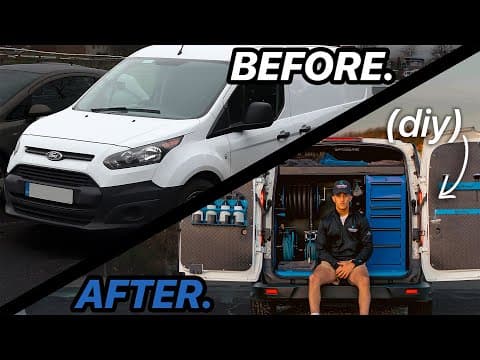
[0:00]I just built out my first ever mobile detailing van. My company recently hit $30,000 per month and this van behind me is going to be a huge part of the process on how I'm going to hit $100,000 per month with a mobile detailing company. I documented the entire process of me building it this way you guys can replicate it. To make it even easier for you guys, I included links to every single product I use in the description below. This setup is purely DIY and is made for straight functionality. Let's not waste any more time and get straight into the build. So the first step that we're going to do is we're going to paint. To prepare for that, we pretty much removed the rubber mat that was inside and then all the plastic pieces. The vision that I have in mind is pretty much to paint all the sides, the roof black, and then make the plastics as well as the partition that we removed right here is to make that blue as well as these plastics over here blue. Just to make it really pop, make it stand out and make it be unique. So to prepare for that, we removed everything like I said. I didn't show this on camera because it is super easy. If you guys are going to go ahead and do this, all you have to do for the plastic pieces, it just simply pop them off. Just be very careful because they are flimsy. Then to remove the rubber mat, it's just simple lag bolts that are right here. So you just got to get the right bit, remove them, and it's actually really easy. That's just why I didn't show it on camera. I think it would have been a waste to uh, fill up the video with just us removing because it really is super easy. Just DM me on Instagram if you guys need any help with that. But other than that, it's fully prepped, fully cleaned, and now we're going to get straight on into painting, guys. So the steps for painting is fairly simple. We're going to start off by sanding. We're going to start with a 120 grit sandpaper and then work our way up to 220, and then we're going to spray the interior with some primer. And then after that dries, we'll go and we will take our black automotive enamel and apply that. And then right after that, we are going to take clear durable top coat. And I got high gloss because I wanted it to be glossy. This is all on the Amazon storefront, and pretty much where we're doing specifically right now is just the sides up here. Right over here is going to be covered with the plastics, so we don't have to really worried about that. And then, um, over here as well as the plastic. So mainly just the sides and the roof, we're going to paint all black. So let's get right into it.
[2:41]All right, so the van is fully sanded down and ready to prime. Just a quick reminder also, if you guys are going to paint your van like this, make sure you guys cover up any lights or remove them just so then you don't get any spray paint over them. But now that's fully sanded down, we're just going to go ahead and take some of this rustoleum primer and pretty much prime all of the interior surfaces. So let's get straight on into it.
[3:17]Van is now fully primed as you guys can see. Got the sides, the roof, everywhere that we needed to. Another note is just make sure you guys get a high quality mask. We definitely could have got better mask, but also make sure you guys are ventilating everywhere. We got both garages open, windows open, you guys don't want to be breathing in the spray paint. But other than that though, now the vehicle is fully primed, all you have to do is wait for it to dry. As you guys can see, it's still a little bit wet. And once it's dry, we're going to take this automotive enamel, like I said, and we're going to pretty much color everything black.
[4:02]All right, so you spray painted everything black as you guys can see, both sides are done as well as the roof. It looks a little bit blotchy right now though because it still needs to dry, but once it's all dry, we're going to apply our clear durable top coat. This is going to give it a nice protective layer, this way it's harder to scrape it off, as well as just a really nice finish.
[4:29]All right, so while the top coat is drying inside of the van, we're going to move on to the plastics. It's a same process as inside of the van, the only difference is that before the primer, we're going to apply this plastic adhesion promoter. So now all we have to do is just go on to sanding down these plastics.
[5:31]Now, on to the primer.
[5:42]All right, now that the primer is fully dried, we're going to go ahead and take our blue spray paint and give a nice even layer over all of these pieces. The reason why I went with blue is because my company is blue and black, but if you guys have like say a black and red company, you can go ahead and spray these accents red. We're going to get right on into it.
[6:06]All right, now that all the plastic pieces are blue, once they're fully dried, we're going to go ahead and spray on this matte clear enamel.
[7:00]All right, so all the plastic pieces as well as the partition is in. It's looking absolutely amazing right now, but now it's time to actually move on to the build. So the first step is the floorboard right here. So we're going to take a piece of plywood and lay it down here and get the dimensions and then cut it to size. All right, so we have the piece of plywood and it's going to act as our floorboard. Now, it took a couple measurements. First measurement we took was from the partition all the way down to this one plastic piece. I'm not really sure what it's called, but we're pushing this all the way up against the partition and we pretty much took this measurement. We went a little bit further back, this way we can tuck it underneath a little bit. So we're just going to make this cut and take this whole piece off to shorten it up. Now, the other two measurements we took was this right here because this is a little bit of a lip and we want it to kind of match up better with this plastic piece. So, we went in about an inch and a half and we went all the way down and just kind of lined it up with here as best as possible. So we're going to just take this whole piece out and then we're just going to go in and out and just line up with those plastic pieces way better. And then another thing that we also want to do is we want to, there's bolts underneath here holding the partition in. I think we're going to do is we're going to drill holes so then we can take the bolts and drill them through the plywood through the partition. This way it's all held in super nice. We have the floorboard on the table right now ready to cut. We're going to make the cuts like I said when I was inside of the van as you guys can see. And the only tool we're really going to be using during this whole build process is really just a circular saw and a drill, guys. All right, so we have the whole entire floorboard laid out in here. We just pulled it back a little bit behind these bolts because we're going to make the markings so where we need to drill our holes, this way we can slide the bolts through the plywood into the partition. So all you really need to do for that is the bolts are about an inch away from this partition. So we're just going to do an inch right there, line it up, right about there.
[9:14]All right, so we drilled the bolts into the floor piece right here as you guys can see. It fits nice and snug. Everything is aligned up. We are going to take those out because we're going to build and paint most of the frame outside of the van. We just want to make sure everything fits because our next thing that we need to do is align everything up. This way we know exactly where the backing piece is going to go that will hold the reels, vacuum reel, pressure washing reel, all of that. So we took our Harbor Freight end cabinet and this one thing really determines the measurements of everything. So pretty much we put it where we wanted it. We wanted it a little bit behind this plastic piece just so then if we put our match shine bottles right here or match shine brush holder, everything will fit nice and snug. And so what we did is we just took a line and drew right behind the end cabinet. So, pretty much how it's going to work is the backing piece is going to go right behind it, nice and snug, this way this can push up right against it. So that's going to go right here. And the other measurement we took is just the height of this whole entire thing because what we're going to pretty much have is a backing piece that's back there and then a shelf on top of this end count. This way we have more storage. And the height that we got for that was 35 and a half. We're going to put a rubber mat underneath here, too, so it's going to raise it up a little bit. That's essentially what we did now just so we know exactly what measurements we need to cut out that backing piece. All right, so we got the backing piece right here, which is essentially a piece of three-quarter inch plywood. We got it all lined up right at 35 and a half, like I said. The plywood is already four feet and we'll match up perfectly to our floor piece, so we don't really got to worry about that. All we have to do is make this one cut for the height. So let's get straight on into that. So we got the backing piece fully cut out as you guys can see. We tossed the end cabinet over there so you guys have a better visual just in case you guys didn't understand what I was talking about before. But just as a reminder, this backing piece is 35 and a half inches by 4 feet. So now the next step we have to do is pretty much install that backing piece right there on that floorboard using some brackets and glue. All we did was take some basic L brackets that you guys can find at Home Depot or Lowe's. We put four in the front and then over here we put two in the back. And then another thing we did is just for some extra support was we took some tight bond ultimate wood glue and kind of applied it like caulk just on both sides. And then to add just more support, like I said. Now the next thing that we have to do is we have to cut the top piece for the storage. And what we're going to cut that to is obviously four feet and we're going to make it line up with this end cabinet, so about 4 feet and a little bit less than 23 inches.
[12:01]So we installed the top piece as you guys can see. We used the same L brackets as the backing plate, and then another thing we did is we took a line of wood glue and pretty much put it right there. And then we kind of sandwiched it on top of each other, this way just has more support. So that's that. It's looking amazing. Now the next step that we're going to go ahead and do is we're going to take a little piece of wood and just apply it right on the end just so then if we put anything on top, it doesn't fall off. But that's the next step. And that's obviously going to be 4 feet and then we're going to make it about 2, 2 and a half inches tall.
[12:42]All right, so we installed this nice little piece here. I even went ahead and beveled it this way it gives it a nice finish. As you guys can see. And then one more thing that we are going to do that we just decided, we're going to have to backtrack a little bit, but we realized we should have took this rubber mat that I had and put it on top of this um base prior to putting on this backing plate. So what we're going to do right now is we're going to work backwards a little bit. Not too much work though. We're just going to take off the backing plate and then install that rubber mat on the entirety of the base rather than just up here because we were originally just going to cut it out and put it right down here, but now I just decided, you know what, it's probably best if we just put it over the whole entire base. So we're going to go ahead, take this off, cut this to size, install it, and then put everything back like how it is now.
[13:41]So we backtracked and now we have the rubber mat on top of the base plate. We should have done it before, but it's whatever now. Everything's back and installed. We're going to not really install the reels, we're going to set them up and drill the holes, this way everything's ready to go and install once the thing is fully painted. So what we're going to do is we made our marks for our vacuum hose reel right there, as well as I'm about to take my pencil and make the marks right there, and then drill holes. And how these bottom reels are going to be installed is we're going to take just a simple lug nut like this. As you guys can see. And then we're going to screw a nut right on top of there, so then it'll stick up through, and then we'll just tighten it on, and that's going to securely fasten these bottom reels. All right, so we drilled all the holes for our reels. Now we can move on to painting. Also, real quick note, don't mind me, absolutely trash in this garage floor. We're going to get it redone soon. That's the reason why I was able to just drill straight down. I didn't make a hole in the floor. I did stop as soon as I hit the concrete, but you guys got to keep in mind if you guys are working on a floor that you guys actually care about and aren't getting redone soon like me, you might want to either raise this up with some two by fours or do something like that, this way you don't damage the floor beneath. But anyways, let's move straight on to the painting. The first step before we actually get into the painting, we have to sand everything down, make it nice and flush.
[15:18]So the whole thing is now primed. Now, we just have to move on to the black.
[15:33]All right, so now that the whole entire frame is painted black, we took it and we slapped it inside of the van. Before we did that though, we made sure that we had the bolts on there. And then we also took off this little blue piece at the bottom, make sure that it doesn't get scraped up. But it's looking absolutely amazing, it fit in perfectly. And if you guys come around over here, it looks perfect as well. It's super dark, but it's coming along. So now what we essentially have to do though, is we're kind of going to like finish this backside. So we're going to install all the reels, so the vacuum reel, the compressor reel, the pressure washing reel, and then we're also going to install that blue cabinet right here.
[16:22]All these reels are installed now, including this electrical reel in the top right. It's starting to get dark now, but the last thing we're going to do for tonight is I'm going to take some of this roof flashing right here and just install it underneath all these seams where possible water might get underneath the plywood underneath. I just want to make sure it's all water tight and nothing goes wrong with that. So I'm going to apply that right now, and that's also black, so it'll fit in perfectly. Everything is now nice and sealed up. Tomorrow we're going to move on to the water tank and everything behind the actual setup. All right, so we got the water tank inside of the setup. Now we're going to go ahead and do is we're going to ratchet strap it down, this way it's nice and secure. And how we're going to do that is I already took these and placed it on the far side over here. But now we're going to take these two and place them right here, this way you can take the ratchet straps and hook them on either side, this way it's nice and secure, like I said. The float valve is now installed. And then over here I did something else I didn't get on camera. I added in a couple fittings. This is the connection that's going to go to the pressure washer, as well as the bucket filler. And what I did here is I pretty much took a male to male three-force adapter, put an on and off switch connected to it, which is just three-force or three-force, and then I put a three-force to one-half inch hose barb on here. That'll connect the PVC to the bucket filler and pressure washer, like I said. And now what we're going to go ahead and do is we're going to install the Aqua water system right in the corner over there. I put a trash bag this way it collects all of the, whatever, the metal that comes off of that when I make a hole. So all you have to do for that is take this one and a half inch hole saw and then just drill a hole in there, slide this in, put the cap over, and then just install it using these screws. Super easy.
[20:17]So the Aqua water system is installed. You just open it up like this, super easy. Close it.
[20:25]Now to connect that to the float valve, we have to use this PVC piping, as well as some hose barbs. So what we're going to do is we're going to take this one half to three-force little divider right here, connect it to this hose barb. And then that's going to be able to connect this to the end of the float valve. So this is going to go right in there. So the Aqua water system is hooked up to the float valve. Now all you have to do is start doing is start making this box that goes around this water tank here. So we're going to start by making this front piece and the dimensions for that is 44 and a half by 28. And that'll pretty much make it so that on either side, it'll match up perfectly with this end right here.
[21:17]So we cut out this side. Now we have to cut out the top. And the top measurement is 44 and a half by 21 inches. So once that's done, we'll pretty much cut those out, spray paint them and then move on to all the fittings behind here for the water tank and the pressure washer and the bucket filler. The top piece is now cut out. It's going to go in the van something like this. Obviously going to be straighter once we actually install it, but it's just a general vision just to make sure shit fits. But now that everything fits, we're going to go ahead and spray paint it all black. And while that's drying, we're going to move on and do all these fittings behind here.
[22:17]So all these pieces are fully spray painted black and while we're waiting for them to dry, I'm going to explain the plumbing you guys. So real quick how the plumbing essentially works is it all starts from the water tank, obviously from the hose barb how we set it up. And pretty much from this hose barb, we're going to take your clear piping and attach it right to there. And then that'll go to the water pump. But you guys want to make sure that the pump pretty much flows this way. So you want to make sure the flow of water is going from this end, as indicated by the arrow, to that end. And make sure you guys install your filter, you know, this way it works properly. But other than that, the clear piping is going to go from right there. Connect up to here, and then obviously it's going to flow out. And then we're going to put some more clear piping from here onto this system. Now, this system obviously split up, but this is going to go to our pressure washer. And then this is going to go to obviously to bucket filler, this will obviously, you know, go to the pressure washer. So everything's set up. It's actually looking way better than I thought. We mounted the pump up right against this plastic piece and then we went ahead and did over here is we literally just drilled holes right here. And then there was a hole already there, we pretty much just tied zip ties down through here. So super convenient, you know, if you're coming in from the van, you come out, you go in, you just turn on your fittings, all that wonderful stuff. So other than that, that's all set up. But now what we got to do is we got to go ahead and install this box. We got to put the wall right here, as well as the top piece. This way everything's covered up and we can toss our pressure washer, our air compressor, as well as our vacuum on top of here. So let's go do that, boys.
[24:16]So I found good placement for all of my equipment inside of the van. This is obviously going to vary for you guys depending on the type of equipment that you guys have. But real quick, I'm going to go over why place it in this area, so you guys know what to look out for. So real quick, I had this split right here. Now, essentially what this splitter does is allows me to connect to the water tank and also a customer's um house using a garden hose. Now I put a quick connect on it, this way, you know, it makes it a garden hose connection, super easy. But essentially, the reason why I have this is because I don't want to fill up the water tank all the time. Mainly because of these transmissions inside of these vans aren't the best and obviously adding water in here adds weight. So overall, I'm just going to use a garden hose when I can and when possible. So that's what's going on here. Other than that though, I pretty much placed the pressure washer on the right, the air compressor in the middle, and then the vacuum on the far left. And the reason for this is because the vacuum hose lead hose is super long, so I was able to run it all the way through on top of the water tank, all the way over to the vacuum over there. And then the air compressor, obviously, I just had enough room for it to fit in the middle. And then this kind of works out perfectly, you know, all the stuff for the water hose all on this side over here, just making it super easy when we go up to details. Other than that though, one thing that I do want to do for the electrical and the wires, they're all going to somehow end up connecting somewhere over here once the generator is plugged in. So I'm going to go ahead and do is I'm going to just drill a small hole somewhere back here, so then one, this air compressor lead hose can come up from the bottom and then go into here. This way it just looks a little better. It looks a little funky right now, coming across there like that. And then also what I can go ahead and do is I can kind of plop the electrical cords down in there. And then I'm going to probably, once I install the generator, just drill a small hole right here that can obviously, you know, pull out and then connect inside of the generator. But that's pretty much the setup that's going on here. Other than that though, one thing I do need to do is I need to go grab Bungees and stuff, this way we can properly hold all these down, this way they don't move when we're driving. All right, so I cleared off the shelf up here. And I also ran a Home Depot and grabbed some Bungee cords and some screw eyes. What I'm going to go ahead and do now though is just take a hole saw and drill a small hole, this way I can connect the air compressor lead hose up and through there like I was saying before, so it looks better. As well as some electrical cords, if need may be. So I'm going to go ahead and do that. Before I do that, I'm going to obviously set up a trash bag underneath there, this way it catches all the sawdust, as well as that little circle that falls out when you drill with the hole saw.
[32:00]So that's the system. So now we're going to go ahead real quick and just drill a hole and get all that stuff situated. All right, so I cleared off the shelf up here, and now I'm going to go ahead and drill the hole. I already know where I'm going to place them. It's literally going to go just about right there. But other than that, all I have to do is just drive it in and then we're good to go from there. I'm going to go ahead and do that now and I'll check back in with you guys in a little bit. All right, so I drove them in as you guys can see. The reason why I drove these in at the angle that I drove them in is so that when I actually put this piece of wood on top, there'll be no issues or anything like that. But other than that, I drove them in pretty secure and they're not really moving around a lot, which is a good sign. But now what we're going to do is we're going to use this angle to hold it down. We're going to connect these with a bungee cord. Other than that, it's pretty good to go. It's all set up. So I secured everything with those rubber straps. Now, everything's perfect, nothing really moves. So I have no issue when we're driving. I also went ahead and hooked this up to the splitter over here, so now this whole entire system is set up. Also, one more thing we tested the whole water system. Make sure you guys are double clamping these and using Teflon tape on the barbs, this way, you know, no water shoots out. That's actually a really big tip because there was tons and tons of water shooting out, and this just double clamping it and adding some Teflon tape on the barb helped a lot. So now that whole water system set up and ready to go. But now what we're moving on to is our H2O slide out, our generator slide out. So how we're doing this is we're pretty much taking two by fours that we spray painted black and we're putting it on the inner sides of the slider. As you guys can see. Both inner pieces connecting to the plywood. And then pretty much there's holes down here. Right here. Which we're going to go then and take these bolts and slide them right on through, as you guys can see right there. Also, right below this isn't the bottom of the van, so you really don't got to worry, there's like a little platform. So you're literally hitting nothing when you drill straight down. So that's completely fine. Other than that though, that side be finished, but it's super secure. Now we're going to go move over to this side and actually install the generator itself, ratchet strap it down, and then we'll move forward from there.
[34:25]We got the generator installed, it's fully ratchet strapped down. We kind of just worked the ratchet strap through the slide out up and around and then made it come out all the way over here. Then just tied it down, so now it's super tight, it's not moving anywhere. But now we're going to make the shelf and the storage space on top of the generator. So it really depends on how big you want your storage space to be. But we pretty much took a measurement from right here to back there. And then obviously across to meet the partition, I know everyone has a different partition, so you guys kind of have to kind of measure to it. Um, if you don't have a partition, you can probably just make like a wall that comes from here, going up. But other than that though, we got that cut out. We got it spray painted black, we primed it, did all the steps, and now we just got to use these L brackets to go and install it underneath. And we're barely putting it above here. It's going to be a little bit above the generator, this way we have as much room as possible.
[35:39]Other than that though, I pretty much placed the pressure washer on the right, the air compressor in the middle, and then the vacuum on the far left. And the reason for this is because the vacuum hose lead hose is super long, so I was able to run it all the way through on top of the water tank, all the way over to the vacuum over there. And then the air compressor, obviously, I just had enough room for it to fit in the middle. And then this kind of works out perfectly, you know, all the stuff for the water hose all on this side over here, just making it super easy when we go up to details. Other than that though, one thing that I do want to do is I'm going to drill a small hole somewhere back here so then one, this air compressor lead hose can come up from the bottom and then go into here. This way it just looks a little better. It looks a little funky right now, coming across there like that. And then also what I can go ahead and do is I can kind of plop the electrical cords down in there. And then I'm going to probably, once I install the generator, just drill a small hole right here that can obviously, you know, pull out and then connect inside of the generator. But that's pretty much the setup that's going on here.
[37:19]Other than that, thank you guys so much for watching. If you guys struggled at any point during the build, feel free to DM me on Instagram. I'll answer any and all questions. My Instagram is Vincent Caruso. Also guys, don't forget all the links to all the products and equipment I use are in the description below. And then also if you guys do end up building the setup, feel free to shoot a picture over to me on Instagram and I'll repost it to my story.