[0:00]So, the problem is clear, too much pollution. What then is the solution? Well, putting greenery on the outside of buildings is one way to clean the air. Anna O'Neal reports now on London's living buildings. 21 meters high and containing thousands of plants, this living breathing wall in Victoria is the largest of its type in London. It's one of a growing number of similar projects in the capital, put up to try to counter air pollution. A study being carried out at Middlesex University is looking at how plants absorb the pollutants in the air and it's showing some encouraging results. Plants on living walls can absorb the particulate matter and therefore reduce the amount of this harmful pollutant in the air. And we've also seen some reduction in local nitrogen dioxide levels. It's not just about living walls. London is getting clever about where it can add more greenery. There are more than 200,000 square meters of green rooftops in Central London, like this one here at Evershed Sutherland in the city. And more than a million across the city as a whole, making London one of the green rooftop capitals of the world. Over in Milan, they've taken the green concept even further. The Bosco Verticale, or Vertical Forest Skyscraper, won Best Tall Building worldwide in 2015. We bought it off plan in 2014, and I remember that one day I was passing by and it was the day that they were bringing the plants up to the terraces. All the roads were blocked and I looked up at this incredible skyscraper that was coming to life. Its creator says is an example of how architecture can help in the fight against air pollution. It's a quite a strong contribution in terms of reduction of CO2, production of oxygen and what is also more important is the contribution to absorb the dust, the micro protocol which has the most poison. If we increase the surface for forest inside our city, we are, let me say, decided to fight in the field of the enemy. Back in London, while living buildings are breathing life into the city, the root of the problem still needs tackling. If you want to sort air pollution out in London, you focus on the sources rather than trying to take the bad air out. So, if you want to sort air quality, sort the cars, sort the gas boilers out. Once we get rid of diesel and you've got the residual air pollution, the green roofs, like the green walls, like the trees, like the parks will actually help ameliorate the residual air pollution after diesel's gone away. As London grows, improving air quality is becoming more urgent. Green roofs and walls have an ever growing part to play in improving the air we breathe. Anna O'Neal, BBC London News.
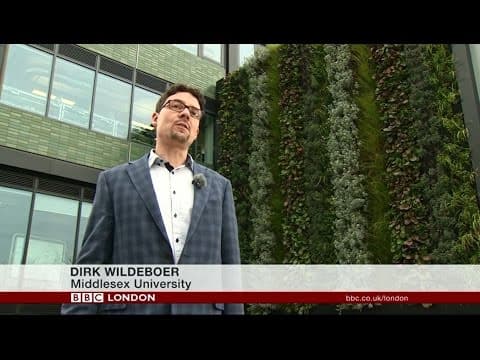
Can living walls reduce air pollution? BBC News investigates at Middlesex University
Middlesex University
3m 2s478 words~3 min read
YouTube auto captions
Transcript source
YouTube auto captions
This transcript was extracted from YouTube's auto-generated caption track. The transcript below is server-rendered so it can be read, searched, cited, and shared without opening the original YouTube player.
Pull quotes
[0:00]21 meters high and containing thousands of plants, this living breathing wall in Victoria is the largest of its type in London.
[0:00]It's one of a growing number of similar projects in the capital, put up to try to counter air pollution.
[0:00]A study being carried out at Middlesex University is looking at how plants absorb the pollutants in the air and it's showing some encouraging results.
[0:00]Plants on living walls can absorb the particulate matter and therefore reduce the amount of this harmful pollutant in the air.
Use this transcript
Related transcript hubs
Watch on YouTube
Share
MORE TRANSCRIPTS


