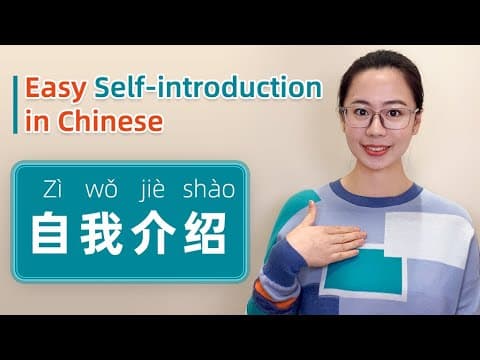
[0:04]大家好, welcome back to Everyday Chinese. In today's video, we're going to go through a self-introduction template. It will cover the most common expressions you'll need to introduce yourself. All right, let's get into the lesson. For more basic Chinese lessons like this video, you can check out our everyday Chinese 101 course. The link is in the description box as below. Before you introduce yourself, first you need to give a conversation starter to greet people. If you are in a one-to-one situation, you can certainly say, 你好。 你好。 But if you are in front of a group of people, you should say, 大家好。 大家好。 你好。 你好。 你好。
[1:07]大家好。 大家好。 大家好。 Here, you can also add a lead-in before you start. 下面我来介绍一下我自己。 下面 means next. 我来, let me. 介绍 to introduce. 一下 a little bit. 我自己, myself. 下面我来介绍一下我自己。 or you can simply say, 我来介绍一下我自己。
[1:52]下面我来介绍一下我自己。 下面我来介绍一下我自己。 我来介绍一下我自己。 我来介绍一下我自己。
[2:09]To introduce your name, you can use 我叫 + name。 我叫Joyce。 Or "You can call me" 你可以叫我 or 你们可以叫我 + nickname。 My parents and friends would like to call me by my nickname 佳佳, so I would say, 你们可以叫我佳佳。 Or everyone calls me 大家都叫我 + nickname。 大家都叫我佳佳。 我叫胡安娜。 你可以叫我安娜。 大家都叫我安娜。 我叫王建勋。 你可以叫我建勋。 大家都叫我建勋。 Next, you can introduce your background a little bit, for example, where do you come from, where did you grow up or where do you live now. To introduce the country you come from, you can use 我是 + nationality。 我是。 For example, 我是中国人。 我是美国人。 Or you can also use the pattern 我来自 + place。
[3:44]我来自。 来自 means to come from. 我来自陕西西安。 我来自美国纽约。 Note that when you express locations in Chinese, you always start from the largest location to the smallest one, which is the opposite to that in English.
[4:08]我来自河北邯郸。 我来自四川成都。 我来自黑龙江哈尔滨。 If you were born in one place, but grew up in another place, you can say 我在 place 出生, 但是我在 place 长大。 出生 means to be born. 但是我在 a place 长大。 长大 means to grow up. For example, 我在美国出生, 但是我在澳大利亚长大。 If you've lived in one place for years, you can say 我在 place 住了 + time + 了。 For example, I will say, 我在香港住了十年了。 我在哈尔滨出生,但是我在北京长大。 我在上海出生,但是我在香港长大。 我在深圳住了十五年了。 我在法国住了两年了。
[5:26]Next, you can introduce what you are doing currently. If you are a student, you can introduce 我在 place 读 degree。 读 means to read. Here it means "to study". For example, 我在中国读大学。 我在美国读研究生。
[5:53]我在香港读大学。 我在长春读研究生。 If you want to introduce your major a little bit, you can say 我学习sth.专业。 专业 is the Chinese noun for major. For example, 我学习教育专业。 我学习金融专业。
[6:24]我学习市场营销专业。 我学习历史专业。 If you work right now, there are several ways to introduce your job. The first way is to say 我在 place 做 occupation。 我在旅行社做导游。 我在餐厅做服务员。
[6:53]The second way is to use the 是...的 structure to emphasize the job function or the industry you are in. 我是做销售的。 我是做金融的。 The third ways is to simply say 我是一名 + occupation。 我是一名汉语老师。 我是一名工程师。 我在香港做金融。 我在北京做IT。
[7:31]我是做保险的。 我是做物流的。 我是一名工程师。 我是一名医生。
[7:45]To say your interests or your hobbies, you can say 我 ( 超级/特别/最 ) 喜欢 noun/verb。 超级 means super. 特别 means particularly. 最 means the most. For example, 我超级喜欢学习外语。 我特别喜欢交朋友。 我最喜欢做饭。 You can also say I'm very interested in 我对 sth.很感兴趣。 我对艺术很感兴趣。 我对中国历史很感兴趣。 我超级喜欢打游戏。 我超级喜欢看电影。
[8:49]我特别喜欢跑步。 我特别喜欢听歌。 我最喜欢看书。 我最喜欢学汉语。 If you want to introduce your personality a little bit, you can say 我是一个 + description 的人。 我是一个很开朗的人。 我是一个很害羞的人。 Or you can quote your friends, 我的朋友们都说 + description。 我的朋友们都说我是一个很害羞的人。 我是一个很开朗的人。 我的朋友们都说我是一个很幽默的人。 At the end, you can say something very friendly. 很高兴认识你。 很高兴认识你们。 or 很高兴认识大家。 Or you can also say something very modest. 请多多指教。 请多多指教 means please do give me some guidance or I'd highly appreciate your kind guidance. 很高兴认识你。
[10:18]很高兴认识你。 很高兴认识大家。 很高兴认识大家。 请多多指教。 请多多指教。 Now I will take myself as an example to give you a complete self-introduction. 大家好。我叫Joyce。我的朋友们都叫我佳佳。我来自陕西西安。 我在香港住了十年了。我是一名汉语老师。我特别喜欢学习外语。 我的朋友们都说我是一个特别开朗的人。很高兴认识你们。请多多指教。 That's all for today's video. You can check out the full template in our website. You are most welcome to share with us your own self-introduction in the comment. And if you decide to learn Chinese systematically, you can go to our website to check out our Chinese lessons prepared by our qualified teachers. I'll see you next time. 再见!


