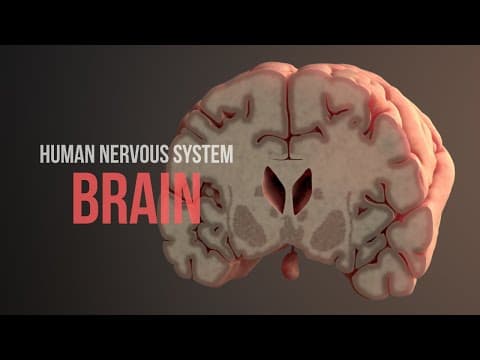
[0:02]In this animation, we will explain how our brain works with breathtaking images.
[0:12]During pregnancy, a new human being is formed in the womb. A brain develops in which the cerebrum has no folds. Soon, however, brain folds develop that enable our cerebrum to have an incredible number of neurons in a very small space.
[0:33]Let's take a look at the general design of our brain. The brain is generally divided into different parts. The brain stem consists of three parts, the medulla oblongata, the pons and the midbrain.
[0:51]The cerebellum is smaller than the cerebrum, but has almost as many nerve cells as the cerebrum.
[1:03]Like the cerebellum, the cerebrum has a left and a right hemisphere. Both hemispheres are divided into areas. The central sulcus, which appears red here, separates the frontal lobe from the parietal lobe. There is also a temporal lobe and an occipital lobe.
[1:37]The insular cortex can be found under the frontal, parietal and temporal lobes.
[1:47]Let us first familiarize ourselves with the outer structures of the brain. As the brain is very fragile, it is well protected by the hard skull, which consists of several bones. In addition, the brain and spinal cord are surrounded by three managers. The first meninges is attached directly to the brain and is called Pia Mater. Blood vessels between the pia mater and the arachnoid mater supply the brain.
[2:18]The dura mater is very robust and forms the outermost of the three meninges.
[2:29]The cerebrospinal fluid, which contains more than just immune cells, can be found between the pia mater and the arachnoid mater. This cerebrospinal fluid also serves as a cushion, protecting the brain in the event of rapid movement of the skull or a blow to the head.
[2:56]Around 500 milliliters of cerebrospinal fluid is produced by cells in the brain per day. The cerebrospinal fluid circulates not only in the subarachnoid space, but also in cavities known as ventricles.
[3:17]Ventricles are commonly divided into lateral ventricles and the third and the fourth ventricles.
[3:28]The brain consists of nerve fibers, which can be recognized as white matter and nerve cell bodies, which are referred to as gray matter. In principle, all nerve cells have a similar structure. Nerve cells have a cell body in which there is a cell nucleus. Nerve cells often form dendrites, which possess spines.
[4:04]In addition, an axon is formed, with the help of which the nerve cell can transmit an electrical signal to another cell. The two nerve cells use a synapse to transmit an electrical signal. A synapse consists of a presynaptic part, a postsynaptic part and a small gap between the two.
[4:36]Although the general structure is always the same, there are numerous forms that nerve cells can take. Nerve cells are usually divided into the types shown here. In addition, many axons in the human body are surrounded by myelin, which is formed within the brain by oligodendrocytes. This allows an impulse to be transmitted even faster.
[5:01]The cerebral cortex consists mainly of six layers. For the sake of clarity, only a few cells and nerve fibers are shown here.
[5:25]Under certain conditions, these nerve cells can die. In this case, we are talking about diseases such as Alzheimer's. A progressive breakdown of the nerve cells causes the brain to shrink and the folding changes. Some of the most common symptoms are forgetfulness, orientation problems and difficulties in learning new information. Certain nerve cells or areas of the brain perform different functions. The prefrontal cortex contains nerve cells that are said to be responsible for our personality, problem solving and self-control, among other things. Broca's area, which makes spoken and written language possible, is often located on the left side. Another important area in the frontal lobe is the motor cortex, which cooperates with the cerebellum so that we can carry out voluntary movements. With the help of the directly adjacent somatosensory cortex, which processes information from receptors on the skin, for example, we are able to generate complex movement sequences. It is important to note that the left side of the brain receives signals from the right side of the body, and the right side of the brain receives signals from the left side of the body.
[7:03]Inside the brain, there are also clusters of nerve cell bodies that perform very specific tasks. The thalamus is an extremely important area, which is also known as the gateway to consciousness and is part of the diencephalon. All sensory perceptions, with the exception of the sense of smell, are processed and filtered by the thalamus before they reach the cerebral cortex. For this reason, we only perceive a few of the numerous sensory stimuli. Here are just some of the many nerve fibers that send signals from our body to the thalamus, which processes them and, if necessary, transmits them to the neocortex.
[7:55]The brain has nerve fibers that run from one side to the other, so that both hemispheres of the brain can communicate with each other. The entirety of these nerve fibers is called corpus callosum. The thumb-sized corpus callosum is used for the exchange of information and coordination between the two hemispheres of the brain. So the left hand literally knows what the right hand is doing. Let's take a look at some other areas of the brain that are responsible for very specific tasks. One very important area is the hypothalamus, which is probably the most important control center of the autonomic nervous system. The correct setting of temperature and blood pressure is the task of this brain region. The hypothalamus also controls our thirst and hunger. The limbic system lies deep in the cerebrum and consists of the hippocampus, the amygdala and the fornix with the mammary bodies at the front end. The hippocampus is responsible for memory formation. If the hippocampus is removed or destroyed, people are unable to store new memories. The amygdala is used in particular to store information about dangers.
[9:22]The human cerebellum is smaller than the cerebrum, but has a significantly higher cell density. Like the cerebrum, the cerebellum possesses white and gray matter. The most important nerve cells in the cerebellum are Purkinje cells, which can be regarded as the most complex neurons in the entire nervous system. With the help of its nerve cells, the cerebellum is able to transform planned movement patterns of the cerebrum into coordinated movement sequences. Without the cerebellum, harmonious movements such as walking would not be possible.
[10:02]Many other areas, such as the pituitary gland, which is part of the diencephalon, are just as important. The pituitary gland is responsible for our hormone regulation and thus for growth, reproduction and metabolism. In addition to the pituitary gland in the front of the brain, there is the pineal gland, which is also known as the epiphysis cerebri. The pineal gland secretes a hormone called melatonin. Melatonin is produced in the dark and thus influences our sleep-wake cycle.


