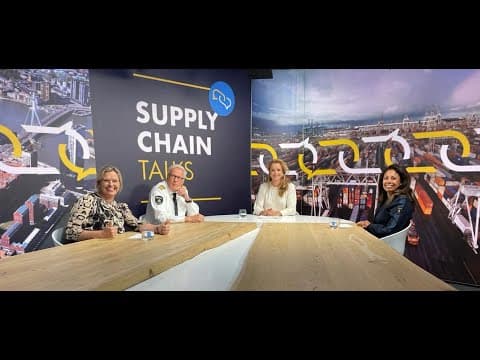
[0:10]Yes, back to the studio, talking about safety, uh, because safety is a broad concept. It can relate to social safety, water safety, workplace safety, and cyber security. And the Port of Rotterdam Authority and its partners, they use a variety of services and projects to make the port as safe as possible for everyone. Combating criminal networks, corruption, and preventing illegal transit of goods and persons are amongst others the top priorities. And in today's show, uh, we will talk about risk mitigation, prevention of cyber attacks, and best practices for optimizing security in the supply chain. Because next to safety in the port, safety in a logistic chain has become of vital importance over the past years. So I'm very, very glad to introduce my guest here at the table. First of all, Rob Gutteling. Rob, welcome. You're head of Vessel Traffic Services and Deputy Harbormaster at the Port of Rotterdam. Thank you. Next to you, Evelien Bras, you're the director of Firm, and uh Sarah Geerts Lachman, uh Team Leader at the Dutch Customs Administration located here in the Port of Rotterdam. Well, welcome to the Supply Chain Talks. Um, yes, um, Evelien, let me begin with you because I can imagine that our viewers that they have a general understanding what the traffic, the vessel traffic services is doing and the customs administration. But what about Firm? What is your company, uh, what is it about? Well, Firm, it's a, it's a non-profit organization, a cooperation between public and private organization. And uh Firm is, it's not an abbreviation, it's uh, Firm. It's uh standing strong and it's a Dutch word, it's actually a Dutch word and that's exactly what we aim to do in the area of cyber resilience. We want to be, we want to strengthen among ourselves against cyber attacks. Yes, because why is that such an important topic nowadays? Um, well you can read it in the news, every newspaper, every day is talking about some kind of cyber incidents. Um, every one in five companies will get hit this year. It's not a matter if, but it's a matter when you get to deal with cyber incidents and their effects can be huge. Did you know that 71% of all uh uh command systems have a vulnerability? 71%. 71% still have a vulnerability nowadays, so that's, that's significant. Yes, because what are the, the, the main threats for companies in the port of those that are using the facilities of the port? Well, I would say in, in my opinion, the number one threat still is ransomware. It's it's, it's huge, it's a global threat and it threatens your own business continuity. So that's a, that's a more of a business threat. Uh the second one, I would say it's impact on the physical infrastructure on the physical domain. Um, if uh a big company uh is in the harbor gets put out of business. It interacts through uh way through rails, through fairways. So the impact on the physical infrastructure is is also a big threat. And third, and I would say that's a typical harbor problem is storage spoofing. Spoofing, fake websites, companies pretending they act in or on behalf of the Port of Rotterdam, but in fact are false. And they claim to make deals, but you know, you actually end up, Yes. So so, yeah, so uh important threats also to share with our viewers of course. So Rob, do you do you recognize those threats that Evelien is describing? Yeah, absolutely. The harbormaster's main focus is on nautical safety, which is around all the ships visiting our port, and of course, it relies thereby on, uh, on huge amounts of data to be exchanged between all the parties which are participating in the process. So yeah, a disruption would have great input. Yes, because nautical safety, could you elaborate a little bit more, what is nautical safety? Yeah, nautical safety is more about the safety around the water. Uh we want to avoid dangerous traffic accidents uh or other incidents to happen, and ships therefore are assisted by uh all sorts of nautical service providers. And they are getting informed of all the risks which are surrounding them when they are entering the port. Yes, because the Port of Rotterdam, it is a huge, a very large area, uh to control. How can you control such a large area? You cannot not control it as one party. I mean, all the stakeholders involved should have their own responsibility, and they have. I mean, terminals, they have their own safety procedures and regulations. Uh, the Port of Rotterdam, uh, as an, as an organization, uh, uh services them, uh, all the companies in, uh, in the port with an, uh, a safe infrastructure. Uh, and the harbormaster, for instance, is safeguarding all the ships to, uh, make safe operations whilst they are sailing around. Yes, because so, so Evelien, I think, uh, Rob and his team are very important stakeholders for, for Firm. Yes, they are. And they're more than a stakeholder, actually, they're one of our founding partners, and they are key in the harbor safety. They also have a cyber access point which is 24/7 uh, you can report incidents 24/7 there, so, yes, they're very important. Yes, because how does it work in practice then, when when, in theory, when the port has an incident on on cyber, uh attack, uh what will be the procedure then? Can they call you? Are you going to make a solution for them? Well, um, uh, typically we're more on prevention. So sharing information, we will certainly share it in our trusted community and if there is a a knowledgeable partner which has a solution we will provide and we will assist you in that.
[6:31]Uh we will also uh provide with preventive training, with awareness sessions, also in maturing. But we do not have a set, a computer emergency response team with 24/7 on call. So we do not have that, we're more in the prevention loop, but we certainly will assist any company that, that has an incident. Yes, it's about prevention, awareness and also joining the forces. Yes. Well, another essential link in the in safety and security at the Port of Rotterdam is of course the Dutch Customs Administration. Um, well, Sarah, uh, safety has become a hot topic, uh at the port recently, but it must have been a top priority for you for, for many years already now, isn't it? Yes, definitely. Um, safety has been a hot topic for us since 9/11, and it is also part of our mission as the Dutch Customs Administration. If you know that about 30% of all goods come through the Port of Rotterdam, uh destined for Europe, then we have an important task to be a gatekeeper. Yes, a gatekeeper and and not only uh at the port, but also for the outborder, for for Europe. So what is the customs administration doing to protect the outborder and the port of Rotterdam? Well, it is um uh impossible for us to check all the goods that uh uh that go through the port. So we work risk-based, uh so, um therefore we look at different aspects, uh based on security, safety, health, environment, economy, and we also do random checks. And we have an enforcement vision that focuses on the level of compliance of the different companies, and we also look at the certification they have. And those combined, um we look at the different internal control measures every company takes. And so they have to be proven compliant, if they are not, we do more physical checks. Yes, you you also brought a video, to demonstrate how you collaborate but also how you cooperate with the national and international businesses. So I will suggest that we take a look.
[8:58]The Dutch coast forms a European border, and so our procedures involving the traffic of people and goods need to meet European requirements. Our security must satisfy all member states, and so we work closely with all national customs authorities within the European Union, in building one single system of enforcement. We believe cooperation and information exchange between national customs agencies can lead to the development of both trusted trade lanes and smart and secure lanes. That's why we provide foreign colleagues with information concerning the reliability of certified logistical partners and the presence of identified high risk cargoes. We expect the same of them, as part of our belief that information concerning inspection and risk control should be shared, following pre-agreed criteria. That's why we have intensive cooperation and communication with several countries all over the world. International cooperation between customs authorities and civilian partners, as well as investment in intelligent risk management, are vital elements in achieving a responsible balance between expedience and security. They allow us to focus our attention where it's needed most around high-risk cargoes and around high service levels for our clients. Yes, Sarah, nice video. Um, is it safe to say that um, security and safety is more related to goods than uh to systems and processes? Uh, well, uh, one of our aims is also to improve the competitiveness of the Netherlands and also of the European Union.
[11:13]So we try to do our checks as less disruptive as possible.
[11:21]Um, for example, we have different scan equipments, uh and those are not at the area of the Customs Administration itself, but they are on the terminals. So we uh the flawlessness of the logistical chain is improved. Yes, well that's also wonderful to hear because I think Rob, a fast and efficient clearance uh procedure also helps you to ensure the the safety and also the throughput, at vessel traffic services. Yes, sure. I mean, our organizations are sharing the same uh, let's say, uh interest, and we are finding the efficiency in the port process uh very important.
[12:11]Yes, and and what do you expect um for the future if we talk about safety? Well, we see that data flows and and digital exchange uh will uh to support systems uh are very related and and they will have increasingly important, so also for the shipping process in the port. Do you agree, Sarah? Definitely, yeah, uh we need more information to build our intelligence, but we're also um well, we rely on good information. Yes, so so relation, data, that is that is key and then Evelien, we are also uh in your business, it must sound like music for your ears then. Yeah, well, I'm very glad to hear that uh uh information security is top priority because it is, and I think that it should be the top priority for the coming years. And and and obviously, we we sing the same song in this music, so, yes. Uh and I think cooperation is also the only way to become the world's safest port. Yes, cooperation is key. Well, let's also see if we have some questions from our viewers. Koen? Yeah, we have. I picked one out of the chat, all the others will be answered in the chat itself. Evelyn, uh, is it possible for all companies to join Firm and how can they join? Yes. Well, um, obviously, I'd like as many companies to join Firm because the more companies that join, the more power we have and the safer we can be together. However, uh it's a trusted community, and, uh, companies can participate based on trust, uh and and basically if they're related to to to the harbor industrial complex. Yes. So there's and how can they join? Well, if they send a message to contact@firm-Rotterdam.nl then we will surely pick up the application. Okay, okay, well wonderful and thank you and you and you of course, Sarah for joining us and sharing your information about security and safety in the port. Thank you and good luck with the job.


