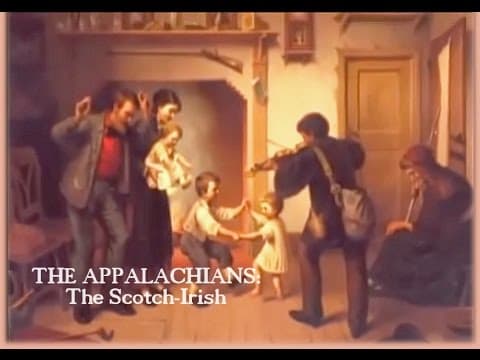
[0:04]The Appalachian mountain range is nearly 400 million years old. This place is ragged and torn and rumpled. This landscape is one of the most ancient in the world.
[0:25]For more than 1500 miles, the chain snakes down from Canada through New York, Pennsylvania, and all of West Virginia.
[0:37]Large parts of Kentucky, Tennessee, Virginia, Maryland, and the Carolinas are dominated by the rugged Alleghenies and Cumberlands. The soaring Blue Ridge and the Great Smoky Mountains to the south. All these ridges, gorges and valleys came to be known collectively as Appalachia. A region as mysterious as it was remote. It was in the 1730s that the ancestors of today's Appalachians began streaming into the mountains. To escape hard times they came from Germany, England and Wales. But the group that would become most prominent in the mountains started their journey off the rugged coast of Northern Ireland. They were a grim, stern people, strong and simple, swayed by gusts of stormy passion, the love of freedom rooted in their heart's core. They were of all men best fitted to conquer the wilderness and hold it against all comers. Teddy Roosevelt.
[1:54]O the day I parted away from you. In sorrow grief and trouble too, oh you gave to me all the parting hand and you wished to me safe in old Cumberland land. A bit of Irish history accounts for the exodus. A hundred years earlier, King James of England had grown tired of battling rebellious Scots in the lowlands. The king thought he could use the Scots as a hedge against the bothersome Irish, so he offered them free farmsteads in Ulster in the north of Ireland. What better thing to do than to get some of the borderland Scots, who were always giving you trouble, to go over and whoop up on the Irish? So they took advantage of it, moved to Ulster, got farms and they became known as Scotch-Irish.
[2:58]For about a hundred years, the Scotch merged with the Irish. They mixed their words, they mixed their phrases, they mixed their horse racing love. They took in many ways the best qualities of both people. After a century in Ulster, the Scotch-Irish were suffering religious persecution, rising rents and bad harvests. Tens of thousands moved on to a second migration to the New World. This hybrid culture took root in the Southern mountain wilderness of Appalachia. Oh, but thank the Lord good health we found. We've all got here both safe and sound and here in peace, oh we hope to be, with the Indian tribes, in old Tennessee. The Scotch-Irish were very quick to be among the first settlers who actually made their permanent home in the mountains. Those mountains had the funny smoky look in the morning.
[4:24]When we got up to the top of the mountain and set down very weary, we saw very high mountains lying to the north and south, as far as we could discern. It was a pleasing, though dreadful site, to see mountains and hills as if piled one upon the other. Robert Fallam, 1671. Now of nothing strange, or to write to you. Well, the preaching scarce, so and religion too. But we've better land and a fertile soil. We've got plenty milk, we've corn and all. Once they made their permanent home in the mountains, they by no means were the only ones that settled in there, but they were the most colorful, most influential. You had the other mix of the Germans who came here, and the Germans are known for their orderliness and you know, their rules for everything and building really staunch barns out of material that will last. The Scotch-Irish on the other hand, tended to be more footloose and fancy free. And the Scotch-Irish also were more hot-tempered than the Germans. And so when the Indians attacked, you wanted Scotch-Irish there because they were terrific fighters, but when the Indians weren't there, the Germans were just as happy not to have the Scotch-Irish around. It was said at the time that whereas the English when they got to America would build a church, the Germans would build a barn, but the Scotch-Irish would build a whiskey still. It's when I'm dead, and in my grave. No more corn liquor will I crave upon my tombstone. I want it roll, 10,000 gallons went down my throat. Whiskey making was only one of the skills that the frontier migrants brought from the old world. With traditional crafts like quilting, pottery, and metalwork, they furnished their homes and cooked their meals as they always had. But the tradition closest to their hearts was music.
[7:08]Music was especially important. It gave them comfort. It was something that they could do themselves, they could sing, they could play their fiddles, they could have a dance and invite the neighbors over.
[7:26]The most important instrument the Scotch-Irish brought with them was the fiddle, small, portable and plaintive. The old fiddle tunes were greatly beloved and passed along through the generations. Those were the kind of songs that Thomas Jefferson probably played his fiddle by. And they were handed down, the reels and the jigs and the the airs and they were beautiful songs.
[8:00]And I was playing with the Chieftains one day and I was playing this bowing technique and and Sean Keene from the group said, "Where did you learn that?" And I said, from an old man in Eastern Kentucky. He said, that's the way they play in Donegal, and uh I was so flipped out, you know, to realize that that had come over here centuries ago. Along with fiddle music, many well-loved ballads made the long, hard trip across the ocean. In Scotland, I was born and bred in Scotland, I was dwelling. I fell in love with a pretty fair maid and her name was Barbara Allen.
[8:54]As people packed up to make the journey to the New World, they had to leave almost everything behind. There wasn't enough room on the ship for anything, but there was enough room on that ship to memorize a few dozen songs. Singing those songs or playing those tunes made them feel at home, you know, they had brought that part of their culture with them. Oh, mother, oh, mother go dig my grave. Go dig it long and narrow. Sweet William died for me today. I'll die for him tomorrow. The ballads of course are basically narrative songs, their story songs. Many of them go back in England as far back as the days of Shakespeare. You know it comes from the troubadours and England, like 14th, 15th, 16th century.
[10:07]They traveled the country, they would stop at a farmhouse, they would write a song for the person who lived there. That's what they had to say about the troubadour always paid his way. They didn't say that he paid his way with a song, but he did for a warm bed and breakfast in the morning.
[10:22]We still kind of do that. Mm-hm. We do, don't we?
[10:30]Those songs didn't die off in the mountains, they stayed in the mountains. Many of these songs dealt with the same kind of archetypal themes that soap operas today deal with: deception, betrayal, murder, and true love. Barbara Allen is the classic example. If your name be Barbrey Allen, later on, we began to get songs that dealt with topical subjects. Especially as Americans began to take hold of the models of the old songs and create new songs around them. That's the only way you passed it down was to write about it. If anything happened, if someone got killed, there would be a song wrote about it. This man got this girl pregnant, and it's a true song, and uh he was gonna marry her. He told her he was gonna marry her. That was about the story was about. And uh they went out walking on a Sunday afternoon, and he threw her in the river, the Ohio River. I asked my love to take a walk, just to walk a little ways. And as we walk, oh we may talk all about our wedding days. Americans tended to change the songs. If you're gonna have fun singing a good ballad, you've got to learn something from it. So on many American songs, you have tied onto the end of the ballad a moral. Then by the banks of the Ohio. Banks of the Ohio. The man takes the woman down to the banks of the Ohio and pushes her into drown, and I watched her as she floated down. Well, he's ultimately apprehended, but you know, that's pretty direct. And all they say that you will be mine.
[12:41]And all they say there's arms and climb down beside where the waters go. Down by the banks of the Ohio. It's one of those songs that has about a hundred verses. And I think he kills her, right? Killed her. Pushed his knife under her breast.
[13:13]I ducked her by her little hand, let her down where the waters found.
[13:25]There I threw her into drown.
[13:31]Washed her as she floated down.
[13:38]Darling, say. It's a hard thing to to put into words. I think partly because there are all these isolated areas in different hollers in the mountains where people got together and made music for themselves.
[14:02]I just always imagine in my mind when I hear this this music. I think about the the journey that the musical style took and and how how it got changed in the mountains. I think about the time travel that of that music and and uh it's beautiful stuff.
[14:27]The same rugged mountains that held and nurtured music and culture, also marked the Western boundary of colonial America. These settlers who had come from the borderlands of England were living again on the edge of two worlds. But the rich land beyond the hills was bound to call to the adventurous pioneer. We're going west to Kane Tuck down the road through Marcus and Gale. Down the wilderness road, down the duck road the only creep road, the road down troublesome road through Marcus and Gale. There was a time when going way out West meant going out to Kane Tuck. The dark and bloody ground as the Indians called it.
[15:23]In 1769, a back country explorer forged his way across the Alleghenies.
[15:33]After traveling dark wilderness trails for 5 weeks, he and his men came upon a most remarkable site. I had gained the summit of a commanding ridge and looking around with astonishing delight beheld the ample plains, the beauteous tracks below. Daniel Boone.
[15:59]Boone could see that the territory was ripe for farming and six years later he established a settlement in Kentucky.
[16:09]He was flatly defying British orders to stay east of the Alleghenies and avoid the French who held lands to the west. Throughout the 18th century, English, French, settlers and Indians were mired in combat in Appalachia. It was said a man could live from boyhood to old age and never know a time of peace.
[16:36]The culminating battle began when the colonies declared their independence in 1776.
[16:45]The American Revolution was hard fought in the mountains by all the friends and foes of the colonial cause. We have to remember that the revolution was a civil war. There were people on both sides, by and large, the people who were on the side of the Crown or who were neutral or indifferent in Appalachia, did not take up arms. One of the assumptions of the British Army that invaded the south in the 1780s was that if they reached the back country that the loyalist there would rise up and that didn't happen. Most of the mountaineers, especially the Scotch-Irish were fiercely committed to throwing over British rule. They were among the first to sign up when George Washington sent out the call for troops. The Scotch-Irish had declared that these colonies are and of right ought to be free and independent. And it was from these that came that outburst of rugged and determined people that made the Declaration of 1776 possible. Colonel A. K. McClure, newspaper editor. The most famous back country fighters were the over mountain men of Tennessee, who defeated the stalwart Colonel Ferguson at the Battle of King's Mountain in South Carolina. Ferguson had threatened to cross the Appalachians and exterminate the people if they didn't support the King. In his proclamation, he called the mountaineers white barbarians. To the Colonel's surprise, the barbarians charged his forces, seeking cover behind rocks and chasing the soldiers off the mountain tree by tree. They killed nearly 200 British troops, including Colonel Ferguson. Well, they won, they won because they adopted the Indian style of warfare as they had before, and they won because the loyalist uh in the back woods didn't rise up in support of the British Army. The surprise victory snuffed out British hopes for taking the South and was a critical turning point in making America the land of the free. George Washington said if he ever had to make a last stand, he would want to stand with the over mountain boys, who knew how to shoot and fight. The revolution was a turning point for Appalachia. The region headed into a period of significant growth and change. Thousands of soldiers were rewarded with free homsteads, bringing a flood of new settlers to the mountains.
[19:50]Come on all you booze fighters if you want to hear about the kind of booze that we sell around here. It's made way back in the swamps and the hills. There's plenty of moonshine still. The Scotsman had always known how to make liquor from barley and rye. They quickly learned to use Indian crops instead, wheat and corn, berries and potatoes, just about anything that grew. Selling whiskey was good business, much more profitable than selling any of the bulky raw crops. But George Washington's government was buried in debt, and one of the ways they tried to pay it off was with a tax on whiskey. These settlers of the Western country were so opposed to this tax because it was very reminiscent of the taxes that were imposed on the colonists under the rule of King George of England. The people that were on the frontier were the rugged individualists, they were the veterans of the American Revolution that fought to establish this country. They were very jealous of their property and their rights. They valued freedom. They did not want to be told what to do by by anyone. A string of violent protests broke out from New York to Georgia. It became known as the Whiskey Rebellion and it raged from 1791 to 1794. The new tax was not to be tolerated. It was a tax that was required to be paid in cash, and cash was scarce on the frontier. Whiskey was a commodity that was used as money.
[21:47]One drop will make a rabbit whip a bulldog. One drop will make a cat chase a wild hog, make a bullfrog spit in a black snake's face, to make a hard shell preacher fall from grace.
[22:18]And the lamb will lay down with the lion after drinking this old moonshine. This was a fight the settlers could not win. Washington took 13,000 troops into Western Pennsylvania under his personal command. It was an army as big as the one that had fought the revolution. The rebellious moonshiners were crushed.
[22:50]Rules and regulations were bound to be imposed on these people who wanted to believe they could just be left alone.
[23:02]The Appalachian mountaineer could grow or make everything he needed to survive. He had learned to rely on himself and did not want outsiders dictating how he was to think or behave in politics or in religion. Immigrants had arrived in Appalachia with different traditions. There were Anglicans and Baptists from England from Germany, a range of Protestant groups and the Scotch-Irish were mostly Presbyterian. But the established churches could not find a foothold on the frontier where distances were great and communication difficult. For a few generations, worship was held inside the family or in the most humble mountain chapel.
[24:01]The religion most had carried with them was Calvinistic, tough, dark and demanding. The old intellectual Calvinism started giving way to this new thought that God is all loving. God would like to save us all, all we have to do is repent and ask for forgiveness and we can be saved. That's the doctrine of free will that we have it upon ourselves to decide whether or not to be saved. Well, this is more optimistic. People could get happy with religion. By the 1740s, this more hopeful vision was spreading like burning tender through the mountains. There began a long series of evangelical or enthusiastic religious revivals, known as the Great Awakenings that would last more than 80 years. Ministers of every stripe swarmed into Appalachia, bound to bring the unchurched into the fold. Most of these people had never before seen a minister or heard the Lord's Prayer, service or sermon in their days. After service, they went to reveling, drinking, singing, dancing, and whoring. And most of the company were drunk before I quitted the spot. Charles Woodmason, Minister, 1768.
[25:37]Presbyterians did not have enough educated ministers to reach the far flung population. The Baptists and Methodists were more successful because they commissioned farmer preachers and sent them off into the mountains. They were called the circuit riders. They spoke a common language with the people they were trying to convert and inspired them to gather together for worship. Long ago, when but a boy, at old camp meeting time. By 1800, the revival had found its most powerful outlet, the camp meeting. Call and all the saints of God into the house of God. Settlers left the hills by the thousands on foot, on horseback, in the family wagon, traveling long days to the great camp meetings under the mountain sky. I like the old time preaching, praying, and singing and shouting.
[26:42]I been in Cane Ridge, Kentucky around Lexington, the Cane Ridge Revival had 25,000 people in 1801, which the population of Lexington, Kentucky was about 5,000 people at that time. So people came from miles and miles and miles away. That was what was considered the first camp meeting.
[27:11]God and music go hand in hand, if you don't believe it, read Psalms. I mean, God is the creator of all beautiful things, and music being one of the most beautiful gifts I think this earth could ever have.
[27:26]Music is our hope and our salvation in awfully hard times of struggle. When you're living on the side of a mountain, and you have a skinny mule trying to plow, I mean horrible land, it's barely feeding your babies and uh you know, you got to have something to hope in. Oh man, what a wonderful thing to be able to go to church and talk to our creator by way of music. The same revivals that energized the spirit would also transform religious music on the frontier. Like the ballads, religious songs were an essential part of life that had been carried from the old world along with the traditional style of singing.
[28:21]By the end of the Great Awakenings, a very different sound was echoing through the mountain hollers. He you far was a preacher, I will tell you what I would do. I would keep on preaching and I'd work on the building too. I'm working on a building. As white and black people mingled at revival meetings, the white musicians picked up on African rhythms.
[28:51]They created blood-stirring songs to fit the new emotional religion. Songs that would become classics of Gospel and Bluegrass. Hallelujah. It's a Holy Ghost building. It's a Holy Ghost building for my Lord. For my Lord. Oh my Lord. Jesus stranger in this valley where many a man met his grave. Music of the spirit, music of the heart, carrying memories of a distant home. Songs that tell of hard times of stormy passions and a deep devotion to God. From the days of the first pioneers, music has been a binding force in the Southern mountains. It is a gift to all the world from the people of Appalachia.


