[0:03]Today, I wanted to show you the simple prayer card system that I have been using for the past several years to help me be more consistent and have a record of the Lord's Providence and answered prayers in my own life. Now, I like 3x5 index cards. You obviously can use any kind of index card. Some people prefer to do a prayer journal. The reason I do index cards is because you can move them around and sort them and when things are answered, you can put them in an answered pile. And I just love that when he does answer the prayers, I have this sort of I don't know, artifact of this thing I prayed for. Like I have ones that were answered years ago in my answered pile, and the edges are all ragged and they have notes in the margin with updates and all that, and it's like, what a cool just like piece of history you've created. Now, you're probably going to want some way of storing these. It doesn't have to be a recipe box. This is something my wife found, I don't know at a garage sale or antique place. I don't know where it came from, but it's just like a copper recipe box. It just looks cool on my desk. Um, you can find them on Amazon, too. But you can just have stacks, or you could put them in a Ziploc bag, you can put a ring through the corner of them. Doesn't matter, but you kind of really want to have two piles. You're going to have active and answered, right? So in my box, I have the uh, tabs for prayer. This is my active pile and answered. I also in here have a bunch of other stuff, you can ignore that. I use this for storing quotes and scripture, memory and, um, research for books and stuff, too. But you really just need tabs for prayer and answered or active and answered. Here's how I like to format these: In the top right corner, I write prayer, simply because I do use this box for multiple types of things. So if it ever gets misplaced, I can look in the top right corner and be like, this shouldn't be in the quotes pile, this should be in the prayer area. Uh, category, so, if you stick with this system for a while, you're going to end up with a bunch of different requests. And so things like family, church, small group, work, uh, missionaries that you're you're praying for. Having a category can help you group these later on if uh, your pile gets really big. And then in the left corner is the date. The date you started praying for this. And one of the things I like about doing the prayer cards is when I write it down, it's a physical act of me committing to pray for it. Right? Someone comes to you in church in the hallway and says, hey, can you pray for this thing? You're like, I definitely will. And but in your head, you're thinking, I'll definitely forget too, right? When you write it down and put it into your prayer system, you by doing that, you're saying, this is something I'm going to be praying for. It's actually in the system. And then the important part is you write down your actual petition itself. The specific prayer request. Uh, I have just this is just an example, this isn't a real prayer obviously, but it says, write a specific prayer request. Resist the urge to be vague. Is this written in a way such that you would know if God actually answered it or not? I like to leave a little room, if I can, because often, if it's someone else I'm praying for, or even for myself, it is nice to be able to put updates on here. And so, you can jot in, you know, like, uh, here's the date. God did X, something like that, where it's not an answer, or maybe you you folled up with someone and you said, hey, give me an update on this. Do you have any updates? Is there anything I can do to pray more specifically? And then write it down on there. So that's the front of the card. Obviously, incredibly simple. But the back of it is going to be where you put the answer to the prayer. Now, again, this is just a template I'm showing you, but at the top, I write this in faith. I write date answered, and then I leave it blank, because I don't know when he's going to answer it, right? But putting it there, it means that I'm praying, I'm beginning to pray of this with the expectation that I'm going to receive an answer from God. I'm going to pray without ceasing, I'm going to pray with persistence, because I believe he will answer it in time. Might be yes, might be no, might be keep waiting, but I'm going to write that down, because when it comes, I'm going to fill in that date. And then under that, the whole rest of the back of the card is where you will describe how the Lord answered that prayer. These will become to you fuel for Thanksgiving, stones of remembrance in your prayer system. These will be things when you are down, and you're in the dumps, or you're in a trial, that you will go back to and be like, my goodness, how the Lord has delivered me and answered me time and time again. I will magnify him again and again and again. Of course, I should keep praying. God does come through, he does answer. And when that happens, he does answer, you just move it over to the answered area in your prayer system, and you start to build that pile out. Next, I'm going to answer some common questions about this prayer system that I've gotten and give you a few more bonus tips on how to be consistent in your prayer using this system here. Hey, I just wanted to jump in here and invite you to a YouTube live that I'm going to be doing next Tuesday, March 24th. In this live workshop, I'm going to walk you through a process for stewarding your week. It's going to help you address those common issues of how do we make time for everything, for our goals, for our habits and just for getting through the admin stuff of life. And of course, we're going to be doing all this through a Christian biblical lens of how do we think about time stewardship as believers. I think this is going to be really helpful. I've taught this workshop in a lot of different contexts and I always get a lot of great feedback on it, so I I'm hopeful that you can make it live. Um, if you want to be notified about this, check out the link in the description. There you'll also be able to download some resources that you're going to want to have handy when we do start the workshop, things for planning your weekly schedule and all of that. So, check out the link in the description, and come back here on Tuesday, March 24th, to watch it live. Hope you can make it. Okay, so let me answer some questions that may be popping up in your head about this prayer system. What do I do, uh, when I have so many cards, I can't get through them all during my prayer time? Right? I have a lot in my active column right now, and this would take a while to pray through each of these with sincerity. Uh, so, what do I do? Well, that's the wonderful thing about note cards, you can just do a few. In fact, you could just do one. If you're running behind, or you just have a few minutes, and you're like, I, I just going to spend a couple minutes to the Lord, you can just pray through one, put it at the back of the pile, right? If if you did five, just move each one to the back, and eventually you're working your way through those prayer cards, no matter how slow you're doing it, you're still praying with persistence, you're still working through those things that you committed to pray to. But you don't need to pray through every single one of them every day. Another thing is, do follow up with people. Some of these are going to be prayers that you're doing on behalf of others, right? So, you're going to want to follow up with people, say, hey, I've been praying for you about this thing. Do you have any updates? Is there anything I can do to pray more specifically? And then write it down on there. Follow a schedule. This is not legalism to have a plan for praying consistently, right? Daniel was known as a man who prayed three times daily, it says as was his custom, and he is held up to us as an example. Having consistent times of prayer in your schedule is just really wise to make sure you stick with it. Follow an acrostic. Uh, I have learned the acrostic ACTS Acts, and that is just a helpful framework for thinking about your prayers. It's based sort of loosely on the Lord's Prayer, and A is adoration, so that's when you praise God. You begin your prayer time with praising for things. That can be his attributes, that can be, um, uh, things you read about in scripture. That's a great way to fuel that by the way. Read a little bit of scripture and then pray it back to him, pray back the promises, pray back the things that uh, it it's it's mentioned that you could be asking for, pray back attributes of him and praise towards him. Uh, another aid to this is Valley of Vision, which I mentioned all the time on here. It's a great little book of Puritan prayers. They're really short, and you can read them, and they just stir your heart to praise God about things that you might not have thought of otherwise. Uh, that's A. C is confession. Spend some time confessing your sins to the Lord. Uh, get right with him, right? It says in uh, first John 1:9, that if we confess our sins, he's faithful and just to forgive us our sins and to cleanse us from all unrighteousness, so we get right with him. The T is Thanksgiving. And that's just thank you, Lord for things. And hint, hint, if you want some things to thank him for, look in the answered prayer section of your system, and you can just pick a few of those to thank him for, right? So the whole thing helps support prayer. And then the S in the Acts model is supplication, and that's really what this is mostly designed for. It's for those specific requests. Supplication, that include petition, you're asking things of God, uh, and intercession, which is asking things of God, but on behalf of other people. James 5:16 says the prayer of a righteous person has great power as it is working. Not might work, it does work. Prayer does work and if we really believe that, we will be people of prayer, and we will be people who are seeking to be persistent, like Jesus told us to be. with asking him for things and asking him in the way that a child comes to their father with a trust and a belief that the Lord loves us and he delights to give good gifts to his children.
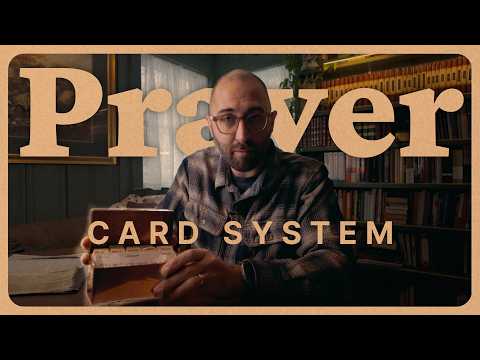
Want to Be More Consistent in Prayer? This Will Help.
Redeeming Productivity
11m 4s1,990 words~10 min read
YouTube auto captions
Transcript source
YouTube auto captions
This transcript was extracted from YouTube's auto-generated caption track. The transcript below is server-rendered so it can be read, searched, cited, and shared without opening the original YouTube player.
Pull quotes
[0:03]Today, I wanted to show you the simple prayer card system that I have been using for the past several years to help me be more consistent and have a record of the Lord's Providence and answered prayers in my own life.
[0:03]The reason I do index cards is because you can move them around and sort them and when things are answered, you can put them in an answered pile.
[0:03]And I just love that when he does answer the prayers, I have this sort of I don't know, artifact of this thing I prayed for.
[0:03]This is something my wife found, I don't know at a garage sale or antique place.
Use this transcript
Related transcript hubs
Watch on YouTube
Share
MORE TRANSCRIPTS


