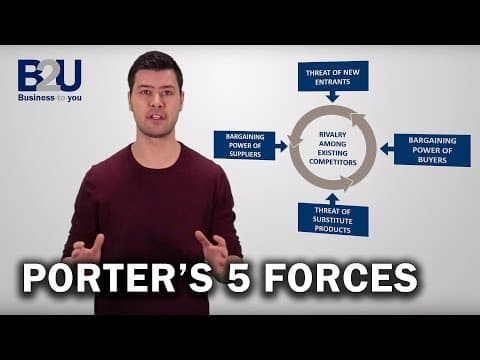
[0:00]Porter's Five Forces, a strategy framework that probably every business student and practitioner has heard about. But do you also know how to use it properly? Today you will be finding it out because I'm going to tell you everything you need to know about Porter's Five Forces. My name is Lars and welcome to a new episode of Business to you. In 1979 Michael Porter, one of the founding fathers of business strategy, published an article called 'How competitive forces shape strategy'. In this article he argued that we often view competition way too narrowly and as a solution came up with five basic forces that together shape the industry structure and determine the competitive intensity of an industry. In the end, these forces affect the long-term profit potential in an industry and therefore its attractiveness. We will come back to that in a second. Because we're talking about competitive forces, the Five Forces model can be considered an external analysis framework, similar to PESTEL. However, as explained in my previous video on PESTEL analysis, it is important to make a distinction between the macro environment vs task environment or meso environment. Do you remember how the macro environment contains factors that have a one-way effect on organizations? And the task environment on the other hand contains factors that are in a direct contact with the focal company, they interact with each other. Porter's Five Forces falls within this latter category and includes the following five forces: rivalry among existing competitors, threat of new entrants, threat of substitute products or services, bargaining power of suppliers, and the bargaining power of buyers. Before we go into each force separately, it is important to understand that the main purpose of this model is to evaluate the root causes of profitability in an industry through the competitive forces. Porter therefore draws a connection between competition on the one hand and profitability on the other hand. If competitive forces in an industry are high or intense, the profit potential of a firm in that specific industry will decrease. As you will be seeing in this video, each of the five forces are able to affect the profit potential in an industry both positively and negatively. We will be illustrating this dynamic relationship between competition and profitability throughout this video with some examples from the airline industry. Let's start off with the middle section of the framework. This force of the Five Forces model examines how intense the current competition is in the marketplace. This is for example determined by the number and size of existing competitors, the industry growth rate, product differentiation between rivals, and exit barriers. Rivalry is for example high when there are a lot of competitors that are roughly equal in size and power, when the industry is growing slowly which increases the fight for market share, and when competitors are not much differentiated from each other, resulting in products and services that are nearly identical. In addition, rivalry will be more intense when barriers to exit are high, forcing companies to remain in the industry even though profit margins are declining. These barriers to exit can, for example, exist due to long-term loan agreements and high fixed costs. When rivalry is high, competitors are likely to actively engage in advertising and price wars, which can seriously hurt a business' bottom line. Let's look at this more closely. If direct competitors fight for market share and decide to battle each other by dropping the prices, profit margin will decrease. Moreover, they might decide to spend more money on advertising, raising the costs and again decreasing the profit margin. When looking at the airline industry, we see that the industry is extremely competitive because of several reasons, which include the vast amount of players that are active in the industry. The fact that the industry itself is very stagnant in terms of growth at the moment, and the high fixed costs that result into high barriers to exit. In addition many players in the industry are similar in size leading to extra fierce competition between those firms. Taken all together it can be said that rivalry among existing competitors in the airline industry is high. Threat of new entrants. New entrants in an industry bring new capacity and the desire to gain market share, that put pressure on prices, costs and the rate of investments necessary to compete. Simply said, you will have to share the pie with more players. The seriousness of the threat depends on the barriers to entry in a certain industry. The higher these barriers, the smaller the chance that more players will enter the playing field and the smaller the threat for existing rivals. Examples of barriers to entry are the need of economies of scale, high customer loyalty for existing brands, large capital requirements, the need for cumulative experience, government policies and limited access to distribution channels.
[5:50]If new competitors enter the industry, existing players might need to increase their investments in product development or marketing in order to stay ahead of the game. This will increase costs and lower the profit margin. Or in order to prevent new competitors from entering, existing players might decide to lower prices in order to scare off new competitors. Again, this will decrease the profit margin. The threat of new entrants in the airline industry can be considered medium. It takes quite some upfront investments to start an airline company. Moreover, new entrants need access to flight routes, licenses, insurances, distribution channels and other qualifications that are not easy to obtain when you're new to the industry. Furthermore, it can be expected that existing players have built up a large base of experience over the years to cut costs and to increase service levels. A new entrant is likely to not have this kind of expertise, therefore creating a competitive disadvantage right from the start. However, due to the liberalization of market access and the availability of leasing options and external finance from banks, investors and aircraft manufacturers, new doors are opening for potential entrants. Over the years, many low-cost carriers like Southwest Airlines, Ryanair and easyJet have successfully entered the industry by introducing innovative, cost-cutting business models, thereby shaking up existing players like American Airlines, Lufthansa, Delta Airlines and Air France KLM. The threat of substitutes. A substitute product performs the same or a similar function as an industry product by a different means. They essentially fulfill the same underlying need, even though they may not look identical on the surface. They are therefore easy to overlook. The existence of these products alone increases the possibility that customers switch to alternatives. In order to discover these alternatives, you should look beyond similar products that are branded differently by competitors. Instead, every product that serves a similar need for customers should be taken into account. Energy drinks like Red Bull, for instance, are usually not considered competitors of coffee brands such as Nespresso or Starbucks. However, since both coffee and energy drinks fulfill a similar need, that is staying awake or getting energy, customers might be willing to switch from one to another if they feel that the prices increase too much in either coffee or energy drink. The number of substitutes, the willingness of customers to substitute, and the relative price performance of substitute products are therefore factors that determine the total threat of substitute products. Since substitute products can lure customers away, companies need to take actions to stay more attractive and prevent their product from becoming replaced or obsolete. They can, for example, lower the prices, which will also lower the profit margin. They can spend more money on advertising, which increases the costs, or they can invest heavily in product upgrades or additional services that will give customers an incentive to stay. Again, this will increase the costs and lower the profit margin. In terms of the airline industry, it is safe to say that the general need of customers is to travel. Of course, there are many alternatives for traveling besides going by airplane. Depending on the urgency and the distance, customers could take the train or go by car. Especially in Asia, it is very common to make use of high-speed trains such as bullet trains for medium to long-distance traveling. We see a similar tendency developing within Europe. Furthermore, the airline industry might get some serious future competition from the Hyperloop concept, in which passengers will be traveling in capsules through a vacuum tube reaching speed limits of 1200 km an hour. Taken this altogether, the threat of substitutes in the airline industry can be considered at least medium to high. Now we enter the horizontal section of the framework, the suppliers and the buyers. This section is basically illustrating a company's supply chain. Let's start off with the bargaining power of suppliers. This force analyzes how much power and control a company's supplier has over the potential to raise its prices or to reduce the quality of purchased goods or services, which in turn would lower an industry's profitability potential. The number and concentration of suppliers to choose from are important factors in determining supplier power. The fewer there are, the more power they have. Businesses are in a better position when there are a multitude of suppliers. Sources of supplier power also include the switching costs of companies in the industry, the presence of available substitutes, the strength of their distribution channels, and the uniqueness or level of differentiation in the product or service the supplier is delivering. The bargaining power of suppliers in the airline industry can be considered very high. When looking at the major inputs that airline companies need, we see that they are especially dependent on fuel and aircrafts. These inputs, however, are very much affected by the external environment over which the airline companies themselves have little control. The price for aviation fuel is, for example, subject to the fluctuations in the global markets for oil, which can change wildly because of the geopolitical and other factors. In terms of aircrafts, only two major suppliers exist: Boeing and Airbus. Boeing and Airbus therefore have a substantial bargaining power on the prices they charge. The bargaining power of buyers. This force analyzes to what extent customers are able to put the company under pressure by demanding better quality, thereby driving up costs or exert control over price. Keep in mind that buyers do not always have to be the end consumer. In case your business is a manufacturing company, buyers can be other companies like retailers for example. Customers have a lot of power when there aren't many of them and when the customers have many alternatives to buy from. Moreover, it should be easy for them to switch from one company to another. Buying power is low, however, when customers purchase products in small amounts, act independently, and when the seller's product is very different from any of its competitors. The internet has allowed customers to become more informed and therefore more empowered. Customers can easily compare prices online, get information about a wide variety of products and get access to offers from other companies instantly. Companies can take measures to reduce buyer power by, for example, implementing loyalty programs or by differentiating their products and services. Bargaining power of buyers in the airline industry is high. Customers are able to check prices of different airline companies fast through the many online price comparison websites, such as Skyscanner and Expedia. In addition, there aren't any switching costs involved in that process. Customers nowadays are willing to fly with different carriers to and from their destination as long as it lowers their ticket price. Brand loyalty therefore doesn't seem to be that high. Some airline companies are trying to change this with frequent flyer programs aimed at rewarding customers that come back to them from time to time. Now we have looked at every force individually, you will notice that we start to get a better picture of how competition in an industry looks like and which of the forces have the biggest impact on your profit margin. However, Porter's Five Forces is not just a tool to evaluate an industry and determine whether an industry is attractive or not. Do you remember how the five forces are part of the task environment, causing them to be in a direct contact with the focal company? This means that a company is able to affect these forces, similarly to how these forces are able to affect your company. In other words, you can do something about it. You can fight them, you can shape them. Understanding the forces that shape industry competition is the starting point for developing strategy. The model is therefore a great tool to come up with strategic actions on what to do in the future. Imagine that you start to notice that your dependency on one particular supplier is increasing. What you could do is try to standardize the components needed to create your product so that you could choose from multiple suppliers and switch more easily among them. Or if you fear that your competitors will start to enter price wars, you could invest more money in product development in order to significantly differentiate your products from those of your rivals. Make sure that you offer features and benefits that your competitors cannot offer, and you will have less chance that you will be forced to cut prices as well. Or if you feel that new competitors might enter the playing field, you could raise the barriers to entry by investing more into marketing. This will enhance your brand awareness and scare off entrants because of the high costs needed to overcome that brand awareness. Even though these actions involve costs in the short term, it will help you to protect your company's profitability in the long term. Because that in the end is the purpose of strategy. If you like business-related stuff and want to learn more business frameworks, feel free to subscribe to not miss out on any of our future videos. And if you have any suggestion on what to cover in the future, please let me know in the comment section down below. Thanks for watching and as always, don't forget alone we are smart, together we are brilliant. See you next time.


