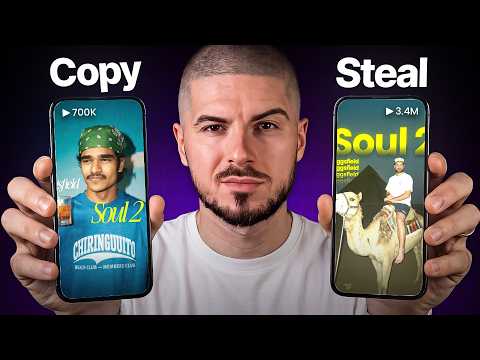
[0:00]There's a phrase everyone in content creation loves to throw around, Steal like an artist. And almost nobody actually understands what it means. Because what most people hear is go find your competitors, look at what's working, and copy it. The hook, the script, the format. Maybe change a few words. And that's not stealing like an artist. That's just stealing. And it's the reason most social media content looks exactly like everyone else's. When I look at a piece of content, I don't see what you see. I see 20 invisible decisions underneath the surface that most people scroll right past. And once you learn to see them too, you'll never need to copy anyone again. Now, I've been doing this for over 10 years, 200,000 plus on YouTube, 40,000 plus on my newsletter, and millions of followers across Instagram pages in completely different niches. And none of it came from blindly copying what was already working. It came from learning to see what nobody else was looking at. In this video, I'm going to show you the five-step process I use to break down any piece of content, extract the principles behind it, and turn it into something completely original. I call it the Detail Stack. So, what does Steal Like an Artist actually mean? There's a quote that's often linked to Picasso: "Good artists copy, great artists steal." And most people hear that and think it just means take whatever works and use it. But that's not what it means at all. So Picasso studied African art and classical painting for years. Then he created Cubism. But nobody looks at Cubism and thinks that's a copy. He didn't take that work, he took the thinking behind it. Steve Jobs did the exact same thing. He visited Xerox, saw the mouse, the graphical interface, all this technology they had invented. And instead of copying their product, he took the principles and built something completely different around them. Xerox invented it, but Apple made it matter. Neither of them copied the output. They studied deep enough to understand the principles, then they created something original. The Sheep. Okay, so look at this. So, same font, same background, same quote, same format. If I covered the account names, you wouldn't be able to tell who posted what. And again, same thing right here. Same angles, same transitions, same hook, same advice, reward it slightly different, it all looks so similar. And again, you can see right here, this is what happens when an entire niche kind of just follows the same advice, copies what works and everyone does. Now, nobody stands out. Seth Godin wrote a book called Purple Cow. The idea is simple. If you're driving past a field of brown cows, you don't even notice them. But a purple cow, you stop the car. You take a photo. You tell everyone about it. The problem with copying is you're choosing to be another brown cow. And then wondering why no one is stopping to look at your content. And here's what I see happen over and over again. I call this the Sheep Cycle. It works like this. So, you copy a competitor's video, it does okay, so you copy another one. Then that does okay too. Then one day you try to post something original. Something that's actually yours, and it gets low views. So what do you do? You panic. You go back to copying and now you're stuck. And even when the copied content performs, the audience it attracts doesn't stick. They followed you for a trend, not for you. So your next video that isn't that trend, they don't care. That's the sheep cycle, and most creators are stuck in that right now without even realizing. Honestly, I've been a victim of this too. The Artist. I said earlier, I was going to show you how to actually look at content, so let's do it right now. Now, when most people watch a video or scroll past a reel, they see the surface, the topic, the hook, maybe the editing, and that's where it stops. That's all they take away. Now, when I look at content, I see something completely different. I see the decisions underneath. Why did they choose that background? Why is the text placed there and not somewhere else? Why does this person feel trustworthy before they've even said anything useful? What about their delivery, their pacing, the colors, the framing? Now, I call this the Detail Stack. Content doesn't succeed because of one big thing. It succeeds because of 20 small things that most people scroll right past. The background signals credibility. The text placement guides your eye. The confidence in delivery makes you trust them. The color grading sets a mood before a single word is spoken. The t-shirt, the lighting, the angle. Everything matters and it all stacks. And I'm going to show you exactly what I mean. We're going to do a few different examples, so let's kick things off. So this reel got 2.7 million views. The creator has over 90,000 followers. That's a 30X ratio. Now, most people would watch this and say, oh, it went viral because he mentioned a famous creator Kai. And yeah, that helped, but that's not why it worked. Now, let me show you exactly what's actually going on. The first thing, so let's look at his room. Before he said a single useful word about speaking, this background has already told you who's qualified. Dark shelves, minimalist decor, clean lines, natural light from the window. That looks like a consultant's office, not a bedroom, not a ring-like setup. That's not an accident. The environment is doing the selling before the content even starts. Most people would not really appreciate that. They just feel it. The second thing is look at what he's wearing. Black crew neck, gray trousers, leather watch. This is intentional. It's polished but not flashy. You trust this person immediately because they look like someone who charges for their time. Now, look down here, red socks in an entirely muted frame, gray, black, navy, and then one pop of color right at the bottom of the screen. That does two things. It keeps your eye inside the frame because there's something visually interesting to land on, and it signals personality. He's not just a corporate robot. He's got an edge. One tiny detail, most people would never consciously notice it, but your brain does. The third thing is listen to this. Kai Cena is trying to become a better speaker by reading out loud for 15 minutes at a time. This is a pretty good strategy, but if I were Kai Cena's personal speaking coach, here are four more strategies I would give him to help him become a better speaker. So there's no music, just his voice on a platform where every single reel has trending sounds or crazy beats underneath. He opens with silence and a voice that sounds like it belongs in a documentary. That's pattern interrupt. Everything else on your feed is loud, this is calm, and calm reads as authority, calm reads as expensive. You stop scrolling because something feels different, even if you can't explain why. Fourth, watch this part. He puts his pen to his mouth to demonstrate annunciation drill. Now, on the surface, that's just a tip. But what it actually does is break down the visual monotony of the talking head. You've been watching one person sitting in a chair for 25 seconds and suddenly there's a physical object, a weird visual, something that makes you lean in because your brain goes, wait, what is he doing? That's a retention tool disguised as advice. Now, the fifth thing is look at how he positions himself. He's not attacking Kai. He's not saying Kai is bad at speaking. He's saying Kai is trying to become better. And then he says if I were his personal coach, read that framing carefully. He's made himself the coach of one of the biggest creators on the internet. Not by lying, not by being arrogant, just by the way he structured one sentence. And now for the rest of the video, you're watching him through that lens. You're watching a man who coaches celebrities. He's not that's how it feels. And that feeling is what makes you follow. That's five decisions most creators would scroll right past. And every single one of them is why 2.7 million people watched this. Most people would take away good video about public speaking, maybe I should talk about Kai as well. They'd copy the topic, maybe copy the hook and miss everything that actually made it work. Okay, now we're going to do something different and look at two creators who are actually kind of stealing from each other or one from another. I'm going to call it R and A, two great creators, you can see their handles on the screen. So essentially, they made a video about the exact same tool, the exact same feature around the same time. And I want you to watch how they feel different. This is a brand new workflow that gives you control over the speed ramping in your AI videos. Here's how you can make this cool product transition shots using a brand new workflow. So it's the same topic, the same tool, but if these two creators had just copied each other, these videos would look identical, but they don't. They don't even feel like they're in the same niche. Let's analyze why. So, let's look at the first frame of R. R opens with a Wimbledon tennis serve. High motion, green and yellow sports energy, whereas A opens with a rotating gold smartphone. Slow, premium product design energy. Both are showing the results first. That's the shared principle. Lead with proof, but the execution is completely different. Because each one of them chose a result that matches their audience. R's audience thinks in cinematic action. A's audience thinks in product renders and commercial work. Now, let's look at how they use the screens. So R stacks three layers, results at the top. The tools in the middle, himself at the bottom, all visible at once. You're getting trust, education and inspiration in a single frame without a cut. Whereas A takes a different approach. He alternates. You see the results, then him, then the screen recording, then him again. Same information, completely different rhythm. R's feels like a dashboard, A feel like a conversation. Their identity signals are telling completely different stories too. R's in a baseball cap, a beige tea, casual, approachable. You're made you who found a cool tool, whereas A is in a striped designer adjacent shirt, warm lighting, styled hair, more polished, more creative. The creative director showing you what's next. Now, neither is better. Both are delivered. Both are building a brand that their specific audience trusts. Now, with the audio, R has a driving electronic beat underneath. It matches energy, fast, punchy, tech, forward. A, same kind of beat, but laid with subtle sound effects, wishes on transitions, clicks when it interacts with the UI. Those tiny audio details make his visuals feel more tactile, more premium. Whereas R feels like a trailer, whereas A feels more like a product demo. Here's what I need you to see. If you ran the detail stack on both of these videos, the principles underneath are almost identical. Lead with a visual result, show the tool easy, create a reason to commit, use your identity to build trust before the content does the teaching. But the output completely different, different visuals, different pacing, different energy, different audience. Neither of them copied the other. They both understood the same principles and built something original from them. That's stealing like an artist. And that's the difference between someone stuck in the sheep cycle copying the surface and someone who's actually underneath. Now, here we have an amazing faceless page, which I wanted to also give an example. And this works in a same way as a personal brand. So, personal brand or not or business, this detailed stack, these principles about stealing like an artist are all the same across social media. So, this page has over 110,000 followers, 74 posts, completely faceless, no person on camera. And they've built an entire dark fantasy universe from scratch using AI. Look at the grid. This isn't a random collection of AI images. This is a world. Original characters, original story lines, a novel, a soundtrack. They're building towards an animated film. This is a brand. This is an IP. And if I check right at the beginning, you can see 318 likes, July 2025. Look at where they started. The art they were creating is decent but still rough. This style, the style hadn't fully formed yet. Now, look at this. Same page, a few months later, nearly 800,000 views. This looks like it could be a scene from a Netflix anime. The characters have depth, the composition is cinematic, the color palette is consistent across every single post. The person studied what makes anime storytelling work, the emotion, the visual language, the pacing, and apply the principles using AI tools to create something that feels completely original. They understood that AI is a production tool, not a content strategy. The content strategy is storytelling, the content strategy is building a world people want to come back to. They didn't copy an existing anime, they extracted the principles, visual consistency, character development, emotional storytelling, world building, and built something entirely their own. This is stealing like an artist. The Method.
[13:25]So how do you actually start seeing content this way? Because it's not something that just happens, it's a skill, and like any skill, you need to practice it. So the first step is you need to stop consuming content like a viewer. Next time you're scrolling and something stops you, don't just like it and move on. Ask yourself why did I stop? Was it the hook, the visual, the color, the face, something about the text? Train yourself to notice the moment you stop scrolling and figure out what caused it. Step two, break it down. Once you've identified something that caught you, pull it apart. Look at the four layers: topic, what is it actually about? Packaging, the thumbnail, the title, the cover. Content style, the visuals, the editing, the pacing, the delivery, and emotional triggers. What is this making you feel and why? Now, I did mention this in my previous video with the content breakdown, et cetera. So after this video, be sure to check that out. Now, step three is go deeper than anyone else.
[14:35]This is where most people stop. They break down the surface and think they've done the work. Wow, that's a really good hook. But the real stuff is in the details nobody talks about, like we saw the background choice. The font, the pacing of the cuts, the way the text enters the screen. The Detail Stack. Ask yourself, why did they choose this angle? What rule did they break? What problem were they solving? What did they refuse to do? That's where originality lives.
[15:15]Step four is extract the principle, not the content. This is the most important step. Once you've done the breakdown, you should be able to describe what worked in a sentence. There's nothing to do with the specific video. They made a video about morning routines with a countdown format, but they used a time constraint to create urgency and painted it with aspirational visuals that made the viewer feel left behind. Now, you can apply that to your niche, your content, your voice, and it will look nothing like the original. Let me show you these steps in real time right now with a piece of content. We're going to go back to NPC Faizan. Same creative from earlier, completely different video. Let's watch how fast this goes. There are a lot of ways to make people think you're really smart, but by far the easiest one is by using bigger words. And I happen to get a lot of requests for how you can do that. So I'm going to tell you the strategy you can use to improve your active vocabulary by explaining it through fashion. So step one, I stop scrolling. Why? Okay, so let's look at the first frame. The word street in big bold text, but it's cropped at the bottom. It looks almost broken, like a glitch. And that's the point, your brain sees something that looks incomplete and it needs to resolve it. The second half of wait, what does that say? Is all it takes. Then the text flips street SF speak, three changes in under a second. Your eyes can't leave. And then listen to the opening line. There are a lot of ways to make people think you're really smart. That's not a hook about vocabulary. That's a hook about status, completely different game. Now, I stop for the visual glitch. I stayed for the promise. Step two, break it down. So we have these different layers. So topic, how to build your active vocabulary. Packaging, fashion meets intellect aesthetic, bold kinetic text, warm cozy lighting. Content style: calm delivery, no music, eye-level camera, jump cuts every couple of seconds to keep it tight. Emotional triggers: aspiration, you want to sound smarter, and a bit of relief. He makes it feel easy by comparing it to something you already understand.
[17:46]Notice what's consistent about this video and the one we saw earlier with Kai. Same setting, same muted color palette, same no-music choice, same wardrobe rules, understated, clean, quiet luxury, same unbroken eye contact. That's not coincidence, that's a system. Every single video on this page is building the same brand, whether the video is about Kai or a specific word. Most people would never connect those two videos, the detailed stack, shows you they're built on the same exact foundation. Step three, go deeper. Two things most people would scroll right past. First, there's someone working at the desk in the background. You barely notice them, but your brain does. It turns this from a guy talking in his bedroom into a guy talking in a productive environment where there are things happening. It's a status signal disguised as set dressing. The one detail changes how much you trust everything he says next. The second thing is the entire video is a vocabulary lesson, but he never once makes it feels like you're in school. He maps it onto fashion. Your vocabulary is your wardrobe. Some words are street wear, everyday stuff you can actually wear. Some words are runway fashion, impressive, but nobody uses them in real life. And the strategy is to go shopping, find words that are one level above your current wardrobe and start wearing them. That analogy is doing all the heavy lifting. It takes a topic that feels like homework and makes it feel like style advice. That's not just creative choice, that's engineering. Okay, so now we're on step four, which is extracting the principle. One sentence, he made a boring topic irresistible by mapping it onto something his audience already actually cares about. That's the principle, not vocabulary, not streetwear. The principle is take a high value skill, the people avoid because it feels like work, and explain it through a high interest topic they're already obsessed with. Now, apply this anywhere. A fitness creator could explain progressive overload by comparing it to leveling up in a video game. A finance creator could explain compound interest by mapping it onto how playlists grow on Spotify. A cooking creator could explain seasoning like color grading a photo. Same principle, nothing copied, completely original content. That's stealing like an artist. But wait, we're not done yet. Step five, create from the principle. Take what you've extracted and make something. Here's what I mean. If I were making a video about email subject lines, a topic most people would make boring, I'd use the same principle. I wouldn't teach five tips for better subject lines. I map it onto a dating app opening message, same psychology, same stakes, completely different energy. The principle gives you the structure, your creativity gives you the execution. That's the step most people skip. Don't just collect principles, use them. The Conclusion. Now, here's what I need you to take away from this. The advice to study your competitors is not wrong. But copying their content is not studying, it's just copying. Stealing like an artist means to go deeper, seeing the details most people miss, understanding why something works, not just that it works. Extracting the principles, building something original from them. The sheep cycle keeps you stuck copying, trending, copying, building nothing. The detailed stack is what separates creators who grow from creators who stay invisible. And the method is simple, stop, break it down, go deeper, extract the principle, create from it. Now, I've put the detailed stack breakdown template in my free resource vault. Link will be in the description. Now, next time you are scrolling, I want you to try this. Find one piece of content that stopped you. Break it down using the process I just showed you. And then make something original from what you found. Drop it in the comments or message me. I want to see it. Once you start to see content this way, AI becomes the most powerful tool in your workflow. I'm going to show you exactly how in the next video. If you haven't seen it already, I made a video breaking down the five levels of views and growth and what to focus on for each stage. That video is right here. I highly recommend watching it. Subscribe so you don't miss the next one. Keep creating smartly.


