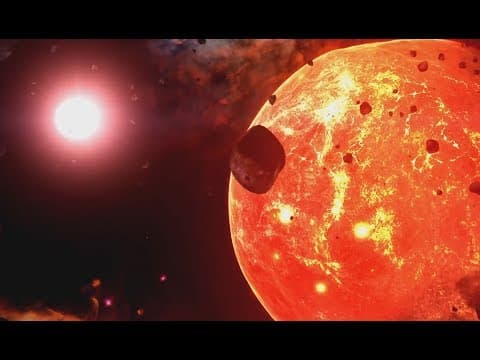
[0:03]Earth, a unique planet, restless, and dynamic. Continents shift and clash, volcanoes erupt, glaciers grow and recede. Titanic forces that are constantly at work, leaving a trail of geological mysteries behind. This episode travels back in time to investigate the greatest geological mystery of all, the birth of the Earth. Scientists explore how our planet first formed from the dust of the solar system. How molten rock solidified to land. How our oceans filled with water and how life arrived on Earth. These are the earliest chapters in the incredible story of how the Earth was made.
[1:10]When it comes to finding clues to the birth of the Earth, our planet has been good at covering its tracks.
[1:25]Billions of years of erosion, volcanic activity, and the shifting of continents and oceans have destroyed almost all the evidence of the earliest stages in Earth's formation. For geologists trying to discover how and when the Earth first formed, this is a major challenge. As geologists began to question the age of the Earth, and of course, they looked for older and older rocks. What we began to find was that the further back you go in Earth history, the harder it is to find any of those rocks. The search for the oldest rocks on Earth brings investigators to the harsh desert landscape of Northern Arizona.
[2:09]This giant hole in the ground is meteor crater, formed when a massive meteorite slammed into the Earth. We didn't really have rocks from the very beginning. Well, where could we find something? What about the meteorites that have been out in space and fall on the Earth? It was here that geologists made a vital discovery. Meteorites are older than any rocks on Earth. They had found the key that would unlock the secret of Earth's formation.
[2:41]If the oldest rocks came from space, that is where the investigation must begin in space.
[2:54]Our solar system, four and a half billion years ago. At its center, the young Sun. The theory that emerged was that the sun was surrounded by a cloud of dust and gas. And as that cloud cooled, little grains of minerals formed.
[3:20]So all these little grains of minerals floating in this gaseous cloud are moving around the sun, and they start to bump into each other. But there was a problem with this theory. Nobody could explain how colliding microscopic mineral grains could ever create an object the size of a planet.
[3:38]Then in 2003, an experiment on board the International Space Station accidentally provided extraordinary new evidence. Astronaut Don Pettit wanted to see what happened to different substances in the zero-gravity conditions of space. He did a simple experiment by pouring some salt into a plastic bag and shaking it.
[4:05]The results were astounding. The particles immediately began to stick to each other, forming little clumps, all held together by tiny static electric charges. Scientists realized that if grains of salt stuck together in space, then so could the mineral grains in the solar dust cloud.
[4:31]Here was real evidence for the fundamental mechanism that kickstarted the formation of the Earth. As mineral grains in the solar dust cloud bumped into each other and stuck together, they grew into small pieces of rock orbiting the Sun. Over the next few million years, some of them collided and grew bigger. Many of these rocks are still orbiting the Sun today.
[5:03]They have drifted for the past four and a half billion years, unchanged from when they first formed. Occasionally, they fall to Earth, and we call them meteorites. They provide scientists with an incredible window onto the past. We brought a what's called a stony type of meteorite. What the scientists do then is slice across it and look on the inside. And to a planetary mineralogist, you start seeing all kinds of wonderful things.
[5:52]So all these little grains of minerals floating in this gaseous cloud are moving around the sun, and they start to bump into each other. Gradually, billions of these rocks grew as they orbited the Sun. First, to the size of boulders, then as big as houses, and they kept on growing. When an object reached about half a mile across, its own gravitational pull became strong enough to draw other objects towards it. Some object in this huge number of objects going around the Sun, one of them had to be the biggest. And as soon as it gets bigger than the others, it's sweeping up more objects. Just like you're driving through a cloud of mosquitoes at night in your car and the front windshield is getting hit more often. So the bigger it is, the faster it grows. And the faster it grows, the more gravity it gets. And that pulls in more objects. So the biggest object starts to run away from the crowd, it starts to grow fastest. And that biggest object was the fledgling Earth.
[7:07]Soon the young planet had so much gravitational pull that it began to attract bigger and bigger objects. As they crashed onto its surface, Earth's size increased with every impact. The bombardment was so intense that it only took about 30 million years for the planet to grow to almost its present size. The young Earth was made of billions of pieces of rock randomly stuck together. But geologists know that the modern Earth is not like that. Below the surface, Earth is separated into distinct layers, a thin crust. Then a massive dense layer of rock called the mantle. And at the center, an iron and nickel core. Some extraordinary event must have occurred to transform the interior of the young planet. Geologists now believe that soon after it formed, the Earth completely melted.
[8:21]Originally, the Earth was probably just a big collection of rocks like this. But it heated up to the point where these rocks all melted. And when that happened, the denser elements sank down through to the very core of the Earth. And the lighter elements floated at the top. The huge gravitational pull dragged the heavy iron and nickel down to form the core, and separated the rest of the planet into layers.
[8:49]What caused such a huge mass of rock and metal to heat up in the freezing depths of space, puzzled geologists for many years. We think it's from the incorporation of very hot radioactive elements. They're out there floating in space, as the Earth accretes, it includes some of this ferociously hot material. As it gets inside there, it begins to heat up the rocks around it. And if you build the Earth fast enough, and you incorporate enough of this really hot reactive elements, either it'll be enough to melt the Earth from the inside out. Only 30 million years after it began to form, Earth had become a giant round ball of boiling liquid rock and metal orbiting the Sun. Imagine a totally molten world. I mean, it had molten magma oceans, uh, no, no dry land anywhere, no water, just flowing lava everywhere. The temperature of the molten Earth was now a staggering 2,000 degrees. But at the edge of the planet, the vacuum of space is a constant minus 450 degrees. Almost 2 1/2 thousand degrees colder. The surface rock could not stay molten for long. It's cooling from the outside in. So from the outside, it begins to crust over, and you get this little scab, like on a wound of cooled rock. But it's still really hot, and then gradually it begins to cool from the outside in. In less than a million years, Earth's surface was covered in a thin crust.
[10:37]But volcanoes still spewed out lava and choking gases. Meteorites rained down in a constant bombardment. Earth had a long way to go before it could support continents, oceans, and life.
[11:00]Scientists investigating the earliest origins of the Earth have uncovered evidence, from salt grains in space. They revealed that the Earth began to form when fragments of the solar dust cloud stuck together. The Earth's internal layers provide the clue that soon after it formed, the young planet completely melted.
[11:20]Scientists had worked out how the Earth first formed from a cloud of dust in space. But they were missing a vital piece of the puzzle. They still did not know the age of the Earth.
[11:35]Billions of years before humans evolved, tiny mineral grains in space clumped together to form the molten ball that became the Earth.
[11:50]But exactly when that happened is a question that has taxed the minds of scholars and scientists for centuries.
[12:01]In 1650, the Irish Archbishop James Ussher added up the ages of all the prophets and kings in the Bible. His calculations led him to very precise conclusions, that Earth was created at nightfall before Sunday, October 23rd, 4004 BC.
[12:23]A century later, geologists realized that Earth's thick layers of sediments and volcanic lavas must have been laid down over millions, rather than thousands, of years. The next breakthrough came in 1897, when physicist Ernest Rutherford figured out that measuring radioactive decay could accurately date the age of rocks. Rock samples from around the globe were found to be not just millions, but billions of years old. But in their hunt for the age of the Earth, scientists hit a major obstacle.
[13:05]Rocks from the earliest stages in Earth history are very hard to find. If you want to go back as a geologist and try to find evidence of those early days, it's very hard to do on the Earth. Because, of course, we have rain eroding, we have tectonics and continental drift destroying continental surfaces. We simply can't find the rocks that go back to that age. In the early 1950s, the American geologist CC Patterson tried a new approach. Using meteorites, he knew that meteorites must have clumped together from the same mineral grains in space that formed the Earth. And that happened at the same time as the Earth was born. So if he could date a meteorite, he should get the true age of the Earth. In 1953, Patterson came to meteor crater in Arizona, looking for samples. The meteorite which blasted out this enormous crater was about 50 yards across. It slammed into the Earth at a fantastic speed. Objects hitting the Earth from space may typically come in at 10 or 15 miles per second, hitting the ground, penetrating into the ground, generating an enormous pressure and shock wave and creating a huge explosion.
[14:40]The explosion vaporized most of the meteorite, but individual fragments survived. This is one of the pieces of the object that crashed into the Earth and made this crater. This is pure iron. We know it's iron because, for example, it's magnetic. An amazing piece of something that's floating in space. This was the kind of place that people could get samples for the first radiometric dating of meteorites. And so Patterson came here and got samples like this. Patterson dated the samples and was amazed by the results. The meteorite was a staggering 4.5 billion years old.
[15:26]Meaning that the Earth was also born 4.5 billion years ago. Patterson had solved the problem that had defeated scientists for centuries. There's this apocryphal story that Patterson got so excited about the date that was coming back from the laboratory. And so hyper about it, he thought he was having a heart attack, and he was driven to the hospital. And it turned out to be just his excitement over this fantastic discovery. Modern radiometric dating techniques have refined the age of the Earth to a remarkable degree of accuracy. The most recent study dates the Earth as four billion, 567 million years old. So scientists now knew how and when the Earth was formed. But nobody had figured out what happened next.
[16:23]Then in 1974, a radical new theory emerged. In the early solar system, there were dozens of mini-planets chaotically orbiting the Sun. According to the theory, one of these was on a collision course with Earth. The idea was the brainchild of Bill Hartmann, who was trying to explain the origin, not of the Earth, but of the Moon. What we came up with was that maybe during that period of intense impacts, maybe a very large impact hit the Earth and blew some crustal outer mantle rock off of the Earth into space around the Earth, and the Moon formed from that material. Hartmann suggested that another planet about the size of Mars crashed into the Earth. He claimed that the Moon could have been formed by debris from that collision. To many scientists, this was nothing but fantasy, but Hartmann had evidence collected from the Moon itself.
[17:45]Footage from the Apollo 16 mission in April 1972 shows astronaut Charles Duke struggling to pick up a large sample of Moon rock to bring back to Earth for geologists to analyze.
[18:05]At the Johnson Space Center in Houston, this actual piece of Moon rock is still kept under strict laboratory conditions. I would say, behold the Moon. This is an actual piece of the Moon, and it's the largest single rock that they brought back from the surface of the Moon when the Apollo astronauts went there. We can't touch it. They don't want human beings touching these rocks and leaving organic material on them. Until the late 1960s, geologists thought that the Moon formed in the same way as the Earth, by clumps of mineral grains sticking together in the solar dust cloud. They believed it had layers like the Earth and a heavy iron core. But when geologists analyzed lunar samples, they were astonished to discover that the Moon rocks contained much less iron than they expected. One of the mysteries has always been why isn't there as much iron in the Moon as there is on the Earth? If the two two objects are right close together in space, the question bothered Hartmann so much that he began to think that conventional theories about how the Moon formed might be wrong. That lack of iron in the Moon, or to put it another way, the fact that the Moon is made out of rock that looks like the crust and the upper mantle material of the Earth. That was a clue that the Moon may have formed from rocks from the outer portion of the Earth. This was the key to Hartmann's idea of a collision between Earth and another planet. The force of the impact completely destroyed the other planet, and flung billions of tons of Earth's crust and mantle out into space and into orbit around the Earth.
[20:03]Within a few thousand years, this debris clumped together to form the Moon.
[20:13]Advanced computer models show that the collision was a glancing blow. The other planet did not hit Earth head-on. This meant that while Earth's outer layers were ripped off, none of its iron core was blasted away. That lack of iron would end up explaining why, why we have a Moon that is only the rocky material without the iron material. Hartmann's collision idea is now accepted as fact. It was his fascination with the Moon that led to a new understanding about a vital stage in the formation of the Earth. The Moon always to me is a reminder that we live in a larger environment than just the Earth. It's the cosmic environment. The inner solar system is our environment that we can move around in now.


