[0:00]When I first reviewed this tool, I thought it was magic, and now it's even better because they've got updates. Check this out. So, I'm talking about Theus AI. This is what it looks like. One prompt, 50 pages, world's first AI assistant that can draft a whole scientific document with just one prompt. So, what does it create? Well, I'm going to show you how to create an awesome literature review and get a real deep insight into a brand new research field in minutes rather than days and weeks. That's what it used to take me in the past. Oh my God, how I'm jealous of you right now for being able to do this. So, head over to Thesis AI, and this is what it looks like. And importantly, you just need to go to the chat once you've logged in. So once you're in the chat section, you'll get something, you know, well, that's what it looks like when it's finished, but let's go through it here so it's not so confusing for you. Here, this is what it looks like, um, a nice clean interface where down the side here you still have the options of how you want your, um, sort of document to end up. Here, we've got citation style. I always use IEEE because that's what I'm used to, but there's other ones as well. You get citation level whether or not you want the page referenced or the paper, then you get document language, and now it supports even more languages than before. I'm learning Persian, but I cannot read Persian because the Arabic script is very confusing for me. It takes me ages to read. Anyway, it doesn't matter. I'm obviously going to do it in English. Um and then temperature down here, zero is if you want it to be super um, like academic and not creative at all. And then if you want a little bit of spice added in there, you can sort of like push it up to one. I like to keep it as zero, but if you find that it is just being too clinical and you do need for your field a little bit of energy injected into that text, then you can increase this temperature slider a little bit more. Um, maybe one thing here he could say like, you know, example, zero means this, one means that, but, you know, a lot of people are getting used to this temperature control on uh, AI. So, now, this is the most important thing. First of all, you need to upload references or the new thing is you can import from Zotaro. And that is fantastic because you've already done all of the hard work of finding the references, now you can import it directly from Zotaro. Let me show you a workflow that I've been through that just minimizes the amount of time you have to manually search. Check this out. Okay, so before I'm importing from Zotaro, I want to go here. I want to sort of like find something to actually write about. Maybe I'm entering a new research field, so I head over to something like consensus, and I put in preparation, characterization and testing of light harvesting additives for organic solar cells. That's what I'm interested in, and I let it do its thing, and it gives me all of these things. And down here, I can see it gives me results. Then I go to this little button, which isn't clear that it's actually like there, and it's part of results. They need to sort out this interface if it was up to me, but nonetheless, you can click here, export results. It looks like every other button in here. Um and then you go RIS, and you export that onto your computer. Great. Then you can go to something like elicit. Why not? Go there as well. Put in a question that you want answering, and then you can get even more stuff to reference and put into thesis AI. Absolutely love that. You can go all the way down to the bottom, and you can then export the references. Download RIS. Then, head back to Zotaro here it is. And all you have to do is go up to file and import, then you select the file. You can go to next, you can find the file, and then uh, import it into your Zotaro file. Excellent. You staying with me? We're going through this pretty fast, aren't we, but I care about your time. Let's carry on. Okay, the next thing is once you've got these in here, you don't have the full text. So, I like to go here, highlight everything, right click and then go find full text. And what it'll do is go through and find the full text. Now, here's a little bit of a sneaky trick that you definitely shouldn't do, because maybe it's a little bit illegal. But if you head here to settings and then advanced, and then all the way down to config editor, yes, I accept the risk, and then here you put oh, what do you find? It's the um, it's the, oh, I've forgotten the name of it. Show all. Anyway, and then show only modified. Here we are. This is what we want. Down here, extensions. Zotaro, find PDF resolver, and then you put this in, which means you can get the paper from SciHub. Oh, that's a little bit naughty, isn't it? Definitely don't do that for your Zotaro. Anyway, I'll put this text in the description so you can create this. You go to this little thing here, you edit it here, paste it in, done. Bob's your uncle. If you got an uncle Bob, congratulations. Okay, let's get out of this. Then, once you've got all of these little sort of like PDF icons in here, it means there is a PDF attached. There it is. There's the full text. Absolutely love that. Now, this is where we kind of like have finished collecting the references for a new research field that we want to explore. Now we can use the power of thesis AI. So, I can take this over here, and what I did is I put in uh, import from Zotaro. And then I click there, import from Zotaro, and then because it's already sort of like connected, um, when you first click it, you'll need to go and sign in, um, and then accept, uh, you know, the the defaults, but it's very, very simple. You you you can do it, I trust you. Um and then we go here, import a collection. So, you can see I've got additives OPV, and then I just click import collection. And then every single file in here that has a PDF document, it will import that PDF document. Great. And then we end up in this section. So, once you've done that, it'll say successfully imported 18 files. Love it, love it, love it. And then we can go here. Um, it gives me the please provide a short description of your topic. Well, I can just put in what I put in, for example, in consensus. I can just say I want that kind of reference here. So I've got preparation, characterization and testing of light harvesting additives for organic solar cells. And then you click go, and you put that down here. You click go and then it says I'm writing the document now. This can take up to 30 minutes depending on the number of files provided. I think you can add up to 100 files. This one had 18, and it took about sort of like 5 minutes to go through, but the results will amaze you. Something that used to take weeks of work, now can be done in a matter of minutes. Check this out. All right, this is what we're all here for. So, check out this. This is what happens when you get to the end. It says, here we go, you can export it to overleaf or you can start a new chat. What I'd like to see here as well is, you know, open PDF, because the way you can actually get to these is go to documents, and then you have one that I've done before, and then the test I've done today, document two. This is what I'm interested in. I can click document two, and then look, these are the sort of things I'd like to to see, download PDF, download all files. I'd like to see that in the chat function, but this is where you can find it at the moment, but ultimately, let's have a look at the PDF. I've downloaded the PDF and this is the magic that AI now allows us to do when we're entering a new research field. We can get a literature review from the sources we found instantly. Well, not instantly, within five minutes, but that's pretty bloody good because this would take me hours and hours, weeks of work to get to this point, but now it's done for me. So, in and I know, by the way, I know done for you. A lot of people are resistant to get into this stage, using AI in academia, because you should be reading the papers, you should be doing this, should, should, should, should, should. You can do it now. I'm not saying this is the final point. I'm saying to get to this point so you can review it, get the information into your brain, start critically analyzing it. That is what we're here for as researchers, not to create this. This is done for you now. Anyway, we'll let the academic world catch up, but this is where we are right now and uh, it's amazing. So, let's check it out. Okay, contents. Here we go. We've got introduction, and you can see we end up with 41 pages. That's a lot. That's, that's like a thesis worth of like an introduction, by the way. That's more. I think my my introduction was 20. So this is twice as long as I had to smash my hand into my keyboard for my PhD thesis. Um, okay, and then you can see here, we've got um, a nice little title. You've got the me who wrote it, and then the abstract. Enhancing performance of organic solar cells achieved through the strategic integration of light harvesting additives alongside advanced absorber and transport materials. Additives like CXC22 significantly improve photo currents and power conversion efficiencies under indoor lighting by leveraging superior optical properties tailored to indoor Spectra. So, is it perfect? No. Is it better than a first draft that I could write when I'm tired and fed up of looking at another peer reviewed paper? Yes, yes, it is. Okay, then. So, down here, you can see it gives me an introduction, and it just goes on and on. And each one of these, I can click it, I can go to the reference. I know the reference exists. It used all 18 of my references because obviously they were highly uh correlated to this topic because it was literally literally, there we are, that's better, literally the same sort of like, you know, thing I was looking for. So, it used all of it, which I absolutely love. And then it just sort of like created something that I could read. I could understand all of those research papers, how they interact with each other. It even starts really sort of like, you know, base level understanding of like mechanisms of action. And then even you go all the way to the top, it even has like just the introduction, principles of photovoltaic energy conversion. Just starts from the very beginning. If I was starting a new research project, and I did all of this in like 20 minutes, going to consensus, and elicit, and research Rabbit, those sort of places, grabbing it, putting it in Zotaro, getting the PDFs automatically by just going, um, uh, to this one and saying, find full text, and then putting it into Thesis AI, and getting this amazingly long, detailed, fully referenced output that then I can start to sort of like base my own understanding of a research field on. Absolutely love it. Starting a PhD, starting a new research field has never, ever been easier, and I absolutely love it. Another thing that you can do, by the way, with Thesis AI, is export to overleaf. And I think this is the only research tool at the moment like this, where you can actively export it to overleaf and then have full control, full 100% control of everything you are putting into your report. So, you can see your references here, you got full control of all of the references. You've got all of control of everything in here, and it is just crazy. It even has the rightful, um, integration, so it'll give you feedback as you are writing. Oh, I've got all of these different error codes here. Let's just recompile and see what happens. But ultimately, all of these things here are just really awesome. And uh, I feel like these days, creating your own literature review from scratch is a thing of the past. We can now get to a good point on our, uh, research sort of like journey without having to do loads and loads and loads of the manual labor work that we had to do in the past. People are going to be resistant to this sort of workflow at the moment, but it will become part of academia. Mark my words, and so that is how within, I would say 15 minutes, I went from zero references to a 43 page document. I will now go away and read it, see if it's true. Well, it will be true, by the way. I've read a good portion of this, and it is absolutely true, but what I mean, I think is does it represent the research in the way I would want to sort of like talk about it? Does it use my language? Do I understand stuff? I go through and I don't understand something, that tells me I should go and read the actual paper. And because it's fully referenced, I can go do that. I've created a personalized learning literature review for myself and a great basis and first draft of something to go into a thesis, into a peer-reviewed paper, into a review article that I could submit to uh, a journal. This is where I would start right now in 2025, and I absolutely love it. Check it out for yourself. If you like this video, go check out this one where I talk about the top free AI tools every researcher should know about. They're 100% free. Go check them out.
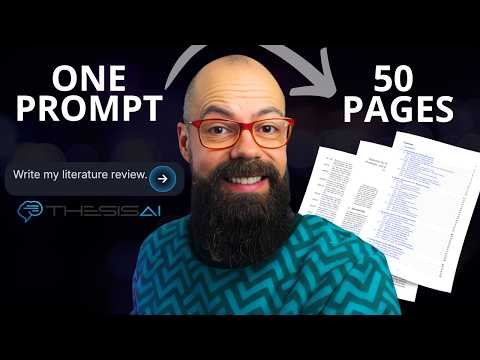
One Prompt = Full Literature Review (Why Every PhD Needs This Tool)
Andy Stapleton
15m 17s2,522 words~13 min read
YouTube auto captions
Transcript source
YouTube auto captions
This transcript was extracted from YouTube's auto-generated caption track. The transcript below is server-rendered so it can be read, searched, cited, and shared without opening the original YouTube player.
Pull quotes
[0:00]When I first reviewed this tool, I thought it was magic, and now it's even better because they've got updates.
[0:00]One prompt, 50 pages, world's first AI assistant that can draft a whole scientific document with just one prompt.
[0:00]Well, I'm going to show you how to create an awesome literature review and get a real deep insight into a brand new research field in minutes rather than days and weeks.
[0:00]So once you're in the chat section, you'll get something, you know, well, that's what it looks like when it's finished, but let's go through it here so it's not so confusing for you.
Use this transcript
Related transcript hubs
Watch on YouTube
Share
MORE TRANSCRIPTS


