[0:00]mitosis. In this module, you will learn about mitosis. Mitosis is a process of cell division that makes possible regeneration of body parts. To elaborate, mitosis is the separation of nuclear chromosomes into two identical daughter nuclei. It is divided into four key phases. Prophase, metaphase, anaphase, and telophase. An additional phase called cytokinesis occurs after the complete nuclear division. Before a dividing cell enters mitosis, it undergoes a period of growth and rest. This period is called interphase. In interphase, the genetic material of a cell increases. Prophase. During prophase, the chromatin condenses and becomes short and thick to form chromosomes. Each chromosome has two sister chromatids joined together at the centromere. The nucleolus disappears and the nuclear membrane starts to break down. The centrosomes, each with a pair of centrioles, move apart to the opposite poles, forming a spindle between them. Metaphase. During metaphase, microtubules of the spindle interact with chromosomes. This causes the chromosomes to move and align along the middle of the cell or the equatorial plate. Sister chromatids are held at the centromere, confirming the presence of protein structures called kinetochore at the surface. The kinetochore holds the chromosomes and attaches them to the spindle. Anaphase. During anaphase, the sister chromatids separate at the kinetochore and the daughter chromosomes along with the divided centromere move towards the opposite poles as the microtubule shortens. The poles of the spindle also move apart and help to separate the chromosomes. As the chromosomes separate completely into two sets, one at each pole, anaphase is considered complete. Telophase. During telophase, the daughter chromosomes arrive at the pole and the chromatin starts to decoil. Also, the nuclei reform along with nucleoli. This triggers the reformation of the nuclear membrane. Cytokinesis. Cytokinesis is the partition of the cytoplasm. In animals, a cleavage furrow appears in the plasma membrane, which deepens and divides the cytoplasm into two daughter cells, each containing a nucleus. In plants, new cell wall formation is triggered at the center of the cell by the formation of a cell plate. The cell plate grows outwards till it meets the existing wall, resulting in two daughter cells. In this module you have learned, mitosis is the process of separation of nuclear chromosomes into two identical daughter nuclei. Mitosis involves four key phases. Prophase, metaphase, anaphase and telophase. In prophase, the chromatin condenses and becomes short and thick to form the chromosomes. In metaphase, microtubules of the spindle interact with the chromosomes. In anaphase, the sister chromatids separate out at the centromere and move towards the opposite poles as the microtubule becomes shorter. In telophase, daughter chromosomes arrive at the pole and chromatin starts to decoil, followed by the reformation of nucleoli and nuclei.
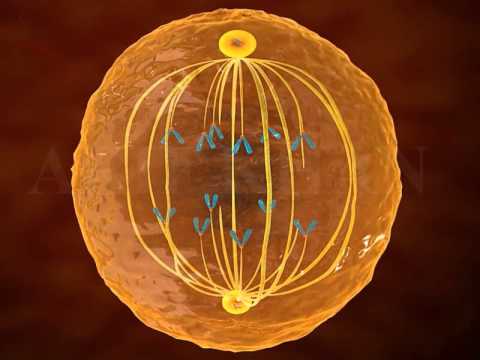
mitosis 3d animation | Phases of mitosis | cell cycle and cell division | mitosis and meiosis
Creative Learning
4m 34s454 words~3 min read
YouTube auto captions
Transcript source
YouTube auto captions
This transcript was extracted from YouTube's auto-generated caption track. The transcript below is server-rendered so it can be read, searched, cited, and shared without opening the original YouTube player.
Pull quotes
[0:00]Mitosis is a process of cell division that makes possible regeneration of body parts.
[0:00]To elaborate, mitosis is the separation of nuclear chromosomes into two identical daughter nuclei.
[0:00]An additional phase called cytokinesis occurs after the complete nuclear division.
[0:00]Before a dividing cell enters mitosis, it undergoes a period of growth and rest.
Use this transcript
Related transcript hubs
Watch on YouTube
Share
MORE TRANSCRIPTS


