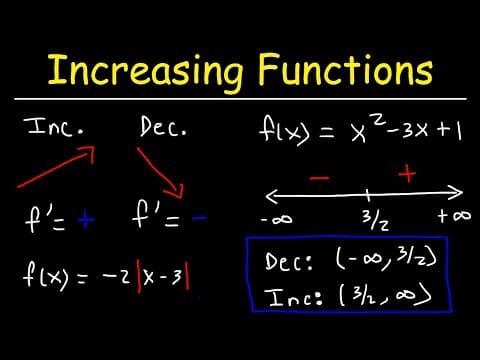
[0:00]In this video, we're going to focus on finding the intervals where a function is increasing and when it's decreasing. So, let's say if you have a graph, anytime the graph is going upward, if it's going up, then the function is increasing. The first derivative is positive. Now, if the graph is going down, it can be going down in many different ways. When it's going down, the function is decreasing and the first derivative will be negative. So anytime the function is decreasing, the slope is negative, and when it's increasing, the slope is positive.
[0:46]So, let's say if we have this particular function. Let's say that f(x) is equal to x squared minus 3x plus 1. So what we need to do in order to find where the function is increasing and decreasing without graphing, we need to find the first derivative, set it equal to 0, and make a sign chart. And then we could determine where it's increasing and decreasing. So the derivative of x squared is 2x and the derivative of 3x is 3. Now let's set that equal to 0. And if we add 3 to both sides, we can see that 2x is equal to 3. And if we divide by 2, the only critical number that we have in this example is 3 over 2. Now, let's make a sign chart. So let's put 3 over 2 in it. Now let's pick a number that's greater than 3 over 2. Let's say 4. If we plug in 4 into the first derivative, will it give us a positive number or a negative number? 2 times 4 is 8 minus 3, that's 5. So that's positive. So the first derivative is positive when x is greater than 3 over 2. But now what about when x is less than 3 over 2? Let's say if x is 0. 2 times 0 minus 3 is negative 3. So when it's less than 3 over 2, the first derivative is negative.
[2:25]So with this information, how can we write the interval where the function is increasing and when it's decreasing? Now, all the way to the right we have positive infinity and to the left, we have negative infinity. So we could say that the function is increasing between 3 over 2 and infinity. And it's decreasing when the first derivative is negative, and so that's between negative infinity and 3 over 2. So, it's decreasing in this section, but it's increasing in this section.
[3:08]Let's work on another example. So let's say that f(x) is equal to x cubed minus 9x squared plus 24x. So go ahead and find the intervals where the function is increasing and when it's decreasing. If you want, take a minute, pause the video, and go ahead and try this example, give it a shot. So let's start by finding the first derivative of the function. The derivative of x cubed is 3x squared, and the derivative of x squared is 2x, and the derivative of x is 1. So we have 3x squared minus 18x plus 24. And we could set that equal to 0. So let's begin by factoring out the GCF, which is 3. 3x squared divided by 3 is x squared. -18x divided by 3 is -6x. 24 divided by 3 is 8. So now we need to factor this particular trinomial. So what two numbers multiply to 8 but add to the middle coefficient -6? 4 times 2 is 8, but -4 plus -2 adds up to -6 and still multiplies to positive 8. So it's going to be x minus 4 times x minus 2. So if we set each factor equal to 0, this will give us two critical numbers. The first one is at x equals 4 and the second one is at x equals 2.
[4:53]So now let's make a sign chart.
[5:05]I kept this part because I want the first derivative in its factored form. It's going to be very helpful for analyzing the sign chart. So let's put the critical numbers in ascending order, so we have 2 and 4. Now, the multiplicity of each critical number is odd. That means the signs will change across each critical number. So if we find the first sign, we can easily find the rest. So let's start with a number that's greater than 4. Let's try 5. So 5 minus 4 is positive. 5 minus 2 is positive. If you multiply two positive numbers, it will give you a positive number. So the others should be negative and positive, they're going to alternate. So if we try 3, 3 minus 4 is negative, 3 minus 2 is positive. A negative times a positive will give us a negative result. Let's say if we try something less than 2, like 0. 0 minus 4 is negative, 0 minus 2 is negative. A negative times a negative is equal to a positive number. So now at this point, we can determine the intervals where the function is increasing and decreasing.
[6:21]Don't forget to include your infinity symbols in the number line. So the function is decreasing where it's the first derivative is negative, and the function is increasing where the first derivative is positive. So it's decreasing between 2 and 4, but it's increasing between 4 and infinity and negative infinity and 2. So let's write the final answer. The function is increasing from negative infinity to 2, union 4 to infinity. And it's decreasing only between 2 and 4. And so that's it. That's how you can find out whether or not a function is increasing or decreasing. Here's another problem that you could work on. This time we're going to have an absolute value function. So determine where the function is increasing and then decreasing. Write the intervals for it. Now, for this one, there's no need to find the first derivative because it's very easy to graph this function. So let's start with the parent function. We make a bigger graph.
[7:38]So if we were to graph the absolute value of x, it would look like this. It's going to open upward, it has a slope of 1 and the vertex will be at the origin when x is 0. But now, let's say if we wanted to graph our original function, it's still going to shift 3 units to the right, so it's going to be somewhere over here.
[8:18]But because of the negative sign, it's going to open downward instead of upward, but with a slope of 2, so it's going to be more narrow, so to speak. So with this information, we can tell where it's increasing and when it's decreasing. It's increasing when the function is going up, as you view it from left to right. And it's decreasing when the function is going down. So it's decreasing on the right side, increasing on the left side. So if we were to make a number line, it changes at 3, when x is 3.
[8:55]So to the right of 3, the function is decreasing, which means the first derivative is negative. Because as you can see, the slope is negative on the right side. On the left side, the function is increasing, so the slope is positive. So it's increasing on the left of 3 and decreasing on the right. So now to write the final answer, the function is increasing from negative infinity to 3. And these represent x values, and it's decreasing from 3 to positive infinity. And so that's it. So to identify this point, all you need to do is take the inside, x minus 3 and set it equal to 0. When you do that, that's how you can get x equals 3. So for example, let's say if I have this particular a function. Let's say, uh, 3x plus 4. Actually, let me use a different one. Let's say uh 3x plus 4. So to find the vertex, I'm going to set the inside part of the function equal to 0.
[10:03]And so the graph is going to change at negative 4 over 3. So when I graph it, it's going to look like this. -4/3 is like -1.33. But this graph is going to open upward, instead of downward. So notice that it's decreasing on the left side and increasing on the right side.
[10:30]So we can write the final answer like this. It's increasing from negative 4 over 3 to infinity, and it's decreasing from negative infinity to negative 4 over 3.


