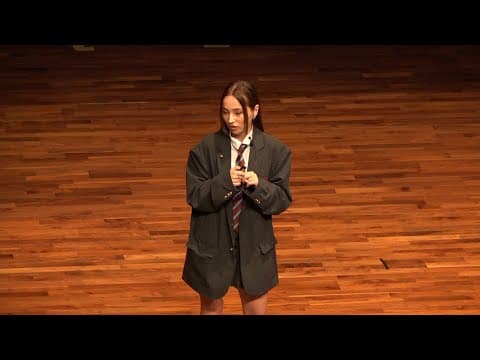
[0:11]Where are you from? By a show of hands, how many of you can answer this in under two words? Okay. So, for a lot of people, this could be a very simple, straightforward question, right? Insert third culture kids. Suddenly, this question is complicated and can become the root of identity crisis. So today I'm going to be talking about my journey as a third culture kid and how bilingualism affects the brain.
[0:44]little meme. So about me, um, I'm a French-Chinese content creator here in Hong Kong. And I actually grew up in Hong Kong my whole life. I've never lived anywhere else. And we're going to have to go in a little bit more about my background, and I think I had a pretty unique upbringing. I first went to local school from kindergarten. Um, so that means I was really immersed in the local scene, okay? I spoke Cantonese every day. Everything I liked had to be very local, you know, the songs, the music, the shows. When I was 12, my life changed overnight. I was sent to an international school. Suddenly, I was speaking English every day, um, having friends who were Western. Western friends, and I had to change also and adapt what I liked to make friends. Western shows, Western songs. Then university, I went to Hong Kong University. No, not this one. I went to university in Hong Kong. So, yeah, thrown right back into the local scene. On the inside though, oh, I'm Honkgan. Right? I just love favorite food, Chinese food. I wear slippers at home, I do practically all the Asian things you can think of. On the other side, I mean, I'm also very white. You know, I'm practically, I mean, you can probably think that if you hear what I sound like or see how I dress. I don't feel exactly French, having never lived there, but yeah, I am a Guaimou also, right? That's me. So, every time I get the question, where are you from? I, I feel like I always have to prove my origins and explain where I'm from. And of course, this question is natural, very normal for people to be curious, it's just the repetitiveness of it, having to prove your origins and explain where you're from. That bit can be exhausting, and I'm sure a lot of us here can relate to. The first time that I felt different, I was in kindergarten. I remember the bus mother had asked me, Ah, li-leh-men-ah, leh-deh-eh-men-ah. Where are you from? And I just knew that we spoke English at home. So I said, oh hey, English-man. Uh, it's hard to explain, but hard to translate, but I meant like, I'm an English-speaking person, not English, but basically I did not know who I was. And that's when I knew, I'm different, and I don't know who I am. Gotta figure that out. In high school, I remember being told, you're not French, your hair is black. You're not French, you speak better Chinese than French. Then university, if you're rice fam, you would have already heard this story. I was in year two advanced law translation, and you would have had to take one year of law translation to be in this class. Um, and I was already different because I was told, literally by the dean of the university, that I was an anomaly, because I was the first ever non-fully Chinese person to take this course. Because it was law and not law, it was translation and interpretation. And so pretty much everybody were fluent Chinese, and I was the first one who actually was stronger in English than in Chinese. So they had to kind of change the way they graded their papers, otherwise it wasn't fair for me. Back to the class. It was in a massive auditorium. And the lecturer had pointed at me. And said, are you in the wrong class? And I said back in Cantonese, my-a. And I thought it would just end there. But she pointed at the PowerPoint and said, then could you read the Chinese up there? So, I actually had to prove that I could read it, and I thought that would end, because there's a massive class, you know. And, um, she continued to ask me questions like, why do you speak Cantonese, or where are you from, and I was just really embarrassed because I feel like we were wasting everybody's time. But yeah, the question, where are you from, it's a natural question, but when it's so when people kind of tell you you are not what you are constantly. Can you imagine what that does to someone's self-confidence over time? The emotional toll. I felt like I was on a pendulum, you know, always just swinging whichever way that person wanted me to be. And I just had to nod and smile and get it over with. In 2018, not that long ago, I came across the term third culture kid. And I was excited, you know, is this what could explain how I'm feeling? Am I finally going to, you know, fit into a category? So, this term was coined by American sociologist, Ruth Hill Useem, who spent much of her life um studying third culture kids. And it refers to a child who's spent their formative um years significant part of their formative years outside of their parents' culture. Creating one of their own, a third culture. Another quick survey, who here identifies as a third culture kid? Okay, a lot of you, and that's not surprising. Hong Kong is a very um, international city, right? There's a lot of expats, there's a lot of us who can feel the same, which is great to feel like we're not alone. And with that, we have to take an example. Or look at these examples first, common traits of a TCK, yeah, with feeling belonging and clear definition of a home. So, oh, yes. Oh, yeah. Here are the examples. Of two different individuals who have very different struggles as a third culture kid. My husband, and me, what a perfect photo for this demonstration. He was terrified to be on that horse, by the way. He couldn't trust how still he was being. Okay, so as you know, I'm mixed, but I'm fluent in Cantonese and Mandarin, and I feel like I'm perfectly fit in in the local crowd, but I'll never be considered, you know, like a local. Then, Dan, who is English, grew up in Hong Kong, can't speak the local language, because that's what happens when you go to an international school. And yet, when he goes to England, he'll always feel like an outsider. So, third culture kid, one term, but still, very different definitions for two people. Consider this. Is anyone ever half anything? Is anyone ha- is anyone half flesh, half blood? Can you split a person down in the middle and see two sides? Me and you were made up of the same things. More than that, we crave the same things. To be loved, to be accepted, to belong. And it was a long journey for me to get there, but the first step to feeling whole is to know that you are whole. And that third culture kids, you know, us, we're not half anything. Different, yes, but never incomplete. The second step of feeling whole is to know that you are not alone. Because sometimes that's just enough. I mean, it worked for me when I first started my #JLourants series on Instagram, years ago. And I was actually hesitant to post these because I was like, maybe not many people could relate to these cultural experiences that I was feeling. But to my surprise, the series had garnered millions, millions of people who had come together in agreement, laughing and crying with me. And it was just so powerful to feel like I was finally part of a community, that I wasn't alone.
[9:18]And how cool is it that we're practically born bilingual? I'll tell you how cool, through science. Now, science was never my strong suit, okay? I did not qualify to apply for this university or other other universities, but we're going to talk science and specifically how multilingualism affects the brain. Now, language is a window to different cultures, right? But actually it extends further than just knowing different sentences and different metaphors. Let's take a look at this study by Dr. Thomas Bak, where he tested 853 participants in 1947, when they were all 11 years old. They were retested in 63 years later when they were all in their early 70s. They were tested on their attention tests and their concentrations because he found that bilingual students seemed to perform better, so he wanted to get to know it more. And the results were astonishing. People who picked up a new language or bilingual were seen to have positive effects mostly in general intelligence and reading. And it was also seen that adults who picked up a second language in their adulthood also had positive effects. So, it's never too late to pick up a second language, you can always do it and it will actually have the same cognitive benefits, um, to your brain, um, when you learn a second language. No spoiler alert, but I felt that what was most fascinating apart from this was that those individuals were found to have improved thinking skills and memory abilities. And the reason for that is, okay, our brain is very complicated. But what happens when you learn a second language, is the language centers of your brain actually create new areas in your mind. And that strengthens your brain's natural ability to focus. You know, your gray matter is denser and all of that, but that was something I never knew before. Other than that, they were also found to be more creative. But the most fascinating part that I found, oh yeah, and it's also like a workout for your mind. We have to show my little brain dude. Um, let's go to the next one. But the most fascinating part that I found was that those who were bilingual or spoke more languages were found to have more empathy. Empathy, this trait stands alone, right? I mean, this is a personality trait that can't be learned. But when you're aware of more than just one culture, more than just yourself, you naturally become more sensitive to different layers of humanity. You are more accepting, you're more open to people's points of view. So, if people, if there were more bilingual people in the world, could it be a kinder place? So, if my journey of healing didn't help, I hope that science talk did, because I just told you your brain was really cool. Um, and if you're struggling with your identity, please know this. No one is half anything. You cannot split a person down the middle and see two sides. You are loved, accepted, and you belong. I'm standing here proof to you that what you're feeling, what you're experiencing is valid. And I hope that validates your pain and comforts you in the roller coaster journey of self-discovery. And the next time someone asks me where I'm from, I'm going to answer it with pride. I hope you can too. Thank you.


