[0:00]Right at the bottom of the instrument approach plate is the landing minimum section. Some people say minimum if they want to sound fancy. The FAA actually uses both, so I'll stick with minimums here. Here we have the ILS or localizer approach for runway 33 left at Baltimore. The minimum section gives you the lowest altitude and visibility requirements for the approach flown. The top of the minimum section is broken out into categories A, B, C, and D. These refer to the speed of your aircraft as you fly the approach. To determine which category your aircraft belongs in, you'll either need to know the V ref speed given by the manufacturer or take 1.3 times the stall speed in a landing configuration or VSO. The categories go from the slowest speed in category A through the fastest speed in category D. Here are some examples of planes in each category. A standard trainer like a Cessna 172 would fall in category A. A King Air would be a category B. A small air liner like the Boeing 737 would be category C. Finally, the heavy airliners like the 787 Dreamliner would fall into category D. It's important to note that if, for example, your Cessna is flying the approach above 90 knots for whatever reason, you'd then be considered a higher category. But it doesn't work the other way. If a King Air, for example, can't be flown in category A, no matter how slow it's flying on the actual approach, it's always going to at least be a category B. These categories are important for determining what kind of restrictions there are on the approach. The minimums are listed below the category strip. The first one is for the straight in ILS to 33 left. The ILS approach is a precision approach. This means that the first figure on the strip, 343 is a decision altitude. When the aircraft reaches the decision altitude of 343 feet, it's time to decide whether to continue the approach to the runway or execute a missed approach. Off to the right is a figure of 200 feet, which is the decision height. The difference between decision altitude and decision height is that the decision altitude is an MSL and is read off the altimeter, while the decision height is AGL. You can figure out the difference for yourself if you look at the touchdown zone elevation from the top of the chart. In this case, it's 143 feet. This elevation is the difference between the decision height and the decision altitude. The standard decision height of an ILS approach is 200 feet. This is what you'll see for decision heights on most ILS approaches, while the decision altitude will vary depending on the particular touchdown zone elevation. The 18 figure after the slash is called runway visual range. Some larger airports have precise equipment for measuring visibility and are able to give a reading in feet rather than statute miles. The approach plate gives minimum RVR in hundreds of feet, so this minimum is 1800 feet. The FAA provides a chart for converting RVR into statute miles if needed. Here 1800 feet is equivalent to 1/2 statute mile of visibility. The figures in parentheses are provided from military operations and aren't applicable to us civil pilots. The strip below the ILS gives the minimums for the straight-in localizer to runway 33 left. The localizer provides only lateral navigation, doesn't have a glide slope for vertical navigation. Either because the equipment is broken on the field or it's broken in your aircraft. Because of this, a localizer approach is a non-precision approach. This means that the altitude minimums are not decision altitudes, but minimum descent altitudes or MDA. There is no decision to make once you arrive here, but you can't go below until you have sight of the runway. Notice the MDA of 540 feet is higher than the decision altitude from the ILS of 343 feet. The non-precision aspect means you can't get really close to the ground without seeing the runway. After the slash is the RVR again. This time it's 2400 feet, a bit higher than the ILS minimum. Now the 397 foot figure is called the height above touchdown. Notice also that now for the localizer, the minimums change depending on which category aircraft you're flying. With this ILS, all aircraft have the same minimums, 343 feet and RVR of 1800. But on the localizer, your RVR goes from 2400 to 4000 feet, if you're flying a Cat C or D aircraft. The thinking here is that in a faster aircraft, the pilot needs more time to react to seeing the runway, and so should make visual contact further out and or higher up. The last strip provides circling minimums. Instead of performing a straight-in approach to runway 33 left, we could use this approach and then circle to another runway at BWI. This is also a non-precision approach, so the altitudes are again, MDA and height above airport. Instead of a slash with a two-digit number, we have a dash with a one. This is the visibility and statute miles required for the approach. It's a lot more common to see minimums given in statute miles than in RVR. Notice again that both the altitude and visibility minimums are increasing as the category aircraft get faster. If the cloud ceilings and visibility are below the minimums for the approach in category you're flying, you won't be able to gain visual sight of the runway and land. Now, if you're flying under part 91 of the Fars, as most of us are in a training environment, you are allowed to attempt the approach if the clouds are below minimums and have a peak for yourself, so to speak. But if the visibility is below minimums, you won't be able to even attempt the approach under any circumstances. Let's look at an approach to the same runway, 33 left at Baltimore, but instead of the ILS, this is an R-Nav GPS approach. Again, there's the same minimum sections at the bottom, but notice there's no indication of a straight-in approach with the runway number, as we saw in the ILS plate. Let's look at the acronyms for each strip. The first one is LPV, which stands for localizer performance with vertical guidance. And the second is LNAV, VNAV, which stands for lateral navigation, vertical navigation. As the name suggests, you get both vertical and lateral guidance with both approaches, similar to an ILS, so we can think of these as precision approaches. Notice to the right are the letters DA which indicate decision altitudes, same as for the ILS. The next strip is the LNAV. This is just lateral navigation, so it's a non-precision approach and uses MDA. Same thing for the circling approach, this again is a non-precision approach. When you're flying a GPS approach, it's crucial to know ahead of time what kind of guidance you'll be getting so you can choose the correct minimums and whether to treat it as a decision altitude or MDA. You can confirm what kind of guidance you're getting once you're on the approach, as most units will display either LPV or LNAV. One more crucial thing to watch out for on some approach minimums. Here's the ILS approach to runway 23 at Frederick, Maryland. Let's focus just on the localizer minimums. You have a category A MDA of 1080 feet and visibility of 3/4 statute mile. However, notice below, there's another section titled Zibatt fix minimums, where now the same localizer approach gives an MDA of only 1020 feet. You can see the Zibatt intersection on the profile view above. The reason for the two minimums is that if you're able to fix or identify the Zibatt intersection, you're allowed to descend below 1080 feet, down to a lower MDA at 1020 once you cross that point. If you don't know where Zibatt is, you won't know when to descend to 1020, so you need to stay up at that higher 1080 feet. How do you identify Zibatt? Notice in parentheses it mentions dual VOR receivers required. This is because Zibatt is identified as the intersection of the localizer course with the 270 radial from the Westminster VOR. You'll need two receivers to find both of these. So that's a breakdown of landing minimums on the instrument approach. Make sure you're clear about which minimums apply, and if you're treating them as a decision altitude or a minimum descent altitude.
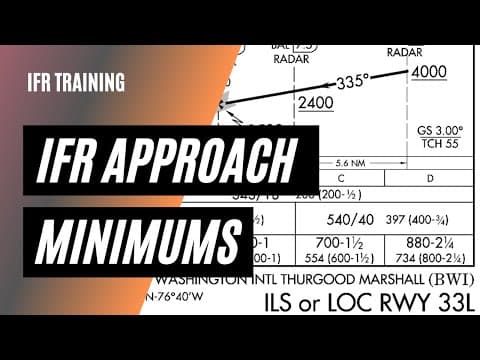
Approach Plate Minimums Explained | Decision Height | Minimum Descent Altitude
FlightInsight
8m 11s1,432 words~8 min read
YouTube auto captions
Transcript source
YouTube auto captions
This transcript was extracted from YouTube's auto-generated caption track. The transcript below is server-rendered so it can be read, searched, cited, and shared without opening the original YouTube player.
Pull quotes
[0:00]Right at the bottom of the instrument approach plate is the landing minimum section.
[0:00]The minimum section gives you the lowest altitude and visibility requirements for the approach flown.
[0:00]To determine which category your aircraft belongs in, you'll either need to know the V ref speed given by the manufacturer or take 1.3 times the stall speed in a landing configuration or VSO.
[0:00]The categories go from the slowest speed in category A through the fastest speed in category D.
Use this transcript
Related transcript hubs
Watch on YouTube
Share
MORE TRANSCRIPTS


