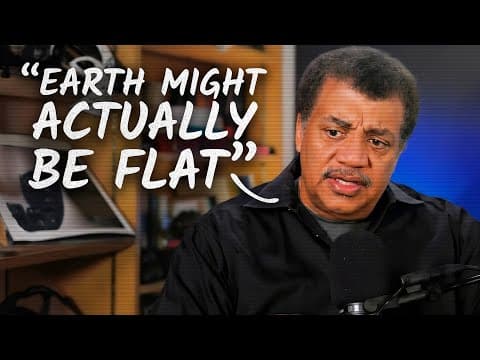
[0:00]Lately, I've been doing calculations, as well as looking back at old NASA footage and raw data from satellites hovering above earth. And I just can't escape the conclusion that the Earth might actually be flat.
[0:22]That's not me. It was never me, those aren't my words. That's what's called a deep fake. What is a deep fake? So, a deep fake, the shortest, shortest definition I can come up with is a synthetic or manipulated media, and by media, I mean video, audio, spaghetti or images, which is generated with AI, artificial intelligence, to make people appear to say or do things that never actually happened in reality. Today, we're interviewing an Andromedan. My apologies, this form takes some getting used to. The term deep fake comes uh from the uh deep learning, which is a type of neural networks that are used to uh to generate this this type of content, and fake is a fake. Hence deep fake means definitely generated with AI. So Alex, you mentioned deep learning. Could you catch us up on that? It all starts to breaking it down to the human brain, and basically we're looking at neurons. In uh AI, a neuron is called a perceptron, and this has multiple inputs, a single output, each input has an associated weight, and if all the inputs multiplied by the associated weights, uh is higher than a threshold, it will fire uh an electric signal. So, this is like the basic concept simulated from the organic matter, from the from the neuron. In order to train this neuron to do something, you're going to show him what the output should be, and it will adjust the weights so it fires at the right time. Now, this is just a single dot. Then you can expand to a neural network where you have multiple neurons, multiple inputs, multiple outputs, and so on. Now, a deep neural network means multiple layers of this uh list of neurons. So when you call the term deep learning, it means deep because there's a lot of depth to to to train, and usually the amounts of data are we're talking about terabytes of data. So that's why it's a huge network. It's a lot of training to do, so that's why it's called deep learning.
[2:38]I didn't think much about deep fakes until I got deep faked. And, you know, the early stuff is fine if it's parody. And if it's obvious it's parody, one of my favorite of these is when I was babified in an actual conversation I had with Theo Von on his podcast. You're not thinking to yourself, did Neil actually become a baby to do this? Because it's parody. It's one of the most cherished means of expression we have in the United States. But when you do this and the viewer does not know it's parody, then you're crossing a line.
[3:25]Obviously, I'm not alone in this landscape as a victim of deep fakes. There are many, many celebrities out there, their public figures that have been deep faked in ways that are also affecting the integrity of their actual message that they would post on their authentic platforms. I've seen people write some kind of science script, then deep fake me saying this script that they wrote. Some of them are attempts to just spread more science, but through my voice and my persona, often, in every case that I've seen, some of the science is wrong. These deep fakes are becoming so sophisticated and so subtle that it even fooled a close friend of mine. I was scrolling through my Tik Tok feed, and I came upon a video of you talking about a type 3 civilization, and I was so impressed, I showed my son. I was like, look at this. Can you believe this? I said, I have to call Neil and tell him how brilliant this observation was in this video that I found on Tik Tok. You texted me, and there I was in the video, narrating it and you there's images of me talking about it, and I'm looking at it, and I say, I don't remember this. I never did this. But you're all excited about it, and I I felt bad saying, dude, that's not me, okay? That's some fake me.
[5:00]And so, what what was your reaction when I told you that? Well, if you felt bad, I felt worse because I totally believed that was you, Neil. It scared me, and it made me go crazy. I was going, oh my God, all day, I was like, oh, I will never trust the Interstellar soundtrack again. Like, what you talking over the Interstellar music, you know? So, I'm flattered that people want to put me into content in a way that attracts audiences. I'm seriously flattered by that. However, it's a deep fake, about 15% of it was false. I don't think it was purposefully false, the person just didn't know. If it's fooling people and people are not thinking, oh, this is a parody, or this is just a fun uh excursion, then it's transgressive of the integrity we've worked so hard to build. Something's got to be done about that, and something will.
[6:05]Of course, a science video here or there that gets deep faked or uh the integrity of a celebrity, that might not get as widely noticed as if a deep fake shows up of a political figure that affects the stability of peace in the world. At the beginning of the war, there was a movie posted on uh hack Ukrainian TV. It was picturing Zelensky that was stating that they're surrendering to Russia. And later on, there was another movie showing up on YouTube or Facebook, it was this time picturing Putin saying that hey, we're finally getting to peace. They weren't that technically good. I mean, they fooled some people, but the majority noticed that it's fake, uh especially since uh and I'm talking about about the one with Zelensky, it had like a bigger head than normal.
[7:05]Not huge difference, but if you really know how the president looks, you could actually notice the difference. Today, for everybody, I hope, it would look very fake. Uh but obviously for other people that aren't really exposed to to multiple media streams and don't really have access to internet, it might actually be, you know, you saw it on TV, right? It must be true. Zelensky came up himself and said that's fake, but there are many other stories or situations that happened that weren't so popular. Uh for instance, when you have a campaign, politically campaign, usually you have to stop campaigning around, I don't know, Friday, and until Sunday, you can't state anything anymore. And on Sunday, there are the elections. So there were countries where deep fakes were released on Friday evening or Saturday morning, uh about the uh politicians getting bribed or discussing war or discussing the particular subjects. And they were not allowed to speak to say they're fake. So that actually had huge implications on people that vote.
[8:14]Deep fakes are already sophisticated enough to exploit people's confidence in ways that swindles them out of their money. By the way, scamming is not new to the internet. People have been scammed ever since there's been uh premise of trust that one human would have in another. But with AI participating in this exercise in the hands of nefarious few, uh it's taken to another level. Okay, so if we look at the types of scams that make use of uh deep fakes, so we have the romance/investment scams. And this discussion is very personal. I receive tens of these messages every week. And they're all like, hey, I uh this is Joanna, you're my driver at what hour do you come to the airport? The first feeling, the first reaction you have is like, hey, I'm not the person you're talking to. And then they'll say, oh sorry, my name is Joanna, who are you? And they'll start talking to you, ask you about your business, what you do, she's going to tell about her side, and the discussion is going, going, going, and at some point, after you after they gain your trust, then they'll start saying, look, this is how I make money, I invest in this funds, and they'll try to get you in there as well. One thing leads to the other and then you're bankrupt. Then you're going to have the BEC, the classical business email compromise. There was a famous case that came out of Hong Kong a few years ago. So basically this financial person gets into a meeting, an online meeting with everybody else. There were other 14 people in there all from the CEO office and other financial people and upper management so to speak. During that meeting, they advise him to do payments in total of $25 million. But in reality, nobody besides him work for the company. They were all other people using deep fake to simulate that they are the persons who stated they were. Uh then you have the relatives types of scam. family members, so to speak, uh basically somebody calls you and tells you it's a family member. And the idea is that the person that's talking to you saying, hey dad, I'm wounded, or I'm arrested, I need help, I need money, most of the time having exactly your son's voice. Because these guys before doing that, they go and find recordings or they actually call him. call your son saying they're, I don't know, it's a delivery or just asking default information, whatever. You need only a few tens of seconds of recording to then be able to replicate the voice as an AI. It's always based on urgency, so you have to act fast. So if you're scared and you really act fast, you're going to fall for it. And you're going to send that money because your son, daughter, neighbor is in danger. So what what hope do we have to defend against any of this? What tools are available other than plain old common sense? If you happen to believe me, for me, I stopped answering phone calls from unknown numbers. Because in the past year, besides two exceptions, it was always a scammer. It was always trying to get details on where do I live, what do I do, uh if I confirm that I work a particular bank and so on. Can can't they masquerade a phone number that you might be familiar with? They can, but uh knowing which numbers I have in my list is a bit more difficult. a tool that's already commercially available which is called Scami, which basically it's the end result of the AI honeypots, we're deploying so to speak vulnerable persons, which are faked are created with AI. The scammer will call them, will start having a discussion. Our Honeypot AI will continue the discussion saying, yes, tell me more, yes, I'm interested in your investment. Sir, this call is regarding on your loan application where you got pre-qualified from $500 to $5,000. Are you still looking for any personal loan so I can help with that? Oh, I see. Yes, I might be interested. Can you tell me more about the terms and conditions? So basically not only they're wasting their time because they're not talking to a real person, they're not going to make any money out of it. We're also interpreting the things that they say, so basically we get more details on how to increase our detection. So we can warn people, hey, if this guy calls you, not legit. Uh there's also two other projects that are pretty much mature and are probably going to be released to the public quite soon. Uh so basically, uh we have two larger tools that we're talking about for deep fakes. The first one is specialized on video and images. completely wrong about this. How can you be so dense? And basically not only it will give you a score, a threshold if it's fake or not, but for instance, for images, it will also tell you which part of the image is fake and which part is real. Because in many times, they don't just generate stuff from zero, they take something that's legit and just they alter it. So it makes it more believable this way. And the second one, which is uh for audio, uh it will transcribe into text and then decide based on the text if it's fake or not and give you also a threshold about that.
[13:49]Will there come a time where the deep fake AI is so good, there's nothing to learn from it to tell you that it's fake. And that would render the tools useless. I believe that there may be a day when a fake, a deep fake is going to be more appealing to a person, even though a protection tool will tell him that's fake. They will be like, no, no, no, no, no, this is this has to be true, you're wrong. Okay, so then what happens then? I hope some regulations will happen and some particular parts of the internet are going to be banned. What I had to think about it and I said, well that makes complete sense, just days ago, Sora 2 was released, and I was I was impressed that they had a rules of engagement where if you're going to deep fake someone, that person has to not only also have an account, but needs to give you their explicit permission for you to do it. By those measures, I should never end up faked by anybody because number one, I'm not on the platform, nor am I giving anybody permission to do so. Is this that sounds like a sensible way to take AI forward, would you agree? Uh, no. No, okay. I mean, for, for Sora, that's perfectly fine, that's correct, and on their platform that's fine. But there will be other uh legit or illegit competitors which will not have that rule. So unless it became a industry-wide set of guard rails that are agreed upon, you will still have a job. In cybersecurity, you'll always have a job. Always have a job. For now, you know, I can tell the deep fake videos of myself, even if people who know me well couldn't. The reason why I know, I I know how I speak, I know the vocal intonations, the tamber of my voice, I know that their pauses that I put into my sentences, some are thought pauses, others are dramatic pauses. I've noticed that AI hasn't figured that out yet, it just has my words and my voice and it just rattles it off. Other deep fakes are people just use me and my likeness to advertise something that they want to sell you. I can let you know here and now, I have never done that, nor will I ever do that. You will not see me hawking products. Not soft drinks, not sneakers, I I don't care, it doesn't matter what it is that's out there. You will not see me hawking it, and if you do, it's not simply chances are it's a deep fake, it is a deep fake. Pure and simple.
[17:00]Don't listen to him, he's not the real Neil. I am. So, I don't endorse products, I don't endorse apps. I hardly ever bordering on never tell you what to do. I'll say, if you try this, then this might happen. If you don't do that, then this will happen. I don't say, do this. Oh, that's not true. There is something I do tell you to do every single day. And you know what that is? It's keep looking up.


