[0:00]In this video, we're going to look at the addition rule of exponents. So, what you're going to do is you're going to treat every, you're going to treat it in smaller steps. So what I mean by that is the following. Notice this minus. Well, do you see any other minuses? There we go. So those two are going to go together. Now, when a minus and a minus multiply, they become a positive, okay? So this whole answer is going to be positive. Now, see the two and see the four. Well, those aren't exponents, those are just numbers and so you can multiply them like normal numbers. And so 2 * 4 is 8. I'm not going to say minus 8 because we've just realized that the minus and the minus are going to combine to make a plus. Now, can you see the X squared and another X squared? Well, because they have the same base, because they both have an X, what the exponent rule tells us is that you're going to leave it as an X and you are going to add those two numbers together, and that's going to give you a four. Now we're going to look at the Y and the Y. Well, this Y has a three, this Y has an imaginary one. Remember, if there's nothing there, then it's actually a one. So the exponent rule tells us that we should leave it as a Y and then add the exponents and that would be the end of that question. Ready to try some examples? Well, let's look at number one. So, what we do is we see the two and the two and the two and the three. They are not exponents, so they just multiply together and that's going to give us six. Then we can see that there is a X to the power of two and an and another X by itself. That means there's an imaginary one, and so the exponent rule says that when those are the same, you leave it as X and you add the exponents. And then there's a random Y by itself and so that's just going to hang out at the end. And so the final answer will be 6X cubed Y. Moving on to number two. You can see the little minus by itself. Well, there's no other minus to take to combine with that minus, and so a single minus is a minus. If there was a second minus, well, then it would become a positive. Then what we can do is we can see the two over here and the four, they are just normal numbers, they're not exponents, and so 2 * 4 is 8. Then we can see X to the power of four and X to the power of minus one. Don't let the minus one put you off. Stick to the rules, and the rules say that you must add. So what is 4 add minus one? Well, this plus and this minus, that makes a minus, and so it's actually saying 4 minus one, and that's three. If in doubt, you can even type it in on the calculator. You just type in 4 + - 1 and it will tell you that the answer is 3. And so it's going to be X to the power of 3. Now I'm going to use green again. See the Y to the power of 4 and Y to the power of 8. Well, you leave it as Y and what do you do to the exponents? You add. And so that's going to give us Y to the power of 12.
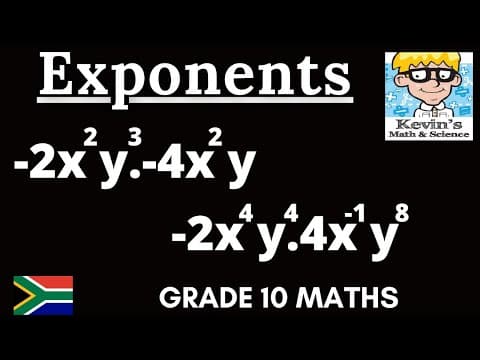
Exponents Grade 10: Addition Rule
Kevinmathscience
3m 11s620 words~4 min read
YouTube auto captions
Transcript source
YouTube auto captions
This transcript was extracted from YouTube's auto-generated caption track. The transcript below is server-rendered so it can be read, searched, cited, and shared without opening the original YouTube player.
Pull quotes
[0:00]So, what you're going to do is you're going to treat every, you're going to treat it in smaller steps.
[0:00]Well, those aren't exponents, those are just numbers and so you can multiply them like normal numbers.
[0:00]I'm not going to say minus 8 because we've just realized that the minus and the minus are going to combine to make a plus.
[0:00]So the exponent rule tells us that we should leave it as a Y and then add the exponents and that would be the end of that question.
Use this transcript
Related transcript hubs
Watch on YouTube
Share
MORE TRANSCRIPTS


