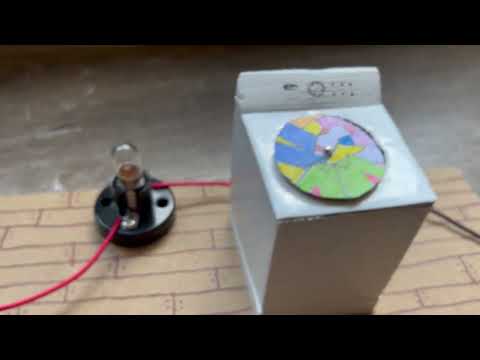
[0:03]Welcome to my Primary Science and Technology presentation for Assignment 1. I'm Lucas Venardos, my student number is 20201643. So before we begin, let's have a look at a demonstration of my model. Okay, so this is the demonstration of my model. It is part of a sustainable household that is run on a renewable energy source, solar power. And the solar panel is represented by my battery pack, which contains four double-A cells for a total of 6 volts in the circuit. So, the positive terminal of the battery connects to the two switches. The first switch operates my series circuit, which has a light bulb and a motor. Here's the switch. The motor represents a washing machine. Here's my parallel circuit, which has my buzzer connected in parallel to my another light bulb.
[1:14]So, they both operate at the same time and independently. So, I have a total of one, two, and three energy conversions from electrical energy into light, kinetic, and sound energy, possibly even heat energy from this light bulb, which is very bright since it's connected in parallel, and also light energy into electrical energy represented by the solar panel. So, some essential knowledge for this project is an understanding of electricity, uh circuits, and types of circuits. So, electricity is, in my understanding, just a form of energy that consists of an electric charge, which is a current moving through a conductive material such as wires and electrical components. An electric circuit is a closed loop that allows a current to flow from a source, such as a battery, to one or more devices that transform the energy into other useful forms of energy. So, the motor transfers transforms that energy into kinetic energy. Now, one type of circuit is a series circuit, which includes an energy source that provides a current along a single loop to devices connected end to end. Um, so we have our bulb and motor, as I, as you saw in the demonstration, connected end to end to make a series circuit. And they share the same energy from the source. Whereas in a parallel circuit, the devices are connected using common points from the energy source, meaning that each device receives the entire voltage from the source. So, the second bulb and the buzzer are connected in parallel in my circuit and you can see that in the diagram as well. So, some issues that I encountered with this specific model, uh, were the buzzer. It wouldn't work when it was connected in series with any of the other components. Well, it would work, but the other components wouldn't work, so I discovered that it had to be connected in parallel, as you saw in the demonstration. Uh, also some of the connections between the wires, uh, since I wasn't able to solder them together and twisting the wires meant that they would come apart easily. I ended up using some alligator clips, which you can see on the the terminals, the battery terminals. They used to easily connect um to divert the power and the energy into uh two different sources. Uh, I also used some heat shrink on the switches. I I bought some very small switches, so instead of buying more larger switches, I stuck with my small switches and used some heat shrink to make sure that the connections were working properly on the switches. Uh, another concern was minor, but the motor was spinning too fast for the cardboard cut out clothes in the washing machine to stay secure. It was spinning very, very fast and I could not secure the cardboard onto the motor, so I connected it in series with my with one of the light bulbs, uh, to bring down the the torque of the motor. So breaking down the budget, we have the batteries and all the construction materials already available at home. I reduced my consumption of materials by using only enough materials as I needed to display my model. I reused, as I said, the scrap materials from around the house and that informed the construction of my model. I looked at what I had, how I could use that, and I came up with this model. And recycle, the model will be kept uh and used for future investigations, perhaps to display in my own classroom as well. So altogether the circuit materials and the components were purchased from Jaycar for a total of $31.50. Okay, the purpose of the model is to engage Stage 3 students in an investigation of "how energy is transformed from one form to another." So, that obviously relates to uh the the eighth outcome for Stage 3 in the Science and Technology syllabus, uh, which is the physical world.
[6:24]Uh, specifically, the students are enabled to investigate how electrical energy can be transferred and transformed in electrical circuits and can be generated from a range of sources. So, rather than just having the batteries here powering the circuit, there's a solar panel involved, which represents how light can be used as a form of electrical energy. So, this model suits this purpose of addressing uh this specific outcome because it is a hands-on construction of an electric circuit and it involves at least three energy conversions from, uh, using the five Es for this project. Students are engaged through a demonstration of a simple circuit initially, and then they can explore through the construction of this model. Then they move on to explaining the energy conversions and representations of the model before elaborating by developing their own model. And then at the end, they can evaluate their understanding through a self-assessment of what they have learned and the skills that they have developed. So, this uh project relates to a couple of other key learning areas. Specifically, uh Stage 3 HSIE Geography, uh with the focus on how humans shape places, where students are looking at uh the management of spaces and how people influence places and contribute to sustainability. Of course, in this project, this model, uh, there's a renewable energy source that is used to power a household. Uh, and as a result, the sustainability cross-curricular priority is inherent to this project. The project also incorporates measurement and geometry content from the current mathematics syllabus, as students are required to measure materials to cut, such as the wire, uh, the floorboards, and also the material for the solar panel. They are required to also construct a 3D solid in the shape of a rectangular prism for the washing machine. Some general capabilities are also addressed, such as critical and creative thinking, solving um problems that come up during the construction, literacy. Students might need to write their responses in terms of the different electoral energy conversions. Numeracy, for noting the measurements and such, also personal and social capability, uh, when they work in groups completing this, this construction. So, in the construction of this project, students achieve the Stage 3 working scientifically outcome, since they must plan and conduct their scientific investigation into the construction of the model and the circuits, and communicate their conclusions regarding the energy transformations that they observe. They also meet the second Stage 3 outcome relating to skills of Design and Production, since they will be required to use the limited materials available to them to officially and accurately produce a working model like this one. The incorporation of the Sustainability cross-curricular priority foregrounds the need for students to reduce, reuse, and recycle. So, this project has also developed my pedagogical content knowledge, uh by deepening my understanding of electricity and circuits, the components and their interactions.
[10:18]I've also developed knowledge on how this relates to the Stage 3 syllabus outcomes for Science and Technology. So, I also had to look at how I could explain the complex concepts more simply using relatable relatable model, some metaphors and analogies, such as a light bulb representing a heater. So, related to considerations for the students, we have considerations for implementing this in the classroom. Uh, the first being safety, so ensuring that the students are responsible with the electrical components. We have a number of things that could go wrong here, such as uh, well, the use of electricity. Um, now these batteries don't provide much of a shock. Uh, but I did notice some sparks coming from the low torque motor when I was connecting that. So, that is a bit of a danger. Simplicity is key, especially for classroom projects such as this, so complex designs that are too difficult for students might confuse them and that would dilute the educational value of the whole project. So keeping it simple like this, there's not much involved in the construction. I think that was a big consideration for me. And that brings me to the end of my presentation. I had fun creating and demonstrating my model. So thank you for listening to me as I shared my experiences, and I hope you enjoyed.