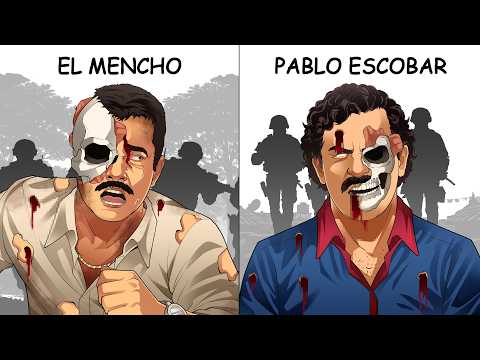
[0:00]El Mencho. He grew up picking avocados in the mountains of Michoacán. He dropped out of school at 10, and by 14, he was guarding marijuana fields for men who would never learn his name.
[0:10]Nemesio Oseguera Cervantes was born in 1966 in Aguilla, Mexico, one of five brothers raised in dirt floor poverty. No money, no education, no way out, so he made one. In his late teens, he crossed illegally into California. What he found wasn't a better life. It was the drug trade. He was arrested in San Francisco at 19 for stolen property and a loaded gun. Then again for selling narcotics. Then again on federal heroin charges alongside his brother. He recognized the undercover cops before Abraham did, but it was too late. To protect his brother from life in prison, he pleaded guilty and took five years. After three, he was deported. He was 30 and done playing small. He joined the police in Jalisco, then quit and joined the Millennium cartel. He married the sister of a cartel clan leader and started climbing. When his bosses were arrested or killed, he didn't mourn. He reorganized and in 2010, he founded the Jalisco New Generation cartel. Under his command, the C J and G shot down military helicopters, assassinated judges, and bombed government buildings with drones. The US put a $15 million bounty on his head. Few photos of him even existed. He moved like a ghost, protected by 400 gunmen and landmines. On February 22nd, 2026, Mexican special forces stormed his hideout in Tapalpa, Jalisco. He'd hosted a party the night before. His guards weren't on alert. El Mencho fled into the woods, wounded. Soldiers found him in the undergrowth. He was airlifted out, but he died before the helicopter landed. Within hours, burning cars blocked highways in 20 states. Guadalajara went silent. The avocado farmer's son had become the most wanted man in the Western hemisphere, and even in death, he brought a country to its knees. Khun Sa. His father died when he was three. His mother died two years later, and the only education he ever received was how to fight and how to grow opium. Khun Sa was born in 1934 in Loi Maw, a remote village in Burma's Shan State. Half Chinese and half Shan, raised by his grandfather. He never learned to read or write. By sixteen, he had formed his first armed gang. By his twenties, he was training with Chinese nationalist soldiers who had fled into Burma and learning the opium business from the inside. In 1963, the Burmese government made him a deal. Fight the local rebels, and you can use our roads to traffic opium. He accepted. Within years, he was one of the most powerful militia leaders in the region. But in 1967, a rival ambush nearly destroyed him. The Laotian army bombed his mule train and stole his opium. Then in 1969, the Burmese arrested him for treason and locked him in Mandalay prison for five years. But it didn't break him. He read Sun Su's Art of War behind bars and came out sharper than before. After his release, he rebuilt everything. He relocated to Thailand and built the Mong Tai army, 20,000 soldiers, heroin refineries, and a network that supplied almost half the heroin entering the United States. The DEA called his product 90% pure. The US put a $2 million bounty on his head. He offered twice to sell his entire opium crop to Western governments in exchange for aid, but both times, they refused. By mid-nineties, rival armies closed in. In 1996, he cut a secret deal with the Burmese military. Surrender the army, and in return, no extradition, no trial, and no prison. He moved to Yangon with his fortune and four teenage mistresses. He later died in 2007, aged 73. Diabetes, heart disease, and old age, in his bed, unpunished. The opium king never faced a single day in court. Felix Mitchell. He grew up in the projects on 69th Avenue, East Oakland. No money, no way out, so he built one with heroin. Felix Wayne Mitchell Jr. was born in 1954 in Oakland, California. He dropped out of high school and, still a teenager, formed a crew from his block, the 69 Mob. What started as kids running petty crimes became the first large-scale street-level drug operation in the Bay Area. He connected with kingpins in Los Angeles and Detroit and built a heroin empire stretching across California and the Midwest. At his peak, the 69 Mob pulled in up to a million dollars a month. He branded his product, stamped envelopes marked 69, and put children on every corner as lookouts and runners. If a rival moved in on his territory, the response was a drive-by. Mitchell didn't just run the drug trade. He wrote the playbook that the streets would follow for decades. With the money, Mitchell lived like royalty. Rolls-Royces, jewelry, lavish parties. But he also gave back, like turkeys to families, and funding youth programs. In East Oakland, he became a folk hero. Before sentencing, he told his probation officer, I like money, I like jewelry, and I like fine cars, and I went out and got them. Isn't that the American way? The law caught up in 1985, convicted under federal kingpin statutes. Life without parole. The judge called it a reign of terror. On August 21st, 1986, two days before his 32nd birthday, a fellow inmate stabbed him multiple times in his cell at Leavenworth. He died that night over a $10 debt. His funeral made national news. A horse-drawn carriage carried his bronze casket through 8 miles of Oakland streets, trailed by Rolls-Royces and limousines. 8,000 people lined the route. But here's the twist. After Mitchell was gone, Oakland got worse. Without his grip on the market, dozens of gangs went to war. Violence exploded. Criminologist gave it a name, the Felix Mitchell Paradox. The king was dead, and his kingdom burned. Amado Carrillo Fuentes. He left his village at 12 and told everyone, I won't come back until I'm rich. And he kept his word. Amado Carrillo Fuentes was born in 1956 in Guamuchilito, Sinaloa. His father was a farmer. His uncle was Don Neto, co-founder of the Guadalajara Cartel. By his teens, Amado had left home with a sixth-grade education and was learning the drug trade under his uncle, overseeing cocaine shipments across Chihuahua. He climbed fast. He learned border operations under Pablo Acosta, then worked alongside Rafael Aguilar Guajardo, who ran the Juárez corridor. In 1993, he had Aguilar shot dead in Cancun, on vacation outside a restaurant, and took the cartel for himself. What came next changed everything. He bought over 30 Boeing 727s, stripped out the seats, and flew up to 15 tons of cocaine per trip from Colombia to Mexico. They called him El Señor de los Cielos, The Lord of the Skies. He forged alliances with the Cali cartel, bribed generals and politicians, and at his peak was worth an estimated $25 billion. Even Mexico's top anti-drug official was on his payroll. Few photographs of him existed. He lived like a businessman, not a gangster. But by 1997, the walls closed in. US indictments, his military protector arrested. Agents barely missed him at his sister's wedding, so he decided to become someone else. On July 4th, 1997, he checked into a Mexico City hospital under a fake name. 8 hours of surgery, face reshaped, three and a half gallons of fat removed. He was wheeled into recovery, and by morning, he was dead at 42 years old. The official cause was complications from anesthesia. Four months later, the three doctors who operated on him were found in steel barrels along a highway. Tortured, strangled, and encased in concrete. His cousin told reporters, Amado is fine. He is alive. The DEA compared it to Elvis sightings. The Lord of the Skies never came back, and no one ever proved where he went. Griselda Blanco. At 11, she allegedly kidnapped a boy from a wealthy neighborhood. When the family didn't pay, she shot him. She was already a pickpocket. Before 30, she'd be running one of the most violent cocaine empires in American history. Griselda Blanco was born in 1943 in Colombia. She grew up in the slums of Medellín, raised by a mother who worked as a prostitute, abused by the men who came through. She ran away at 19. By her twenties, she'd married a small-time criminal, had three sons, and crossed illegally into the United States with fake documents. In Queens, New York, she and her second husband, Alberto Bravo, built a cocaine pipeline from Colombia, using female couriers who smuggled drugs in custom sewn lingerie. When she suspected Bravo of stealing, she shot him dead in front of their five-year-old son. She later had her third husband killed too. They called her the Black Widow. By the late seventies, she'd moved to Miami. Her network pushed $8 million worth of cocaine every month. The 1979 Dadeland Mall massacre, where her gunmen opened fire in broad daylight, is considered the opening shot of the Miami drug wars. Authorities linked her to at least 40 murders. When her hitman accidentally killed a rival's two-year-old son instead of the father, she said she was glad. One less witness. She was arrested in 1985, 15 years for drug trafficking. Then charged with three murders. Her star witness, her own hitman, was caught having phone sex with secretaries in the prosecutor's office, and the case collapsed. She pleaded guilty to second-degree murder, 20 years concurrent. She was released in 2004 and deported to Colombia. She lived quietly in Medellín for 8 years. But on September 3rd, 2012, Griselda Blanco stepped out of a butcher shop. A man on a motorcycle pulled up and shot her twice in the head. She was 69 and she was killed the same way she'd killed so many others. Pablo Escobar. He started by stealing tombstones, sandblasted the inscriptions off and sold them as new. Then he stole cars, forged diplomas, kidnapped a businessman and killed him even after the ransom was paid. By 25, Pablo Escobar had learned the only rule he'd ever follow. Take what you want. Escobar was born in 1949 in Rionegro, Colombia. His father was a farmer and his mother a school teacher. He grew up poor in Medellín. He dropped out of school and dreamed of becoming president. In the mid-seventies, he founded the Medellín Cartel. He processed cocaine from Peru and Bolivia in jungle labs and flew it into the United States. At his peak, the cartel controlled 80% of the world's cocaine, 70 to 80 tons a month. Forbes named him one of the ten richest people on Earth. His estimated net worth was around $30 billion. He built schools, hospitals, and entire neighborhoods for Medellín's poor. They called him Robin Hood. He even ran for Congress and won. But when Colombia's justice minister exposed him, Escobar had him killed. Then a presidential candidate. Then he bombed Avianca Flight 203. All 170 people died. Trying to kill one man who wasn't even on the plane. In 1991, he surrendered on his terms. He built his own prison, nightclub, Jacuzzi, and soccer field. He kept running the cartel from inside. When the government tried to move him, he walked out. The manhunt lasted 16 months. On December 1st, 1993, Escobar turned 44. The next day, he called his son, and authorities traced it. They stormed his hideout. He ran across the rooftops, but he got shot in the torso, legs, and through the head. 25,000 people came to his funeral. Some prayed to him like a saint. The Medellín cartel collapsed within months, but the cocaine trade didn't end. It just changed hands.


