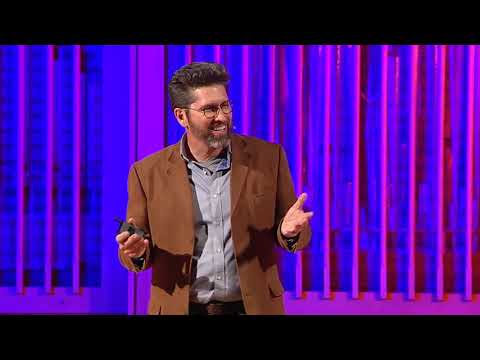
[0:06]Have our words and opinions ever been more under the microscope? From Facebook to Twitter, from the Daily from the Daily Caws to Fox News. We seem to be arguing all the time. And these arguments are having an effect. In fact, recently the LA Times reports that 52% of Republicans think that Democrats are less open-minded than most Americans. 70% of Democrats think Republicans are less open-minded. And it gets worse. 46% of Republicans think Democrats are more immoral than most Americans. And 35% of Democrats think the same about Republicans. Now, listen, I am all for good argument. Arguments are a really important way we have for knowing the world, but we need to learn to argue better. And by that, I don't mean some shallow platitude like let's all just agree to disagree. What I'm talking about is a 2000-year-old tradition, the tradition of rhetoric that teaches us how to argue more productively. Now, rhetoric you're saying, what's that? Well, it's the tradition of studying how language creates meaning and the ethical questions that arise when we write and when we speak. For an example, let's look at Socrates, do you remember him, Plato's teacher? 2000 years ago, he argued for living, and on one occasion, he was engaged in a dialogue with a sophist by the name of Gorgius. And Socrates wanted to know if Gorgius was the same kind of man that Socrates claimed to be. And he said, I am one who would glad to be who would be glad to be refuted if I say anything untrue. And who would be glad to refute anyone who speaks untruly? But here's the important part. Then Socrates says, however, it is the greater good to be refuted than to refute because it is a larger benefit to be delivered from evil than to deliver another. Think about this. Socrates is saying it is better to be shown where you are wrong than to show another where he or she is wrong. How does this change argument? He's saying we need to reframe the way we think about argument. We need to think about argument, not as argument to win, but as argument to learn. How would this change Thanksgiving dinner? You're sitting across from your Uncle Reid. It's always an uncle, isn't it? And he starts to push your buttons, and instead of trying to figure out a way to prove him wrong, what if you start to think about what he's saying and perhaps whether or not he's saying something you can learn from? Let's take this one step further. What if Uncle Reid were to do the same and listen to your argument and your reasons? My guess is that you wouldn't my guess is that you'd leave the dinner a little a little less dyspeptic and a little more enlightened. And in fact, if you were both arguing to learn rather than to argument arguing to win, you might learn something. You might be rid of your own evil. In fact, to win you must lose. That's the better way, according to Socrates. Now, metaphors matter. And have you ever noticed that all the metaphors we have for argument come from war? We attack, we defend, we counter, we win, we lose. And George Lakoff and Mark Johnson point out that the metaphors we choose shape the way we see an idea. So, if we frame argument as a fight, how will we ever argue to learn? Well, Lakoff and Johnson also point out that we can change the metaphor. They ask us to imagine, what if we were to think about argument instead of as war as dance? Wars are adversarial. Dances cooperative. War has winners and losers. Dance has partners. War wounds, dance heals. Metaphors matter and the way we frame the argument is going to make a big difference in whether or not we can argue to learn. Now, another thing, another really useful tool in arguing to learn is a lesson we can take from American pragmatism. In 1861, Oliver Wendell Holmes Jr. was a senior at Harvard and an abolitionist. And he quit Harvard that year and he joined the Massachusetts volunteers and he spent the next four years as a Union soldier fighting in the American Civil War. During that time, he was wounded three times. He saw the ravages of battle. He worsh he experienced the worst horrors of war and he almost died of dysentery. When he returned to Cambridge, he had decided that the price of war was far too high and that we must find another way. And so, with William James, Charles Purse, and others, he invented a new philosophical school called American Pragmatism. And pragmatism is important because the underlying principle for American pragmatism is fallibility. That is, the underlying principle is that the only thing we can be confident in is our own ability to misunderstand, to make a mistake, to be wrong. In short, he's saying the only thing we can be certain of is our own mistakenness. Now, think about this. Think about how if you and your interlocutor are both um aware of your own mistakenness. Think how that would change the conversation. Think how that would help us be rid of our own evil. Now, okay, back to Thanksgiving. Um, how many times have you been driving home and you're saying to your wife or your or your brother or your husband? You're saying, Uncle Reed, he says that he's just defending the Second Amendment, but I know he just loves the power of guns. And how many times does Uncle Reed been driving home with that Lois and said, Dave says that he just wants a safer society, but I know he just wants to take away my personal freedom. Now, both of these are examples of what Wayne Booth calls motivism. Wayne Booth was a dean at the University of Chicago in the 1960s and he was witnessing the conflict and the rhetoric that surrounded the Vietnam War. And he was alarmed by how all sides seem to be talking past one another. And so, as a student of rhetoric, he decided to to examine what was going on and he came up with the idea of motivism, that is, the idea that people were going to the assumed motives of their interlocutor, rather than accepting their given reasons. Now, isn't Uncle Reed just a gun nut? Right? Isn't he just in love all this stuff about the Second Amendment and personal freedom? Isn't this just a cover?
[7:39]I mean, he just really is fascinated with firearms and he just really um, you know, is compensating for some kind of male insecurity, right? Well, maybe, but probably not, and how can I know? The only thing I can know are the reasons that read gives. And think about this, have you ever presented a carefully articulated argument and had your interlocutor, your dance partner, ignore your reasons and accuse you of some secret motive? It feels like an attack. It feels like you've been dismissed and your character and you have some kind of character flaw. But think about how it would be different if you listen to the reasons of your dance partner. Think also how it would be different if your dance partner listens to your reasons without accusing you of some ulterior motive. The dance continues. We're able to make progress. Now, back to Uncle Reed. Poor Uncle Reed, he actually is my real uncle. How many times have I been talking to Uncle Reed and we start way too far down the road? We talk about climate change, we talk about welfare, we talk about taxation. And we really don't back up to the deeper issues. Right? What we really need to talk about is what do we think about fairness? What do we feel like our obligations are to each other, to future generations? What role does science or religion or tradition play in helping us understand the world? Now, if we can back that truck up and find the place where we begin to disagree, we actually might find that there's this large space of things we agree on. If we can back that truck up and find a shared epistemology, a shared way of knowing the world, we might actually make some progress. We might actually gain some understanding of one another. But don't I need to speak truth to power? Don't I need to stand up and be brave and tell people how it is? Well, sometimes we do, but more often than not, we need to think about levels of community. Who are the people we have arguments with? They're our brother, they're our spouse, they're our neighbor, there our colleague. Right? And after we have this argument, don't we need to be able to live with, work with, um, talk to our dance partner? So, before we accuse our dance partner of being crazy, before we get self-righteous and indignant, let's think about the relationship. Let's think about the community. Let's think about how we can preserve this relationship past this one argument. So, this reminds me of a recent op-ed from a woman by the name of Irin Carmen. And she is writing about Ruth Bader Ginsburg's, um, what she calls her cautious radicalism, how she approaches argument. And just as Ginsburg says, fight for the things that you care about, but do so in a way that will invite others to join you. Right? Then she warns about righteous anger. She says, she says that righteous anger can consume us, and in response to this, Miss Miss Carmen says, It may seem strange for a feminist to counsel against anger when those of us who are not straight, white men have had to fight just to have room to express it. But the risk of burnout over fast-flaming conflicts is real. Our current conversations value catharsis over strategy. This doesn't mean picking the middle point of two poles and calling it common sense; it just means thinking past instant outrage and doing sustainable work. Neither Miss Carmen nor Justice Ginsburg are advising us to be passive about things we care about. But they're telling us to be strategic. It's really easy to be offended. It's really hard to be effective. There are few people in this world who have led more effective lives than Justice Ginsburg. So let's take some advice from Notorious RBG. Let's argue in a way that invites others to join us. Now, so far, I've argued that we must argue to learn, that metaphors matter, that we must accept our own fallibility first, that reasons are important, not motives, that we must back that truck up, that levels of community must be considered. And finally, that we need to not be offended, but we need to be effective. And I want to finish with one of my favorite rhetoricians, a man by the name of Kenneth Burke. And in Kenneth Burke's study above the window on the sash, he took a crayon and he wrote, Add Bellum Purificandum. And in Latin, this means towards the purification of war. And he spent his life studying rhetoric and studying how we could use words instead of fists, or rifles or ICBMs. And the following quote sums up most of what I've tried to talk about today. He says, The progress of human enlightenment can go no further than in picturing people not as vicious, but as mistaken. Now, let's stop right here. If I see Uncle Reed is vicious, there's no way we can proceed. If I see him as mistaken, we can have a conversation. I mean, you can't dance with vicious. Burke goes on, when you add that people are necessarily mistaken, that all people are exposed to situations in which they must act as fools, that every insight contains its own special kind of blindness. Let's stop here again. So I not only need to see Uncle Reed as mistaken, I need to see myself as mistaken. I need to realize I am human, I am fallible. I am necessarily mistaken. He finishes by saying, then you complete the comic circle, returning again to the lesson of humility that underlies all great tragedy. So, let's not shy away from talking about things that are important. Let's not shy away from the issues we care about. But let's do it with humility. Let's do it knowing our own humanity, our own fallibility. And if we do so, we just might complete the comic circle. We just might avoid tragedy. Thank you.


