[0:00]so if you're reading a law and it kind of triggers this, ah, I can't do that, then it's not something you should do anyway. It's gonna it's not gonna fit your way of doing you have a certain style, a certain belief system, certain values. I'm not telling you to go outside your values, but look at that law, which is probably the ugliest in the whole book. Crush your enemy totally, and understand that in the business world, that law prevails 95% of the time. is you'd have to go back to my early childhood, maybe, you know, I felt as a child a little bit helpless around my parents in some ways. I was a very sensitive boy. I still have that that issue. They were great parents, but they weren't the most overtly affectionate. And so I was always kind of wondering and observing them and trying to be careful around them. I didn't do anything to upset them, so I became kind of an observer of people, and my main thing was as sort of a protective device to not be hurt and to be able to have a degree of control over the people around me. So I didn't feel like I was, you know, gonna get yelled at or something like that. And then as I entered the work world, um, you know, I kind of it was sort of a rude awakening for me, because I had studied literature and languages, my major was ancient Greek, and things that are completely impractical in this world. And then I entered the work world with all of my dreams, my illusions, my fancies, and it's like slapped in the face. This is not what I expected. I had many different jobs. I lived in New York. I did journalism. Then I lived in Europe. I traveled around, cause I couldn't really find out what I wanted to do. I worked in a hotel in Paris, I taught English in Barcelona, I did construction work in Greece, on an island in Greece. I worked in a television company in London. You name it, I did it, and I had all kinds of bosses. I saw all kinds of power games and manipulations going on. And so taking that knowledge from my childhood, of observing people, seeing how they operate, seeing what's really going on behind their minds, cause people wear masks. They don't tell you what they're thinking. They don't want to admit that they want power, that they want to control you or manipulate you in some way. And so I was always kind of a decipherer of people and what their real thoughts were. And to me, figuring people out is a form of power. And then I worked in Hollywood, which is kind of the ultimate power environment, because nobody in Hollywood wants to admit that their goal is power. They want to make it, oh, we're about art, we're about creativity, liberal causes, blah, blah, blah. But really they wanted power. It's the most power hungry environment I had ever witnessed. I observed a kind of a double-faced thing quality going on. On the one hand, they would present this front to their employees, to everyone else, but really they were practicing all of these games, these kind of power games going on. And so that's what sort of inspired my first book, The 48 Laws of Power, because my sympathies are more on the side of the underdog. I don't have a sympathy for a Hollywood executive, for a Michael, oh, it's for a CEO of a company. I have sympathy for the poor guy like myself, who is thrown into these environments, doesn't understand them, is a bit naive. Doesn't know the rules of power that these generally white men, at least at the back in that era, seem to know instinctively. And so I wanted to like reveal to everyone what goes on behind closed doors, the real games of power that people play. So it's not that I'm obsessed with it, but I feel like people like myself are often too naive. They don't understand what they're about to get into. They don't understand how rough and brutal the world can be. And I actually wanted to kind of help them and reveal the kinds of things that I learned the hard way. But people have this misconception of power, they think it has to do with, you know, CEOs and presidents and it's kind of ugly and dirty. I have a much different conception of it. Something that has to do with your daily life. Now I have the idea that much in our lives we cannot control, you can throw a number out 95%. You can't control disease, you can't control the people that you meet. It's by chance that you met your wife and you fell in love and you ended up marrying her. You kind of fall into jobs. There's much in life that is way beyond your control, but there is a margin that you can control, right? And it's mostly about your relationships. It has to do with your children, your spouse, your partners, your your colleagues at work, your bosses, and the feeling that you have no control over them, that they can do whatever they want. That you have an idea and you want to sell it to them, or you want somebody to stop their annoying behavior, and you have, can't control them. They're completely oblivious, they won't listen to anything you say, is to me the worst feeling for a human being to have. We're animals that need that sense of I can influence my environment, I can influence the people around me. And the sense of helplessness is a very, very primal feeling. It's like when you take an animal, I don't know if you have dogs or cats, and you put them on their belly. They feel exposed, they feel terrified, and that's when they attack you. Well, that position is like being on our belly. I can't control my teenage son. He's into drugs. My husband or my wife isn't listening to me. Ugh, my boss is doing, you know, you want the ability to be able to at least defend yourself or to have some influence or power over them. It's a small margin, because there's much you can't control, but to the degree that you can have some of that power, and you can, and then there's one other aspect, probably the most important aspect that I'm forgetting here, is power over yourself, self-mastery. Because a lot of the problems that you have in life, you can't really control yourself. You're you're subject to all these emotions, these moods, these things that grab you, that obsess you, that possess you. Your mind is has these recurring thoughts. You have no self-control, and it drives you crazy. You have a habit you want to get rid of. You take some program, some class, and three months later you're back at it. Ah, you know, what is it? So the sense that you can control yourself to a degree, and the sense that you can have some influence over people is power. And the more you have it, the greater the feeling you have because you can get avoid that helplessness that makes all of us kind of crazy. Well, that was sort of what I wrote the book about, but a lot of it comes from our culture, which I think plays a very often a very negative role in our lives. It teaches us the the wrong kinds of lessons. And so back in the days when it was television, now it's whatever you watch and whatever medium, you know, all of the villains in the world were these power hungry people in black coats with cars with the with the windows kind of blacked out, you know, and doing all sorts of evil, ugly things. That's what we think of as power. It's like a cultural trope that we've all digested. You know, this kind of Machiavellian character who's out to kind of destroy people. Nobody thinks of power in a positive sense, and it's maddening, it drives me crazy. It's incredibly hypocritical. When self-help books are written and they're trying to say that power or ambition or influence are ugly things, when the writer himself or herself is actually a very powerful person who has influence, who has control, it's awful, it drove me crazy. That's why I wrote, so I try and tell people, look, who's one of the great saints that we hold up in our culture, Mahatma Gandhi, right? I certainly venerate him. He's an amazing person, and I read very deeply about Gandhi, and I wrote about him in my third book, The Strategies of War, and his goal was to throw the English out of India so they could finally experience independence, because the people had been subjugated for so long, that they had forgotten what it meant to be human in a way, right? A very noble goal, but he realized quickly on how difficult it would be, so he had to be strategic. And so he had things like the salt march, where he very much plot, he thought it in advance that he knew using his method of civil disobedience, where once the police came out, you were not to fight, you were to accept them. If they beat you, you accepted it. You never fought, no violence, but he knew that the that back in the day before television, that the media, the newspapers would cover their English, Bobbies or whomever they were, beating these these people up, and it would play horribly in England, because people in England thought that they were very liberal and open-minded, that they weren't these horrifying imperialists. He was strategic. He knew that he had to get maximum publicity for very ugly confrontations. Years later, Martin Luther King, another icon, who also practiced civil disobedience, did utilize the same tactics in his campaigns in Selma and Montgomery at one point. It was very controversial. He had children of the ages of 13, 14 involved in this march, and that they would get beaten up. People were in his group castigated for this. How could you be like that? He knew that that would play on television now to the white audiences around America, they'd be horrified. If you want power in this world, if you are fighting for a cause, if you want some kind of justice, you have to be strategic, you have to think like that, you have to think in terms of power. People just don't give themselves up, you know, if we have the Me Too movement now, men are not just gonna give up all their control in a place like Hollywood. You have to hit them, you have to be strong, you have to be forceful, it's a power game, and I can't stand people who are naive, who think that just being themselves, just being virtuous is gonna get what they want in life. If you're gonna fight for something, you have to be able to meet the enemy on their terms of power. So that's sort of how I like to explain to them. There's nothing unhealthy about Gandhi or or MLK as far as I know. Well, you have to understand there's an offensive and a defensive side to the laws, okay? And I always tell people who have these kind of compunctions about crush your enemy totally. I don't want to do that. Neither do I, okay? So if you're reading a law and it kind of triggers this, ah, I can't do that, then it's not something you should do anyway. It's gonna it's not gonna fit your way of doing you have a certain style, a certain belief system, certain values. I'm not telling you to go outside your values, but look at that law, which is probably the ugliest in the whole book. Crush your enemy totally, and understand that in the business world, that law prevails 95% of the time. When a company like Google or any tech company has an enemy, their more their goal is to get rid of them completely, to buy them out, so they have no competitors, right? Look at Amazon, but even smaller businesses dealing with rivals, it's a dynamic in the business world, so you need to be aware of it, and not be naive. You don't have to practice it, but you need to be aware of it. Other laws are just simply trying to show you what how, you know, we're animals that kind of base our opinions a lot on what we see and perceive. We don't often think too deeply. We kind of take people based on their appearances. So there's a law of power in there called, always say less than necessary, very kind of common sense law. And the idea is that if you're in a meeting with people, that man or woman who talks less, generally has an aura of power, particularly a boss. They seem enigmatic, mysterious, and when they do something, say something, everybody's hanging on their words. What does that mean? What does it say? Whereas people who talk a lot give the impression that they're weak. They signal weakness. They can't control themselves. They can't control themselves. How can they control anything in the business world, right? So we sense that in people. So be aware of that you're probably talking too much in a lot of circumstances, and maybe you can control that. And so this is kind of a way of defending yourself in an environment where people will tend to see you as weak if you can't have any self-control. If you see that a law that's ugly, that makes your skin crawl, you don't want to do it. I have no problem with that. I there are a lot of laws I don't practice in there, but you need to be aware of them. You need to be aware that other people are practicing them, so that you don't become their victim. Then there are other laws that yes, you should practice, right? Like appealing to people's self-interest when you're trying to influence them, or um, despise the free lunch. We learn to pay for things and be generous with your time and your money for people. So it depends on the law, but I hate it when people say, oh, what an evil book. Those are people who haven't read it, because the half the laws, or more than half have nothing evil about them. And the other half are about opening your eyes. I never say you have to practice this. I'm just making you aware of reality of what goes on in the world. Unfortunately, in the world today, and you know, I've had this experience, and we read about it in the news, a lot of people who have a dark side, whom we might consider rather immoral in their behavior, get pretty damn far. Mhm, right? And they use these laws, and they don't pay any consequences. So there's no kind of ultimate justice in this world, although there might be in a religious sense. I don't deny that at all. But in a secular world, there's no consequences to pay for it. So people if they have a lot, if they do crush your enemy totally, and that's their goal, they might end up being even better at it than somebody who doesn't really wanna go there, but then kind of tries it half-heartedly. I'm not here to say that justice and goodness always prevails. But the people who have those kind of intentions, the true sharks in the world, they don't need my book, they know it. It's in their DNA, they grew up at the age of five or six, seven, it's already been implanted in them. And I write about that in my last book, the Laws of Human Nature. You can see that in certain people at a very early age. The great therapist, um, psychoanalyst Melanie Klein, identified the greedy baby at the age of six months that was already sucking so hard on the mother's breast. And she saw that this this type of baby turned into people, the type that was actually very aggressive in life. So it's inbred very early on. People like that have patterns of behavior they cannot control. But those people with those kind of intentions, who are very manipulative, I believe very firmly they don't get, ultimately they hit a wall. They piss so many people off. They don't know the soft side of power. They have no self-control, because all they know is grab, grab, grab, push, push, push. They don't know when to yield, they don't know when to step back, right? They've only learned one way, and so that becomes their downfall. Well, I'm not sure I completely agree with that, because under the way I've defined power, where you feel like, okay, so let's say you have a spouse who has a very annoying pattern of behavior, and in my books, I train you, being direct and yelling at them never work. You have to learn this the art of insinuation of persuasion, which often is stepping back, which often involves teaching them a lesson, mirroring their behavior, right? And so your intention is not ugly or or bad, it's that you you can't live with this person unless they alter their behavior. And so you think about it, you strategize a little bit, you take some steps, and it works.
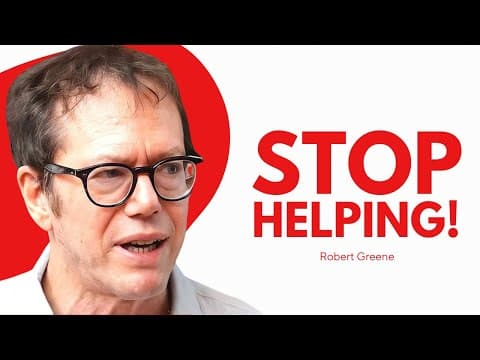
This Is Why Nice People Always Lose | Robert Greene
Strategic Genius
15m 26s2,984 words~15 min read
Auto-Generated
Watch on YouTube
Share
MORE TRANSCRIPTS


![Thumbnail for ✅ Best Smart Door Lock 2026 [Find Which Smart Lock is Right for YOU?] by Foremost Picks](/_next/image?url=https%3A%2F%2Fimg.youtube.com%2Fvi%2FoRozIS6IsnY%2Fhqdefault.jpg&w=3840&q=75)